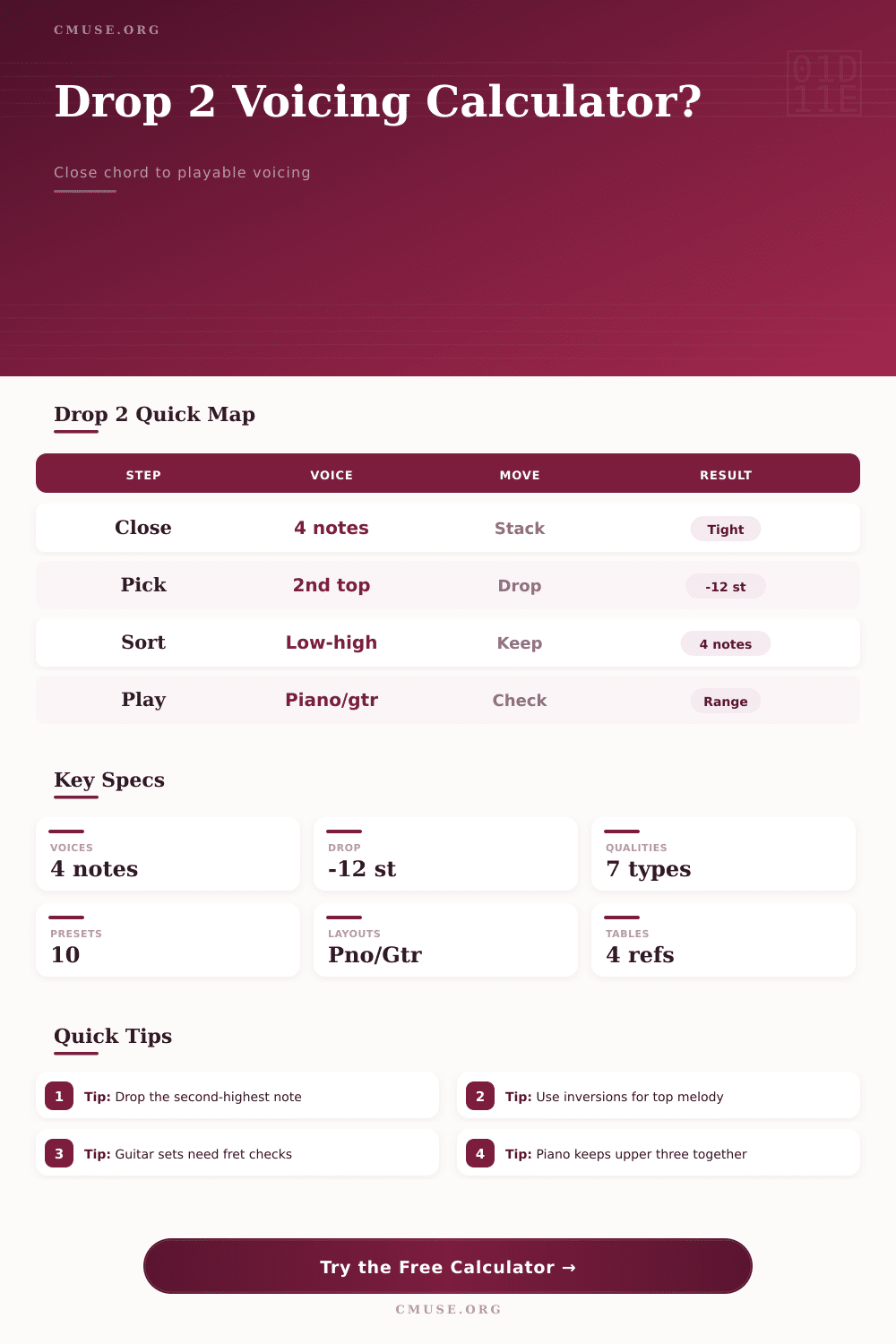
Drop 2 Voicing Calculator
Transform a four-way close chord by dropping the second-highest voice one octave, then check the resulting notes for piano or guitar range.
| Quality | Close chord tones | Interval formula | Common drop 2 use |
|---|---|---|---|
| Major 7 | 1, 3, 5, 7 | 0, 4, 7, 11 semitones | Ballad comping, tonic color, upper-structure melody |
| Dominant 7 | 1, 3, 5, flat 7 | 0, 4, 7, 10 semitones | Blues, bebop shells, swing guitar grips |
| Minor 7 | 1, flat 3, 5, flat 7 | 0, 3, 7, 10 semitones | Minor ii chords, modal comping, warm piano clusters |
| Minor 7 flat 5 | 1, flat 3, flat 5, flat 7 | 0, 3, 6, 10 semitones | Minor ii-V progressions and half-diminished movement |
| Diminished 7 | 1, flat 3, flat 5, double-flat 7 | 0, 3, 6, 9 semitones | Passing chords, leading-tone chords, symmetrical motion |
| Major 6 | 1, 3, 5, 6 | 0, 4, 7, 9 semitones | Swing tonic grips and older jazz guitar voicings |
| Minor 6 | 1, flat 3, 5, 6 | 0, 3, 7, 9 semitones | Minor tonic color and melodic minor comping |
| Close inversion | Close order low to high | Voice dropped | Drop 2 order low to high |
|---|---|---|---|
| Root position | 1, 3, 5, 7 | 5 drops one octave | 5, 1, 3, 7 |
| First inversion | 3, 5, 7, 1 | 7 drops one octave | 7, 3, 5, 1 |
| Second inversion | 5, 7, 1, 3 | 1 drops one octave | 1, 5, 7, 3 |
| Third inversion | 7, 1, 3, 5 | 3 drops one octave | 3, 7, 1, 5 |
| Layout | Useful range | Practical span | Calculator check |
|---|---|---|---|
| Piano low comping | C2 to C4 | 12 to 24 semitones | Best when the bottom voice stays clear of mud below C2 |
| Piano middle comping | C3 to C5 | 14 to 26 semitones | Upper three voices can sit in one hand while bass supports |
| Guitar inner strings | Strings 5-4-3-2 | Frets within five spaces | Works well for dominant and minor 7 grips around frets 3 to 10 |
| Guitar top strings | Strings 4-3-2-1 | Frets within four spaces | Bright melody voicings usually fit with top octave 4 or 5 |
| Preset | Quality focus | Default layout | Typical musical job |
|---|---|---|---|
| Bill Evans Cmaj7 Shell | Major 7, second inversion | Piano middle | Places the 3rd on top for lyrical major color |
| Bebop G7 Comp | Dominant 7, first inversion | Piano or inner-string guitar | Turns guide tones into a compact swing-comping shape |
| Wes Dm7 Guitar | Minor 7, root position | Strings 5-4-3-2 | Classic four-note guitar voicing without open strings |
| Bm7b5 ii Chord | Half-diminished, third inversion | Piano upper-middle | Prepares minor V chords with a clear top voice |
Stacking notes close together without dropping the pitch can sound muddy in a room, even if it look good on paper. What happens is that bass notes clashes with higher ones as they all are so close together. It results in a textural mush.
Drop 2 voicings present a simple solution. They’ve been around for decades providing clarity in the harmony. Played by jazz pianists and guitarist alike, their concept is uncomplicated.
How Drop 2 Voicings Work
Simply pick your four-note chord and find the note that’s two notes down from highest note in the chord. Now place that note a full octave lower than where you found it. This opens up the middle of the sound giving each voice some breathing space while retaining the harmonic content. The effect is an arrangement that works across both guitar strings or piano hands.
If you choose the chord quality and the root note, then the calculator will take care of the rest (above). There’s no need for any guessing about which note goes into what position. You choose the inversion and the tool map them out for you. Since the resulting voicings is based on this pattern, they follow it strictly. In other words, they retain the same relative intervals as in the original form but expand the overall range.
That way you don’t lose track when you move around keyboard. It supports the smooth voice leading. Ergonomic comfort is the primary advantage here for pianists. Typically, when using the drop 2 voicing, it spans about a tenth. That comfortabley fits under most adult-sized hands.
Using the input settings, you can switch from octave to octave. This ensures the voicing falls into the right register depending on the type of music you play. If you’re comping behind a singer, you might want some higher chords so as not to step on the singer’s tone. Perhaps if you were playing solo piano, you would like a lower register for harmonic support. The tool indicates precisely where they fall. It helps you determine whether this span can be accommodated or if another inversion need to be considered instead.
The dilemma is somewhat different than for guitarists. Unlike the keyboard of a piano, there are physical limits to the fretboard. What might be a good choice of a drop 2 voicing on piano can involve a huge stretch of strings on a guitar. This alters the practical range of the chord a lot. Which strings you select will have a significant effect on how practically you can play the chord.
To handle this limitation, the calculator takes into account whether or not notes fall in a playable span of frets. If they spread out onto non-adjacent strings, then it may highlight the voicing as being too wide. That’s where people go wrong. They think just because something looks right on paper that it’ll sound fine on instrument.
You can hear Wes Montgomery or Bill Evans playing these voicings in jazz. They sound familiar because the players hasn’t just remembered the shape; they know what happens when you drop the second voice down. The spread-out major seventh is less bright. A dominant seventh chord gains tension because the dissonant intervals are now separated by space rather than sitting right on top of each other. The spread-out dominant seventh adds tension with the dissonances spaced apart. Each note stand out for the ear to process as an individual before merging back together into one single unit.
How does this affect the melody line? Experiment with different inversions and listen to how the melody line alter. Place the third on the top, and you have a distinctively major sound. Place the seventh on the top, and it sounds more unclear with the need for resolution. The tool displays these relationships plainly in its reference tables. These tables illustrate exactly where each chord tone lands when inverted. That way, you can transition from one chord to another without any jumping about the instrument; instead, it’s smooth voice leading.
Drop 2 voicings are all about control. They provide a solid framework to play along with the chords in a way that sounds like a pro. If you’re a swinger or simply playing a ballad over changes, having these shapes at your fingertips is very helpful. No more worrying about where to put your fingers; now you have time to concentrate on the dynamics and rhythms. The tool shows you what used to take hours of trial and error, which speeds up the learning process.
Abstract becomes concrete. Understanding why and how the drop happens is the first step. Next thing you know, it’s coming out instinctualy. Every chord counts. That open, clear sound keeps the listener engaged.