Dotted Note Duration Calculator
Convert dotted whole, half, quarter, eighth, sixteenth, and smaller note values into seconds, milliseconds, beats, bar share, samples, and MIDI ticks.
Load a practical notation or production scenario, then adjust tempo, note value, dot count, meter, tuplet feel, repeats, sample rate, or MIDI resolution for your own chart.
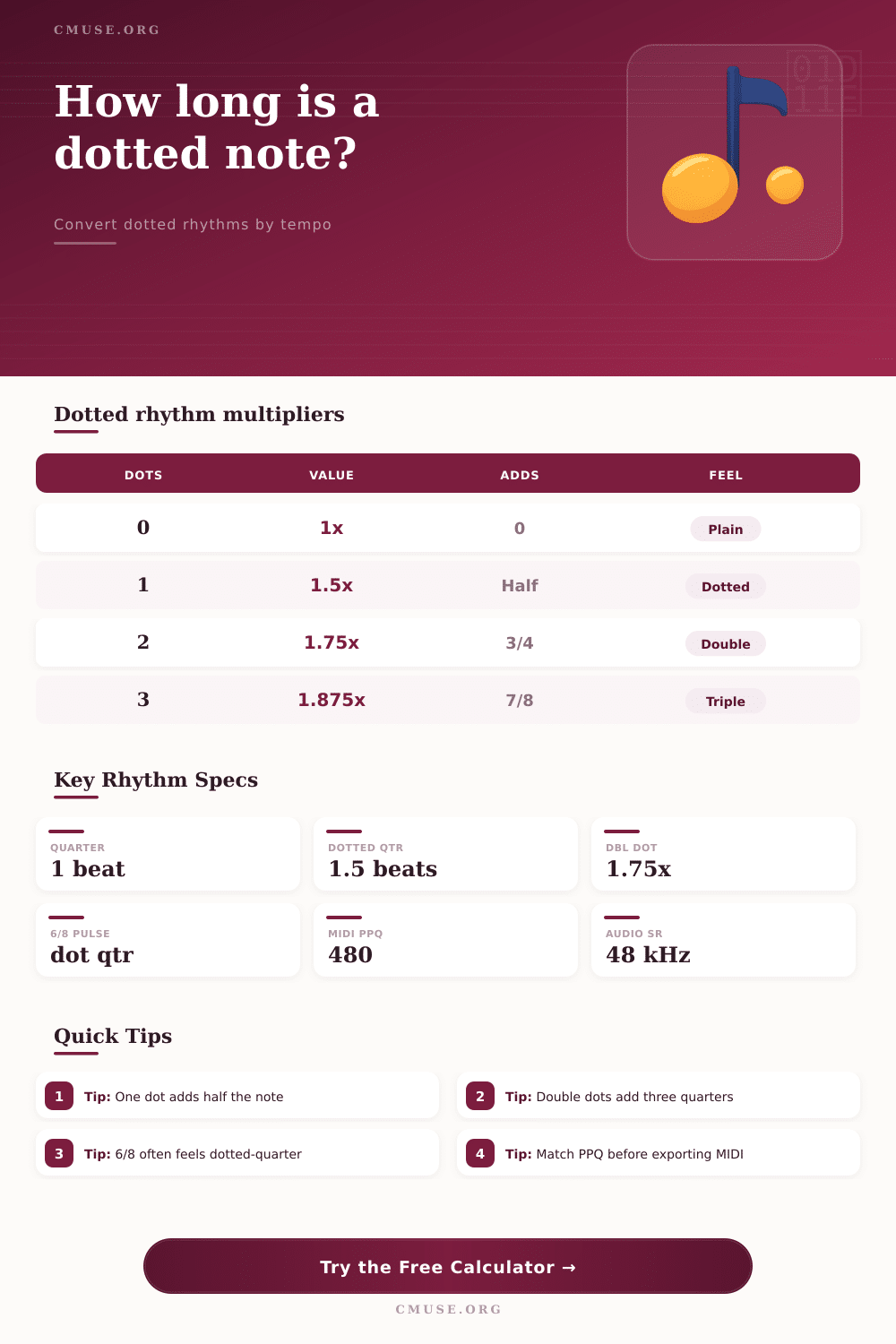
Dot multiplier = 1 + 1/2 + 1/4 + 1/8 for up to three dots. The calculator converts the written value into quarter-note units, then into seconds from the selected tempo pulse.
Rhythm Breakdown
| Dot Count | Multiplier | Added Portion | Dotted Quarter At 120 BPM | Common Notation Use |
|---|---|---|---|---|
| No dot | 1.000x | None | 500 ms | Plain beat |
| Single dot | 1.500x | Half of the base note | 750 ms | Dotted rhythm |
| Double dot | 1.750x | Half plus quarter of the base note | 875 ms | Long-short figures |
| Triple dot | 1.875x | Half plus quarter plus eighth | 937.5 ms | Ornate notation |
| Tempo | Dotted Half | Dotted Quarter | Dotted Eighth | Dotted Sixteenth |
|---|---|---|---|---|
| 60 BPM | 3000 ms / 3.000 s | 1500 ms / 1.500 s | 750 ms / 0.750 s | 375 ms / 0.375 s |
| 90 BPM | 2000 ms / 2.000 s | 1000 ms / 1.000 s | 500 ms / 0.500 s | 250 ms / 0.250 s |
| 120 BPM | 1500 ms / 1.500 s | 750 ms / 0.750 s | 375 ms / 0.375 s | 187.5 ms / 0.188 s |
| 140 BPM | 1285.7 ms / 1.286 s | 642.9 ms / 0.643 s | 321.4 ms / 0.321 s | 160.7 ms / 0.161 s |
| 160 BPM | 1125 ms / 1.125 s | 562.5 ms / 0.563 s | 281.3 ms / 0.281 s | 140.6 ms / 0.141 s |
| Meter | Bar Length In Quarters | Common Dotted Value | Share Of Bar | Practical Reading Note |
|---|---|---|---|---|
| 4/4 | 4 quarters | Dotted half = 3 quarters | 75% | Often followed by a quarter-note pickup or rest. |
| 3/4 | 3 quarters | Dotted half = 3 quarters | 100% | A dotted half fills the entire waltz bar. |
| 6/8 | 3 quarters | Dotted quarter = 1.5 quarters | 50% | Two dotted-quarter pulses fill the measure. |
| 9/8 | 4.5 quarters | Dotted quarter = 1.5 quarters | 33.33% | Three compound pulses fill the measure. |
| 12/8 | 6 quarters | Dotted quarter = 1.5 quarters | 25% | Four compound pulses fill the measure. |
| Preset | Tempo And Meter | Written Value | Primary Duration | Typical Use |
|---|---|---|---|---|
| Ballad Dotted Half | 72 BPM in 4/4 | Dotted half | 2.500 s | Long vocal or piano sustain across three beats. |
| Waltz Dotted Quarter | 132 BPM in 3/4 | Dotted quarter | 681.82 ms | Hemiola-feeling accent over a three-beat bar. |
| Shuffle Dotted Eighth | 108 BPM in 4/4 | Dotted eighth | 416.67 ms | Long side of a dotted-eighth plus sixteenth figure. |
| 6/8 Jig Pulse | 112 dotted-quarter BPM in 6/8 | Dotted quarter | 535.71 ms | Main compound-meter pulse for reels and jigs. |
| EDM Dotted Eighth | 128 BPM in 4/4 | Dotted eighth | 351.56 ms | Delay sync, sidechain shape, and rhythmic gating. |
That’s one of the frustrations we all encounter: that dotted eighth note looks fine on paper, but it sounds like a rush job in your digital audio workstation. That’s because what you hear is time as a continuous flow, and what you read is music as a series of symbol. It is half the value of the note before it, which sounds easy until you have to deal with tuplets and meters stacked upon each other.
The calculator above do that math for you, translating the complex notation rules into precise MIDI ticks and milliseconds. In its simplest form (which makes the underlying math quite elegant), a dot adds 50 percent to the duration of a note. Two dots add 25 percent more (for a total of 175 percent longer then the original). Three dots extend it to 1875 percent. It continues like this, as each dot adds a little less time with every addition. Musicians commonly find they is happy stopping at one or maybe two as any further dots become rhythmically ambiguous and notationally difficult. With this tool, the multiplication are done for you. You don’t need to do fractions in your head while trying to maintain a regular click track.
How This Rhythm Calculator Works
The math alone isn’t everything. It’s also about context. The same dotted quarter note will have an altogether different meaning in a 4/4 time signature compared to 6/8. While in a compound meter, such as 6/8, the dotted quarter note most likely represents the beat itself. It becomes a subdivision that creates syncopation or crosses bar lines and is used in a simple duple (2) or triple (3) meter. To do this the calculator requires the numerator and denominator from your chosen time signature in order to make its change to the bar share calculation. This allows you to see what proportion of the bar any given rhythm occupies. Knowing that a dotted half note takes up 75 percent of a 4/4 bar can be very useful. It helps when laying out drum fills or arranging vocal phrase so they fall neatly onto the downbeat of the following bar.
Musical notation doesn’t matter to digital audio workstations. It is just ticks and samples. That’s why having your sample rate and midi resolution settings can be so important. When you want to program a delay effect that should match perfectly to a dotted eighth note, guess-timing the milliseconds produces rhythmic drift or worse, phase issues. Depending on your sample rate, the tool translate the rhythmic value into a precise number of audio samples. On the other side, MIDI ticks gets output relative to your selected P Pulses Per Quarter setting. So when you automate an envelope or draw a clip, it’ll line up with the grid, not float freely around it.
Another frequent problem is how to interpret tempo. In 12/8 or 6/8, some conductors and composers indicates a tempo based off the dotted quarter. This means if you type that tempo into a ‘beat per minute‘ field expecting it to refer to the quarter note, your music will be twice as fast than they wanted. There’s an option for that type of pulse reading in meters like this one in the calculator. When selected, the underlying maths changes to reflect the real world perception of the piece’s speed. A little setting perhaps, but it avoids ruining whole session by being out-of-time.
There’s also the ability to try tuplet feels out without getting stuck in tricky notation. A dotted note becomes subdivided internally as per the chosen ratio but retains its outer duration when you apply it. That’s useful if you want to generate a shuffle or swing rhythm that doesn’t neatly align to a regular binary grid. You’ll be able to see how this alters the overall pattern length and that may help if you’re looking to loop sections that will be repeated seamlessly.
Ultimately rhythm is all about how sound relates to silence. If you know exactly how long a dotted note lasts then you have control of that relationship. It removes guesswork whether you’re syncing up a synthesizer arpeggio or trying to notate a complex jazz chart. You stop fighting the grid and start playing with it, math becomes invisible and there’s just the feel.
You should of used this sooner.