🔊 Dolby Atmos Speaker Placement Calculator
Enter your room dimensions to get precise speaker positions, angles & distances for any Atmos layout
7 Total Speakers
9 Total Speakers
11 Total Speakers
15 Total Speakers
| Speaker | Horizontal Angle | Height (From Floor) | Dolby Spec |
|---|---|---|---|
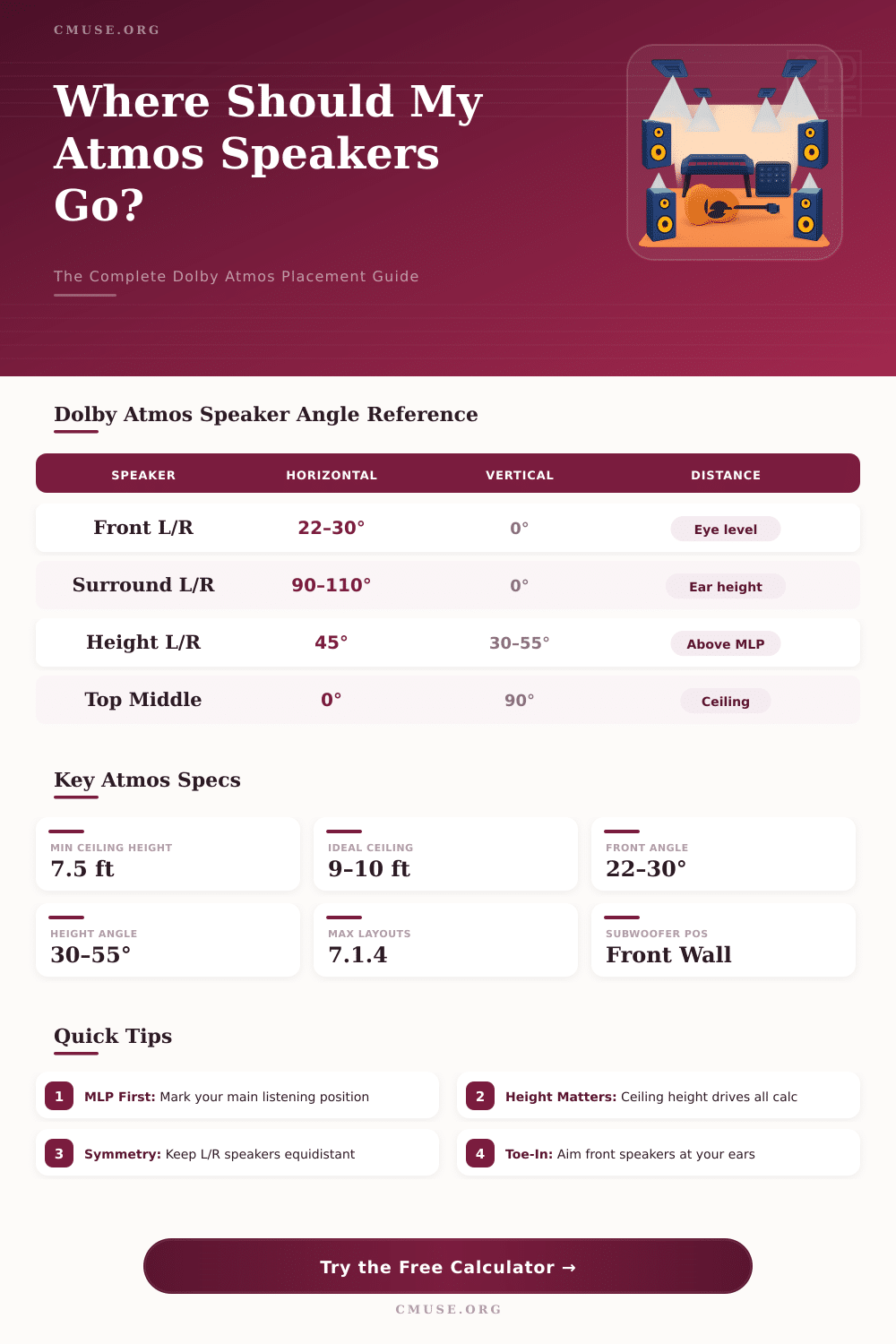
| Front Left / Right (L/R) | 22° – 30° | Ear level (42–48 in) | Required |
| Center Channel (C) | 0° | Ear level (42–48 in) | Required |
| Surround Left / Right | 90° – 110° | Ear level (42–48 in) | Required |
| Surround Back L/R | 135° – 150° | Ear level (42–48 in) | 7.x only |
| Front Wide L/R | 60° – 70° | Ear level (42–48 in) | 9.x only |
| Top Front L/R (Height) | 45° – 55° | 30°–55° elevation | .2 / .4 / .6 |
| Top Rear L/R (Height) | 135° – 145° | 30°–55° elevation | .4 / .6 |
| Top Middle L/R | 90° | 30°–55° elevation | .6 only |
| Room Size | Area (sq ft) | Recommended Layout | Min Ceiling Height |
|---|---|---|---|
| Very Small (9×10 ft) | 90 sq ft | 5.1.2 | 7.5 ft |
| Small (12×14 ft) | 168 sq ft | 5.1.2 or 5.1.4 | 8 ft |
| Medium (14×16 ft) | 224 sq ft | 5.1.4 or 7.1.2 | 8 ft |
| Medium-Large (16×18 ft) | 288 sq ft | 7.1.4 | 9 ft |
| Large (18×20 ft) | 360 sq ft | 7.1.4 or 9.1.4 | 9 ft |
| Very Large (20×24 ft+) | 480+ sq ft | 9.1.4 or 9.1.6 | 10 ft |
| Ceiling Height | In-Ceiling Position | Up-Firing Position | Elevation Angle |
|---|---|---|---|
| 7.5 ft (2.3 m) | Directly above MLP | Not recommended | 45°–55° |
| 8 ft (2.4 m) | 45° from MLP | Usable, limited | 40°–50° |
| 9 ft (2.7 m) | 45° ideal zone | Works well | 35°–45° |
| 10 ft (3.0 m) | Best in-ceiling zone | Excellent | 30°–40° |
| 12 ft (3.7 m) | Wide placement needed | Works, toe angled | 25°–35° |
| Layout | Floor Speakers | Height Speakers | Total (+ Sub) |
|---|---|---|---|
| 5.1.2 | 5 (FL, FR, C, SL, SR) | 2 (TFL, TFR) | 7 + 1 sub |
| 5.1.4 | 5 | 4 (TFL, TFR, TRL, TRR) | 9 + 1 sub |
| 7.1.2 | 7 (+ SBL, SBR) | 2 | 9 + 1 sub |
| 7.1.4 | 7 | 4 | 11 + 1 sub |
| 9.1.4 | 9 (+ FWL, FWR) | 4 | 13 + 1 sub |
| 9.1.6 | 9 | 6 (+ TML, TMR) | 15 + 1 sub |
Correct speaker placement is one of the cheapest ways to improve the sound quality. That commonly does bigger impact than buying expensive gear. The sound of speakers can really change if one moves them from one part of the wall to the other in the same space.
Balance is very important. Every speaker should sit equally far from the side walls, centered along the longest wall of the room. The ideal setup forms a triangle between the two speakers and the listener, where the listener is at the peak.
Where to Put Speakers for Better Sound
The speakers must be at ear height, when one sits.
Also worth turning the speakers slightly. If one angles them inward, so that they aim to a spot a bit behind the head of the listener, the sound becomes more precise. For a broader listening area, making that angle smaller helps to spread the sound to the sides.
Speakers aimed directly at the ears give richer and clearer sound than when they point somewhere else.
Walls and corners can cause problems. Speakers should sit at least three feet from the corners and one to two feet from the walls. A speaker pushed in a corner will produce too strong bass compared to the other, which messes up the balance.
Keeping them away from the side walls, one also escapes weird filtering effects. Reflected sounds from walls, floors and back surfaces all alter the tone, adding warmth or echo based on the position. The direct sound mainly creates the sound image, while the reflections give the upper feeling.
Speakers require space in the room. Pressing them on a full shelf between various objects destroys their impact. They require free area to work well.
In surround sound systems like 5.1, the five main speakers are left, center, right, left surround and write surround, together with a subwoofer. The center channel must face directly the main seat, with the speaker at ear level. The surround speakers go to the left and to the right of the listening spot, spaced equally as the front or a bit more broadly, and aimed at the listener.
Good placement in such systems strengthens the direct paths of the sound and creates a safe sound space. The same setup of speakers counts also for added forms like Dolby Atmos.
The shape and size of the room has big influence. In a dedicated listening space, first one sets the position of the speakers, then places the chair where the sound is best. In a typical home room, start from the place of the subwoofer and go from here has more sense.
Little rooms have their own troubles. Some methods suggest moving the speakers more close to the front wall in such spaces, which avoids certain problem frequencies. Bass units widely benefit from being near to limits like wall or floor, while high frequencies work best at ear height.
The room itself, its reflections, shape and size, matter almost just as much asthe speakers themselves.