DJ Transition Bar Calculator
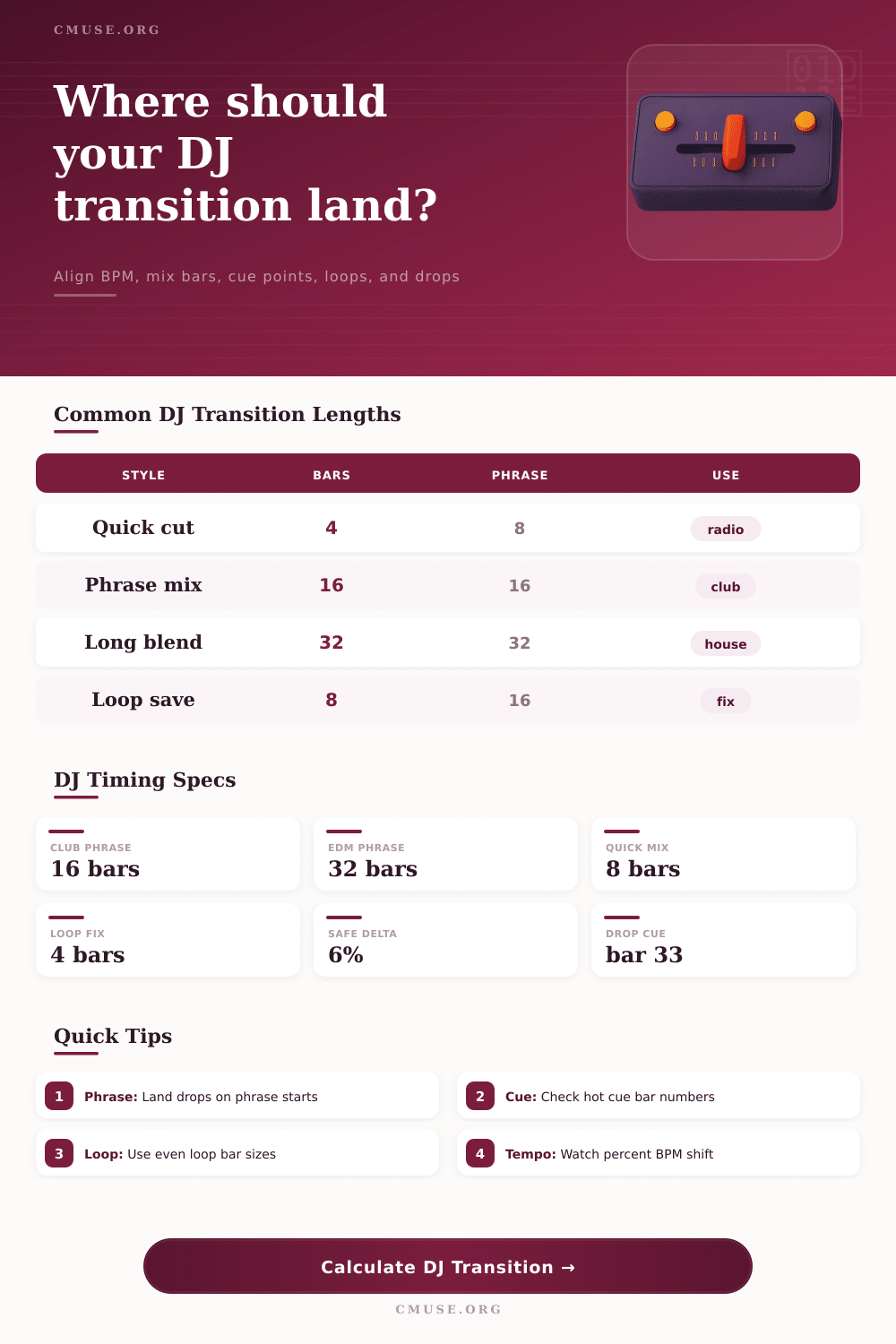
Plan an outgoing-to-incoming mix with BPM distance, phrase length, cue point position, overlap seconds, loop size, drop timing, and the exact bar where the transition should finish.
Calculation Breakdown
| Moment | Set Bar | Deck A Position | Deck B Position | Action |
|---|---|---|---|---|
| Run the calculator to build a transition timeline. | ||||
| Transition Type | Typical Bars | Best Phrase Grid | Common Use | Risk Check |
|---|---|---|---|---|
| Quick cut / echo out | 4 to 8 | 4 or 8 bars | Open-format, radio edits, clean vocal swaps | Needs precise drop or vocal timing |
| Phrase blend | 16 | 16 bars | House, disco, tech house, melodic warmups | Check bassline handoff by bar 9 |
| Extended blend | 32 | 16 or 32 bars | Progressive, techno, trance, long intro tracks | Watch clashing hooks and percussion fills |
| Double drop | 8 to 16 | 16 bars | Drum and bass, bass music, festival edits | Both drops must share phrase downbeat |
| Loop rescue | 8 to 24 | Loop size divides phrase | When the cue starts too early or too late | Avoid odd leftover bars before the drop |
| BPM Difference | Pitch Percent at 120 | 32-Bar Drift | DJ Reading | Suggested Handling |
|---|---|---|---|---|
| 0 to 2 BPM | 0% to 1.7% | Under 1.1 sec | Easy tempo blend | Sync or nudge manually, phrase first |
| 3 to 5 BPM | 2.5% to 4.2% | 1.6 to 2.7 sec | Noticeable pitch move | Ramp during breakdown or percussion section |
| 6 to 8 BPM | 5% to 6.7% | 3.2 to 4.3 sec | Genre bridge range | Use a loop, echo, brake, or transition edit |
| 9+ BPM | 7.5%+ | 4.8 sec or more | Large change | Plan a hard cut, half-time link, or reset moment |
| Loop Size | Works Best With | Phrase Fit | Drop Strategy | Watch For |
|---|---|---|---|---|
| 1 beat | Drum fills, cue stutters | Fine timing only | Last-second correction before the drop | Can sound nervous if held too long |
| 1 bar | Vocal chops, percussion tops | Divides 4, 8, 16, 32 | Cleanest short rescue loop | Keep bass EQ controlled |
| 2 bars | Build loops, risers | Divides 8, 16, 32 | Good for extending a pre-drop build | Check snare fills before release |
| 4 bars | House and techno phrases | Divides 16 and 32 | Reliable phrase-safe waiting loop | Release on bar 1 of next phrase |
| 8 bars | Long intro/outro drums | Divides 16 and 32 | Use when cue is one half-phrase early | Monitor crowd energy during hold |
| Preset | Outgoing BPM | Incoming BPM | Mix Bars | Primary Goal |
|---|---|---|---|---|
| House 32-Bar Blend | 124 | 126 | 32 | Long phrase-aligned blend into bar 33 drop |
| Hip-Hop 8-Bar Cutover | 92 | 96 | 8 | Fast hook-to-hook cut with short overlap |
| Drum and Bass Double Drop | 174 | 174 | 16 | Both drops fire on the same phrase downbeat |
| Loop Rescue 16-Bar | 128 | 126 | 16 | Use a 4-bar loop to fix a cue gap |
Before you even hear it, the energy drop. The crowd’s quiet groan greets the error as the groove on the floor die. In most cases, that was because the DJ begin the transition not at bar 1 but at bar 13.
Phrases are a key part of how music is constructed. In four-on-the-floor styles of music, those phrases is predominantly sixteen bars long. Introducing a second track mid-phrase result in the basslines fighting each other and hooks clashing. Rather than a seamless mix, there is muddiness.
Why Phrasing Is Important for DJing
The above calculator does the maths for you; no need to get your heart racing counting out the beats yourself. What it means is that if you think beatmatching is all there is to DJing, then you are mistaken. It’s half the battle, sure. But phrasing is as important than beatmatching.
Where do the track you want to play begin compared to what’s playing now? Does it need to be dropped straight away, or is the track going to have a slow buildup into its drop? You can enter the actual bar number for your cue point when loading the track. Most tracks don’t just kick in right from the off; they gradualy ramp up the tension. If you’ve got a transition endpoint aligned to bar 33 of your set, but your hot cue is set to bar 12, then unless you launch at exactly the same spot, it’ll either come in three bars too soon, or too late, which destroys the tension release the crowd anticipate.
There’s another layer of complexity with tempo changes. A seemingly minor change from 124 to 126 BPM across a thirty-two bar blend amount to a two beat per minute difference. Over the course of your mix, this has drifted and is now noticeably out of sync. You may have started right on time but now at the end of the mix the next track is either lagging behind or racing ahead. This tempo distance is taken into account by the calculator which then tells you precisely how many bars of overlap are required for the grids to remain locked together. It can help you decide whether to use a sync function, which sometimes drifts during a long mix if not carefully monitored. Alternatively, you can make manual nudges using jog wheels.
When things get close, looping becomes your safety net. When you notice too late that you began two beats ahead of where you should of begun, a loop lets you pause the outgoing track and tweak your internal count. The risk of a given loop size is laid out in table on the page. A four-bar loop is typically safe since it divides neatly into regular sixteen- or thirty-two-bar phrases. By comparison, a three-beat loop is going to completely mess with the phrase structure unless that’s exactly what you’re after. Even loops preserves the musical logic for listeners, even as the DJ frantically recalculates in their head.
Before you step foot inside the booth, you can use the tool to create a visual timeline which will help plan your sets. Whether it’s a long progressive house blend or a quick hip hop cut, you’ll know precisely when your drop sits within the set bar count, so no more getting caught out with that peak time banger dropping too soon and battling against the outro of the track you brought in. It makes you consider not only the starting point but also end point.
No calculator will ever be able to tell you what happens in real world DJ sets; your crowd may not react the way you think they might, and technical issues can occur that throw off any plans. But if you know how the theoretical grid works, you has a starting point. Even if something does go wrong, you’ll quickly be able to get back on track if you know mentally where bar 16 is. That’s when you stop guessing and begin counting.
Sometimes, it’s just a handful of beats at the end of a phrase that makes the difference between an amateur mix and a professional mix. Let the phrase come to its naturaly conclusion, land the drop on the one, and allow the incoming song to smoothly transition into next. It sounds like the flow of music, but really the music is flowing because of the structure supporting it, and all you need to do is respect the grid.