Direct to Reverberant Ratio Calculator
Estimate DRR from listener distance, source directivity, room volume, surface area, RT60, and critical distance.
Direct-to-reverberant result
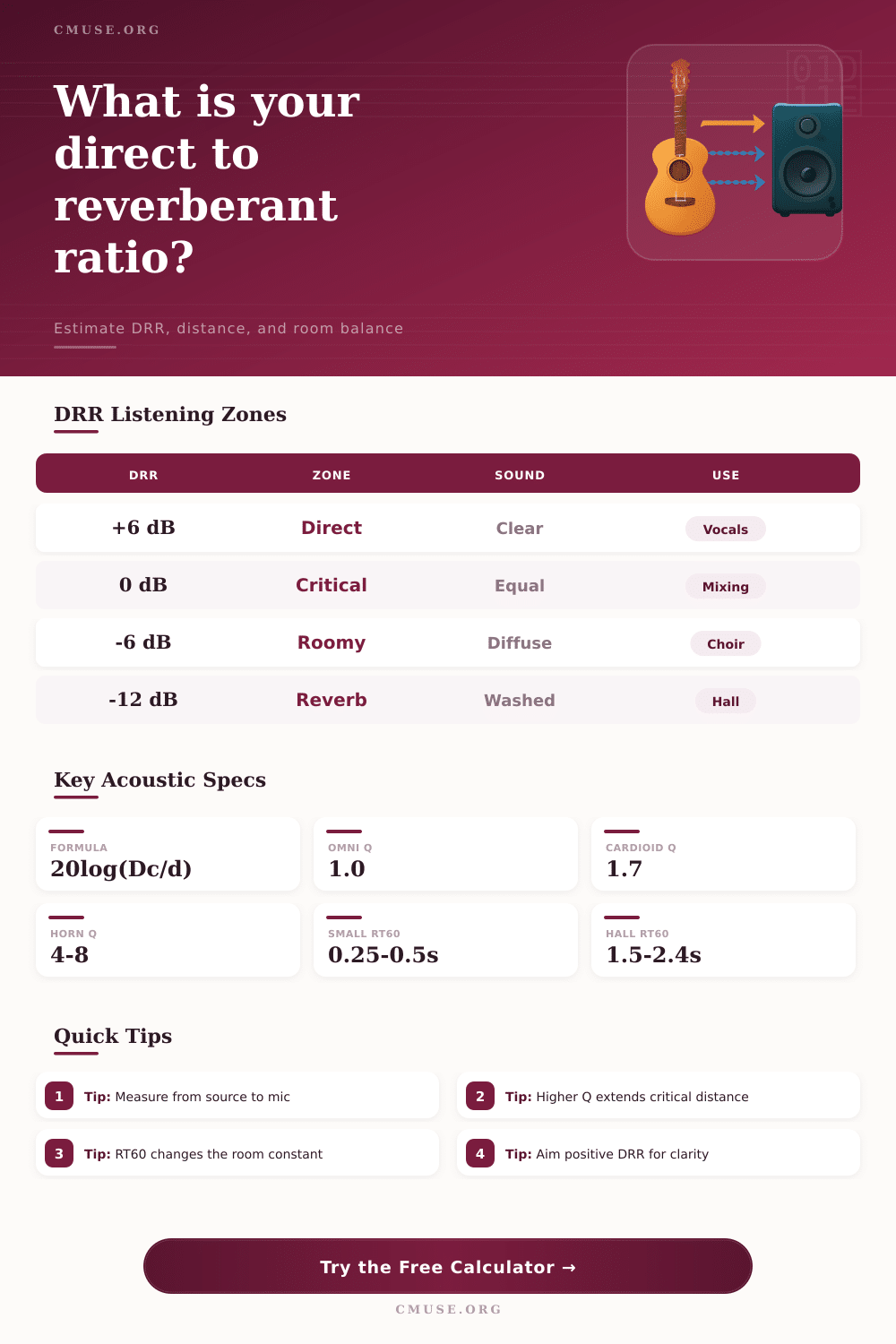
| Source pattern | Typical Q | Directivity index | Common audio use |
|---|---|---|---|
| Omnidirectional | 1.0 | 0.0 dB | Unfocused source, room tone checks, diffuse measurement. |
| Cardioid vocal area | 1.5 to 2.0 | 1.8 to 3.0 dB | Speech, close vocal capture, small rehearsal rooms. |
| Forward speaker lobe | 2.0 to 4.0 | 3.0 to 6.0 dB | Studio monitors, small PA, near-wall loudspeaker placement. |
| Horn or tight array | 4.0 to 8.0 | 6.0 to 9.0 dB | Theatre speech, stage fills, longer throw reinforcement. |
| DRR range | Balance heard | Recording meaning | Distance move |
|---|---|---|---|
| +10 dB or more | Strongly direct | Very intelligible, dry, close, low room contribution. | Move farther back if the take feels too isolated. |
| +3 to +9 dB | Direct favored | Clear vocal, podcast, monitoring, and speech work zone. | Good target when lyrics or dialogue must stay forward. |
| -3 to +3 dB | Critical blend | Direct and reverberant fields are close in level. | Small distance changes noticeably alter clarity. |
| -4 to -12 dB | Room favored | More hall, ensemble, ambience, and spatial bloom. | Move closer or raise Q when detail is being masked. |
| Room case | Room and RT60 | Source Q | Estimated critical distance |
|---|---|---|---|
| Dry vocal booth | 5 x 5 x 8 ft, 0.22 s | 1.7 | About 1.2 ft / 0.4 m |
| Home studio | 10 x 12 x 8 ft, 0.45 s | 2.0 | About 2.1 ft / 0.6 m |
| Small stage | 20 x 16 x 12 ft, 0.90 s | 4.0 | About 4.1 ft / 1.3 m |
| Reverberant church | 60 x 90 x 35 ft, 2.40 s | 2.0 | About 12.5 ft / 3.8 m |
| Preset | Room size | RT60 | Primary DRR use |
|---|---|---|---|
| Vocal Booth 5x5 | 5 x 5 x 8 ft | 0.22 s | Close vocals and voiceover with high intelligibility. |
| Home Studio 10x12 | 10 x 12 x 8 ft | 0.45 s | Nearfield monitoring and overdub placement. |
| Stage Area 20x16 | 20 x 16 x 12 ft | 0.90 s | PA clarity checks for speech and amplified instruments. |
| Church Choir | 60 x 90 x 35 ft | 2.40 s | Balancing ensemble detail against reverberant support. |
The direct-to-reverberant ratio is a measurement of the relative strength of the direct sound and the reflected sound in a recording or performance space. The balance between these two types of sound impact whether a voice will be intelligible or if it will dissolve into the sound of the room. The direct-to-reverberant ratio helps engineers to understand both the amount of sound that enters a microphone or reaches a listener direct from the sound source, and the amount of sound that reaches the microphone or listener after it reflect off of the walls, the ceiling, and the floor of the space.
The direct-to-reverberant ratio allow engineers to decide whether they should move closer to the sound source, change the pattern of the microphone, or if they should leave the room as part of the sound that is created. The direct-to-reverberant ratio can be calculated based off the distance between the sound source and the listener, and based upon the critical distance of the space being calculated. At the critical distance between the sound source and the listener, the level of direct sound is the same as the level of reflected sound.
Direct-to-Reverberant Ratio (Direct vs Reflected Sound): A Simple Guide
If an individual is within the critical distance of the sound source, the direct sound will be stronger than the reflected sound. Beyond that critical distance, the reflected sound will be more stronger than the direct sound. By plugging various room dimensions, listener distance, reverberation time, and directivity factor into the calculator, the calculator return the direct-to-reverberant ratio of the space in decibels.
Based upon these values, the calculator also returns the distance between the listener and the critical distance. The direct-to-reverberant ratio can help an engineer or a sound technician to understand whether the sound in the recording or performance space will have a strong direct component or whether it will have a strong ambient component. The directivity of the sound source is one of the factors that impact the direct-to-reverberant ratio.
Some sound sources emit their sound energy in a narrow pattern of directions, such as a choir of singer or a guitarist playing electric guitar through a speaker. Other sources of sound may radiate sound energy equally in all directions, such as an individual speaking into a microphone. Sources that focus their energy in a narrow beam of sound, such as those that utilize a cardioid microphone or horn-loaded speaker, will push the critical distance of the space further away from the sound source.
Sources that radiate sound energy equally in all directions will make the critical distance of the space shorter within the same area. The calculator allow engineers to select the directivity of the sound source or to enter a custom factor, and the direct-to-reverberant ratio will change based upon that setting. The change to the direct-to-reverberant ratio impacts an engineers ability to decide if the choir should be supplemented with monitors to increase the direct component to the sound, or if the vocalist should be positioned in such a way that their vocal elements remains dry and free of reflected sound.
The size of the recording or performance space, and the treatment of the surfaces within that space, can have an impact upon the direct-to-reverberant ratio. Small vocal booths with heavy acoustic treatment will allow the reflected sound to decay quick. Conversely, large performance halls with hard surfaces will allow the sound to reflect and remain strong for a longer period of time.
The calculator uses the reverberation time of the space in estimating how much sound absorption the rooms provides. If the reverberation time that is measured is longer than that which is calculated by the calculator, it suggest that the sound will be more colored by the characteristics of that space than the dimensions of that space alone. The engineer can control the distance between the listener (or microphone) and the sound source.
Moving the listener or microphone closer to the sound source will increase the direct-to-reverberant ratio, while moving the listener and microphone further from the sound source will decrease that ratio. By entering the desired distance between the listener and the source into the calculator, the calculator will return to the engineer the direct-to-reverberant ratio of that space. Based upon that value, the engineer can decide if the distance between the listener or microphone and the sound source should be adjust.
In most cases, engineers will use the direct-to-reverberant ratio to make decisions regarding sound engineering and placement of engineers and technicians. If a ratio is calculated that indicate that the sound source should be placed closer to the listener or microphone, an engineer may make that adjustment. Likewise, if the calculation indicates that a change to the directivity of the sound source will best address the engineering issue, an engineer may make that change as well.
Thus, engineers use the ratio as a diagnostic tool. In some cases, engineers may make error when calculating or measuring the direct-to-reverberant ratio. For instance, the distance between the sound source and the listener may be measured from the base of a microphone stand, rather than from the sound source itself.
These inches may not make a difference within a large concert hall, but they can make a major difference within a small vocal booth. An engineer may use a single reverberation time for the entire room rather than measuring the low frequency reverberation time separately from the mid-band frequencies. Because low frequencies often have longer reverberation times than the other frequency band, the low frequencies may remain reverberant even when the vocal frequencies have reached the critical distance.
Thus, in this case, the ratio will not reflect the true direct-to-reverberant ratio of the space. Finally, the calculator does not take into account the various elements of the room that are not accounted for in the Sabine model. For instance, the room may contain pieces of furnitures, individual, or other elements that reflect or absorb the sound.
Thus, while the calculator may return a direct-to-reverberant ratio to the engineer, the only way to truly determine the nature of the ratio in the actual space is to listen to the sound that is created in the space. Based upon the calculated ratio, the engineer can make adjustments to the sound field and the sound engineers to ensure that the sound is as desired. The value of calculating the direct-to-reverberant ratio in a performance or recording space is that it allow engineers and technicians to return to that space with repeatability.
If engineers have calculated the direct-to-reverberant ratio for a given space, they can return to that same location on another day and have the same results. Additionally, engineers can use the calculator to compare different rooms prior to deciding upon which space to utilize for a recording or live performance session. The calculator compresses these various comparison into a single figure that can be included in the notes for each project.
Thus, engineers gain a thorough understanding of the space and the factor that influence the direct-to-reverberant ratio. While engineers will still need to listen to the sound created within the space, the calculation of the direct-to-reverberant ratio will allow engineers to understand where to begin creating that sound, and how far each adjustment to the space will move that sound to where it is desired.