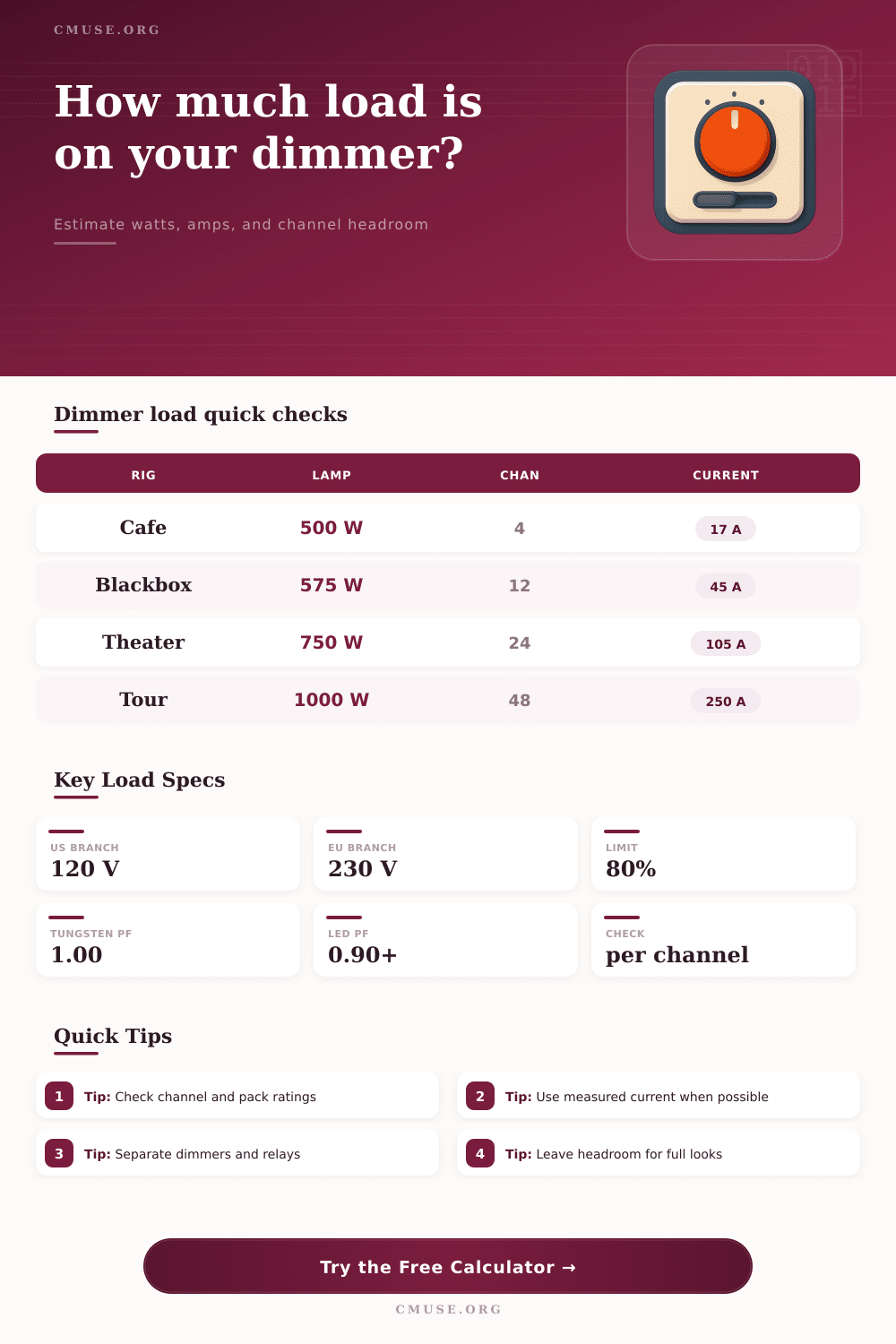
Dimmer Load Calculator
Estimate fixture wattage, channels, voltage, dimmer pack rating, channel rating, diversity, load percentage, and stage circuit current before patching a lighting rig.
Pick a realistic starting look, then edit the wattage, channel count, dimmer rating, diversity, and circuit limits to match the actual venue, rack, or touring dimmer pack.
10 A channel at 120 V
20 A channel at 120 V
16 A channel at 230 V
50 A channel at 120 V
| Channel rating | 120 V watts | 230 V watts | 80 percent planning load | Typical use |
|---|---|---|---|---|
| 10 A | 1,200 W | 2,300 W | 960 W at 120 V | Small packs, practicals, single fixtures |
| 15 A | 1,800 W | 3,450 W | 1,440 W at 120 V | Light-duty architectural dimming |
| 16 A | 1,920 W | 3,680 W | 2,944 W at 230 V | Common EU stage dimmer channel |
| 20 A | 2,400 W | 4,600 W | 1,920 W at 120 V | Standard 2.4 kW theatre channel |
| 50 A | 6,000 W | 11,500 W | 4,800 W at 120 V | High-capacity rack channel or relay feed |
| Fixture or lamp | Common wattage | 120 V current | 230 V current | Dimmer note |
|---|---|---|---|---|
| MR16 practical cluster | 150 W to 300 W | 1.3 A to 2.5 A | 0.7 A to 1.3 A | Watch transformer compatibility |
| PAR 56 or small fresnel | 300 W to 500 W | 2.5 A to 4.2 A | 1.3 A to 2.2 A | Often safe as singles or pairs |
| 575 W ellipsoidal | 575 W | 4.8 A | 2.5 A | Three units can exceed 80 percent on 20 A at 120 V |
| 750 W ellipsoidal | 750 W | 6.3 A | 3.3 A | Two per 20 A channel is a common planning limit |
| 1 kW fresnel or PAR | 1,000 W | 8.3 A | 4.3 A | Two per 20 A channel is above 80 percent at 120 V |
| 2 kW studio fixture | 2,000 W | 16.7 A | 8.7 A | Usually needs a full 20 A channel at 120 V |
| Preset | Fixture watts | Channels | Voltage | Planning concern |
|---|---|---|---|---|
| Coffeehouse Fresnels | 300 W | 4 | 120 V | Small load, but shared circuits still matter |
| Black Box Rep Plot | 575 W | 12 | 120 V | Channel loading is usually the first check |
| Church Warm Wash | 750 W | 8 | 120 V | Branch circuits can fill quickly during full looks |
| School Stage Pack | 500 W | 12 | 120 V | Portable packs need feed and neutral verification |
| Opera House Tungsten | 1,000 W | 60 | 120 V | Rack input and phase balance dominate |
| Use case | Diversity | Average level | Circuit limit | What to verify |
|---|---|---|---|---|
| Full work light or focus mode | 100 percent | 100 percent | 80 to 100 percent | Worst-case channel and branch current |
| Typical theatre cueing | 60 to 80 percent | 65 to 90 percent | 80 percent | Brightest cue, not just average scene |
| Club chase looks | 45 to 70 percent | 45 to 80 percent | 80 percent | Strobe, chase, and blackout recovery loads |
| Architectural practicals | 70 to 95 percent | 40 to 75 percent | 80 percent | Lamp type and dimmer minimum load |
| Mixed LED retrofit dimming | 50 to 90 percent | 30 to 75 percent | 70 to 80 percent | Power factor, leakage, and relay bypass needs |
Lighting crew must understand how to calculate electrical loads to ensure that there dimmer pack dont fail. A dimmer pack will fail if there is an electrical overload within the dimmer packs, which usually happen during a lighting cue that requires the lights to be at their maximumly brightness. Two ways to prevent a dimmer pack failure is to understand the load on each lighting channels and to understand how diversity, dimmer level, and power factor affect the load on those channels.
Fixture wattage are the first calculation to perform to determine the load on each channel. However, fixture wattage is not the only calculation that must be performed. The number of light on each channel and the voltage of the lighting installation also must be considered.
How to Calculate Lighting Loads to Avoid Dimmer Pack Failure
Using a lighting load calculator will make it easier to determine the load on each channel without guessing if the wattage of the lamps will remain within an 80 percent planning limit for the dimmer packs. The channel rating will also provide information that will help lighting designer determine the load on each channel. For example, lighting designers can plan for a 20 amp channel to carry 2400 watts at 120 volts, but they may plan for 1920 watts so that the dimmer rack will not overheat while the technical rehearsal run for the show.
The same is true for the pack input, where lighting technician must account for any spare cable and work lights that may be connected to the lighting installation. Another factor that can be used to calculate the load on the lighting installation is diversity. Diversity is the percentage of the installation that is on at one time.
Many lighting plots will use 75 percent diversity for most of the show, but 90 percent diversity for the finale of the show. Tester will use a lighting load calculator to plan for diversity so that the lighting installation wont fail under the planned show. Power factor is another calculation that lighting crews must consider, especially with the increasing use of LED fixtures and low voltage transformer.
Tungsten light will have a power factor that remains close to unity. LED lights will have a power factor of 0.9 or lower. The power factor will help lighting crews determine how much current is in the dimmer rack and the neutral wire, which can be read with a clamp meter.
By calculating the power factor, the current that is measured will equal the current that is calculate. Circuit planning for lighting installation uses the same logic as dimmer packs. Most venue will provide 20 amp circuits.
However, the load must remain within 80 percent of the calculated load because the circuits will be on for many hours during the show. If the current that is calculated for each circuit is more than 80 percent of the current limit, the lighting technician will have to use another circuit or the lighting patching plan will have to be change. A lighting load calculator will provide a recommendation for a new circuit or a patching plan before the lighting installation begins.
Unfortunately, not all factor can be accounted for in the lighting load calculator. Some factor that can change the load on the lighting installation include shared neutral, voltage drop in the cables, and the age of the dimmer racks. To determine if the electrical calculations were accurate, lighting technician will use a clamp meter to measure the current in the brightest lighting cue of the show.
The current that is measured will be compared to the calculated current to determine if the calculations were accurate. Another instance during which a clamp meter should of been used is to switch from tungsten lights to LED lights. LED lights will have a lower wattage reading, but they may create an inrush current that will trip an older dimmer pack.
The clamp meter will help to detect this problem. The lighting load calculator will provide the lighting designer with a baseline for the calculations, but the clamp meter will provide measurement to determine if there are any issue with the lighting installation. It is a habit for lighting installer to perform the electrical calculations for the lighting installation twice.
The calculations can be performed once at 100 percent diversity and the second time with the calculated diversity and dimmer levels for the show. The calculations at 100 percent diversity will allow the lighting designer to determine if the load on the dimmer packs can survive an error in the lighting plot. The calculation at the diversity and dimmer levels will allow the lighting designer to determine if the lighting plot will be compatible with the power provided by the dimmer packs.
By calculating the load on the lighting installation twice, the lighting designer will be certain that they will finish the lighting installation in the time allotted for the show.