Diminution Duration Calculator
Convert original note values into diminished durations, measure fit, rhythmic compression, and notation-ready output for motifs and variations.
🎼Presets
🎚Motif Inputs
📊Diminution Spec Grid
📘Note Value Conversion Table
| Original value | 2:1 diminution | 3:1 diminution | 4:1 diminution |
|---|---|---|---|
| Whole note (4 beats) | Half note (2 beats) | Half-note triplet pulse | Quarter note (1 beat) |
| Half note (2 beats) | Quarter note (1 beat) | Quarter-note triplet pulse | Eighth note (0.5 beat) |
| Quarter note (1 beat) | Eighth note (0.5 beat) | Eighth-note triplet pulse | Sixteenth note (0.25 beat) |
| Eighth note (0.5 beat) | Sixteenth note (0.25 beat) | Sixteenth-note triplet pulse | Thirty-second note (0.125 beat) |
⏱Rhythmic Compression Reference
| Diminution factor | Duration retained | Compression | Typical notation issue |
|---|---|---|---|
| 1.5:1 | 66.7% of original | 33.3% shorter | Often reads as triplet quarter motion |
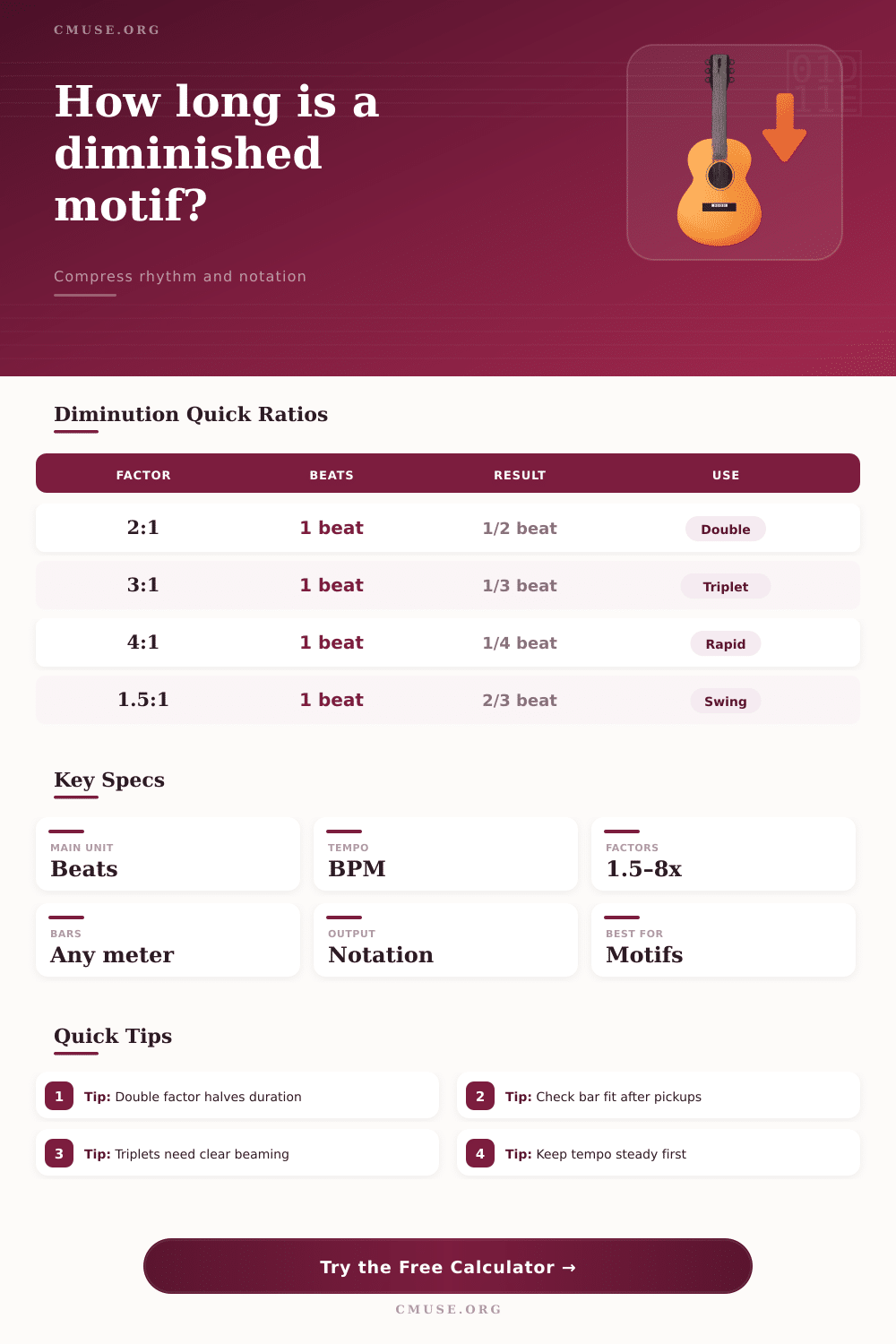
| 2:1 | 50% of original | 50% shorter | Usually clean double-time notation |
| 3:1 | 33.3% of original | 66.7% shorter | Requires clear triplet grouping |
| 4:1 | 25% of original | 75% shorter | Beaming becomes important |
| 6:1 | 16.7% of original | 83.3% shorter | May need sextuplet or ornament notation |
🎵Common Project Size Table
| Musical use | Starting motif | Common factor | Resulting duration |
|---|---|---|---|
| Fugue answer in stretto | 8 quarter notes in 4/4 | 2:1 | 4 beats, one measure |
| Renaissance imitation | 6 half notes in 3/2 | 2:1 | 6 beats, two 3-beat bars |
| Bebop double-time fill | 8 eighth notes in 4/4 | 2:1 | 2 beats, half a bar |
| Ornamental division | 4 quarter notes in 4/4 | 4:1 | 1 beat of sixteenths |
📝Notation Output Guide
| Output style | Best for | What it shows | Reading caution |
|---|---|---|---|
| Standard note names | Simple 2:1 or 4:1 diminution | Original value to nearest smaller value | Approximate when factor is not binary |
| Tuplet-aware wording | 3:1, 6:1, or 1.5:1 compression | Triplet or sextuplet language | Confirm beaming against the meter |
| Compact notation sketch | Drafting a short analytical label | Note count, pulse, and repetition count | Not a full engraved score |
| Rehearsal note | Explaining variation to players | Plain-language performance instruction | Keep tempo and articulation separate |
💡Diminution Tips
Perhaps you have a melody in your head which feels right if you sing it at a slow pace but not if you play it with any speed. The fingers stumble and rhythm pulls back as the musical line just can’t cope with the speed. This is where diminution has a practical answer. Instead of approaching it as a complicated math question, diminution give you the opportunity to squeeze time whilst retaining character of the motif.
Once you establish your starting parameters it does the math for you on the calculator above, which is better than guessing how many bars is left in the piece. While most people understands that speeding up doubles the tempo while halving the time, what they may be missing is physical aspect of writing out and performing notes. If you want an eighth note instead of a quarter note then you’ve changed something beyond a symbol. It’s now asking for double the concentration of player. This visualises the compromise that the tool can help you with before locking down your piece.
Using Diminution to Speed Up Music
What goes in must come out. Think about what you’re inputting. So let’s say you begin with an eight note motif in 4/4 time. That means it covers two complete measure, and the quarter notes are evenly spaced. Those notes is comfortabley positioned on the beat. But when we divide them by 2:1 they become eighth notes which now fit within just one measure. For a fast-moving rhythm this may be ideal but for a more intricate melody, it could feel cramped. The calculator displays precisely where new motif aligns against the bar line, and you can tweak the ratio or count accordingly if it feels uncomfortable.
Other difficulties arises with higher ratios. Pulses that are divided cleanly become triplets when the ratio reduces to 3:1, for example. These need to be clearly notated and beamed correctly so they does not confuse performers. On the same page, you’ll find a simple explanation in the reference table below. That shows how a whole note becomes a triplet pulse rather than a clean subdivision of the beat. This makes all the difference to performers reading from patterns visually. If it’s not clear in the notation, they’ll make a wild guess and get it wrong. Use the output options to choose between using familiar names for the tuplets or using more technical description in your score to clearly communicate how they should of feel.
Another often-overlooked element of this equation is tempo. Reduction by a ratio of 2:1 sounds quite different when it occurs at 60 as opposed to 140 beats per minute. At the former tempo there’s breathing space, at the latter, stamina and accuracy are needed. You enter desired tempo to calculate the time in seconds, bringing the world of ideas into realm of reality. This is especially important when writing for an orchestra, where each player must be aware of length of a given figure against conductor’s downbeat.
Generally speaking, most common errors are anacrusis and any pickup note that is ignored. If you compress a motif that starts on a half- or quarter-measure, its starting point will shift from bar line to bar line. Simply enter number of beats for pickups and the calculator will adjust them accordingly to match harmonic change.
Think of rhythm as if it exists in isolation; it does not! In real life, rhythm is always relational. Does the music flow or stall? What’s relationship between one figure and next? A link from thought to action is what reduction brings. You’ve got the melody in your head, now how do you turn that image into something you can play? These are the devices that allow you to try out various speeds and densities rapidly until you locate that sweet spot, that place where the rhythm sounds naturaly not forced. The musical line stays intact despite the increase in speed while retaining the character of the phrase at an increased pace. The same thought is still there, simply altered to accommodate a quicker performance.