Diminished Scale Calculator
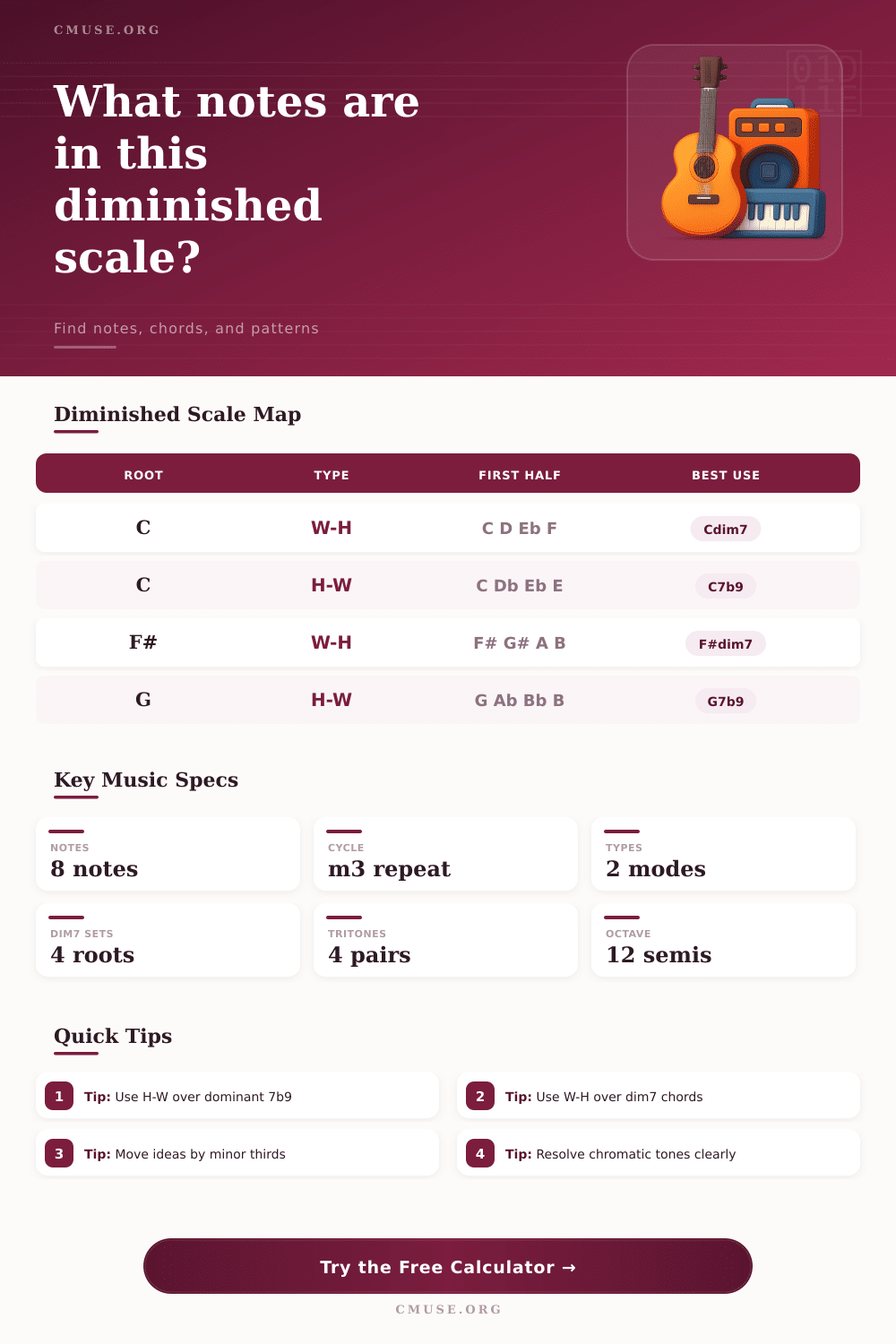
Build whole-half or half-whole diminished scales, spell the notes, compare chord fits, and map the repeating minor-third symmetry for improvisation and arranging.
Preset use: Load a common jazz, classical, guitar, or arranging situation, then adjust the root, scale type, spelling, octave range, chord context, and practice pattern.
Calculation Breakdown
| Scale Type | Step Pattern | Interval Formula | Primary Chord Use |
|---|---|---|---|
| Whole-half diminished | Whole, half, whole, half repeating | 1, 2, b3, 4, b5, b6, 6, 7 | Diminished seventh chords and passing diminished harmony |
| Half-whole diminished | Half, whole, half, whole repeating | 1, b2, #2, 3, #4, 5, 6, b7 | Dominant 7b9, 13b9, #9, and #11 colors |
| Minor-third symmetry | Same notes after transposition by 3 semitones | Four equivalent roots per collection | Move patterns through four related roots without changing note pool |
| Eight-note density | Alternating half and whole steps | Octatonic collection | Creates chromatic tension while keeping a repeatable pattern |
| Context | Chord Tones | Color Tones | Resolution Cue |
|---|---|---|---|
| Diminished seventh | 1, b3, b5, 6 | 2, 4, b6, 7 as passing tones | Resolve any chord tone by half step to the target chord |
| Dominant 7b9 | 1, 3, 5, b7 | b9, #9, #11, 13 | Resolve 3 to tonic or b7 downward in functional harmony |
| Passing diminished | Rootless leading-tone dim7 shape | Neighbor tones between diatonic chords | Keep the bass or melody moving by half step |
| Upper-structure diminished | b9, 3, 5, b7 over dominant root | #9, #11, 13 embellishments | Target a stable chord tone on the next strong beat |
| Collection Family | Equivalent Roots | Example Whole-Half Use | Example Half-Whole Use |
|---|---|---|---|
| Family 1 | C, Eb, Gb, A | Cdim7, Ebdim7, Gbdim7, Adim7 | C7b9, Eb7b9, Gb7b9, A7b9 share one note pool |
| Family 2 | Db, E, G, Bb | Dbdim7, Edim7, Gdim7, Bbdim7 | Db7b9, E7b9, G7b9, Bb7b9 share one note pool |
| Family 3 | D, F, Ab, B | Ddim7, Fdim7, Abdim7, Bdim7 | D7b9, F7b9, Ab7b9, B7b9 share one note pool |
| Transposition rule | Add 3, 6, or 9 semitones | The diminished seventh chord repeats exactly | The dominant diminished color shifts by minor thirds |
| Pattern | How It Is Built | Best Instrument Use | Musical Effect |
|---|---|---|---|
| Straight scale | Play the calculated notes in order across the chosen octave span | Piano, horn, voice, guitar, bass | Locks in the alternating half-step and whole-step sound |
| Diminished thirds | Pair note 1 with 3, 2 with 4, and continue through the scale | Single-line improvisation | Creates a fast symmetrical jazz line |
| Triad pairs | Alternate two implied major or minor triads from the scale | Guitar, piano, arranging | Breaks the octatonic color into clearer shapes |
| Tritone pairs | Pair each note with the note six semitones above it | Brass hits, comping, modern voicings | Highlights the four tritone anchors inside the collection |
| Application | Typical Scale Choice | Example Root | Practical Result |
|---|---|---|---|
| Jazz V7b9 to minor tonic | Half-whole on the dominant root | G H-W over G7b9 to Cm | Gives b9, #9, #11, and 13 while preserving 1, 3, 5, b7 |
| Passing diminished chord | Whole-half on the diminished root | C# W-H between Cmaj7 and Dm7 | Connects chords by chromatic voice leading |
| Big band dominant hit | Half-whole with strong chord tones | Db H-W over Db13b9 | Adds bright upper tensions without losing the dominant function |
| Classical octatonic color | Either form by melodic center | Ab W-H for symmetrical dark color | Creates balanced tension across four minor-third anchors |
The diminished scale is a musical scale that is often used in jazz and moddern music. The diminished scale is particularly useful in that it provide eight notes that provide both tension and stability to a piece of music. The diminished scale repeats itself every minor third.
Because the diminished scale repeats itself every minor third, the same collection of note can be used to form four different roots of a chord. The symmetry of the scale allow for the addition of chromatic colors to a composition, and those chromatic colors will resolve to a dominant chord or from one harmony to another. There is two different versions of the diminished scale.
How to Use the Diminished Scale
The choice of which diminished scale to use will depend upon the chord that the musician is targeting. The whole-half diminished scale is the most common form of the diminished scale that is utilize over diminished seventh chords. The half-whole diminished scale is used over dominant chords that contain a flat nine.
The half-whole diminished scale maintains the major third and the flat seventh of the chord, allowing those notes to remain stable within the chord. The calculator tool will calculate the mathematical component of the scale once the musician chooses the root of the chord, the type of chord, and the chord context. Each of these components will determine the type of chord tones and color tones that is represented in the chord.
For instance, if the selected chord is a dominant seventh chord with a flat nine, the half-whole diminished scale will show the third and the flat seventh as the stable tones for the chord. The flat nine and the sharp eleven will be considered tensions. Changing the chord context will change the labels of the notes in the chord, but the actual notes themselves wont change.
One of the primary feature of the diminished scale is the concept of symmetry. The symmetry of the diminished scale exists because the musical scale repeats itself every minor third. Because the scale repeats itself every minor third, any musical phrase construct using the diminished scale can be moved up in pitch by a minor third to another phrase that contains the same notes.
The symmetry of the diminished scale allows the musician to create musical lines that give the impression of movement in the music, but which actualy remain within the same area of harmony. The four roots that are represented in the calculator will show which chords contain the same collection of notes. Another important aspect of the diminished scale is the voice leading of the individual notes within the scale.
The concept of voice leading is important because the chromatic notes within the diminished scale must eventually resolve to a stable tone for that chord. It is tempting for musicians to treat each of the notes within the diminished scale as if they are of equal importance. By treating each of the notes as of equal importance to one another, however, a musician may lose there sense of where the chord progression is moving within the song.
The calculator displays the chord tones and the passing tones so that the musician can make a plan for resolving each of the notes prior to begin to improvise upon the chord. Some of the most common practice patterns for learning the diminished scale are based off the rule of symmetry of the scale. One common practice pattern is to simply play the diminished scale in eighth notes to learn the sounds of each of the half steps and whole steps of the scale.
Another pattern is to play each of the notes that are a third apart from one another to form symmetrical lines. Still another pattern is to play the tritone pairs to emphasize each of the tensions within the chord. Each of these pattern can be seen on the calculator with an example of the pattern that can be played.
Beyond knowing how to play the diminished scale in even the most complex of chords, there is some rules that a musician should of know and apply to the scale. Each collection of notes of the diminished scale can be played for several bars of music, but each chord progression must eventually resolve to the next chord in the progression. The symmetry of the diminished scale allow for the musician to create their musical ideas while staying within the same area of the chord, but the listener will be able to recognize the underlying key of the music.
One or two of the chord tones can be played as an anchor for the musician for their line to stay within the chord, while the remaining tones in the diminished scale can be used to add chromatic color to the chord. The diminished scale remains relevant in music today because it can provide a balance between the tension and resolution of chords. Understanding how musicians can use each of the two forms of the diminished scale for certain types of chords will allow musicians to incorporate the scale into their musical ideas.