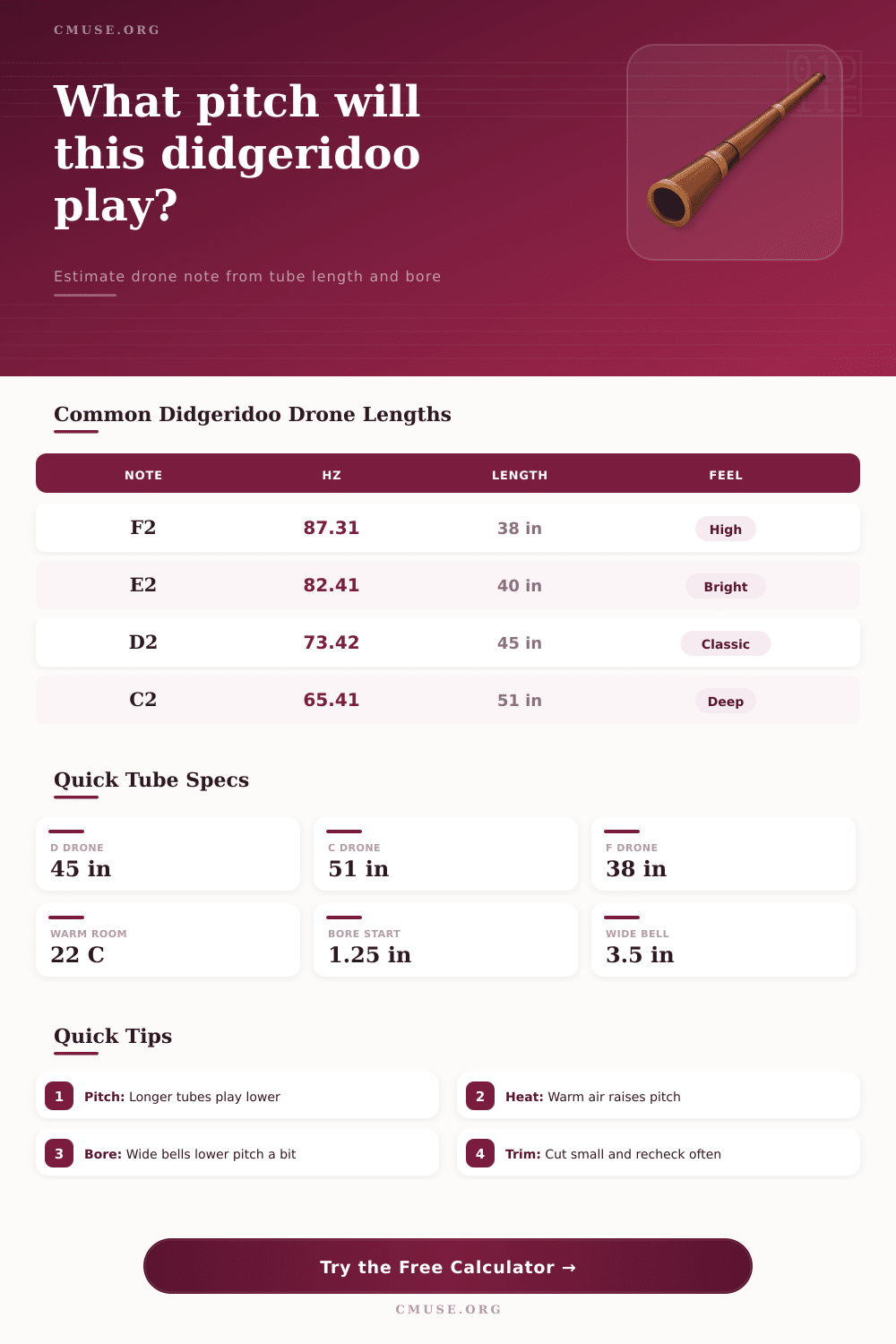
Didgeridoo Length To Pitch Calculator
Estimate the drone note from a tube length, or reverse the model to find the physical length for a target didgeridoo pitch.
Calculation Breakdown
| Drone Note | Frequency | Approx Length | Common Feel |
|---|---|---|---|
| G2 | 98.00 Hz | 33.9 in / 86 cm | High, quick response |
| F2 | 87.31 Hz | 38.2 in / 97 cm | Bright and compact |
| E2 | 82.41 Hz | 40.6 in / 103 cm | Common medium-high key |
| D2 | 73.42 Hz | 45.6 in / 116 cm | Classic mid-low drone |
| C2 | 65.41 Hz | 51.3 in / 130 cm | Deep but manageable |
| B1 | 61.74 Hz | 54.5 in / 138 cm | Deep, slower air column |
| Bore Type | Typical Diameter | Pitch Effect | Playing Response |
|---|---|---|---|
| Narrow backpressure bore | 1.0–1.25 in / 25–32 mm | Slightly sharper | Efficient air, focused drone |
| Straight medium bore | 1.25–1.75 in / 32–44 mm | Baseline | Balanced response |
| Mild natural taper | 1.3–2.5 in / 33–64 mm | Slightly flatter | Open tone, flexible harmonics |
| Wide bell flare | 2.5–4.5 in / 64–114 mm | Flatter end correction | Strong projection, lower feel |
| Air Temp | Sound Speed | Pitch Shift Vs 20°C | Practical Meaning |
|---|---|---|---|
| 10°C / 50°F | 337.4 m/s | −29 cents | Noticeably flatter |
| 20°C / 68°F | 343.4 m/s | 0 cents | Room reference |
| 30°C / 86°F | 349.5 m/s | +30 cents | Noticeably sharper |
| 40°C / 104°F | 355.5 m/s | +59 cents | More than a quarter-tone |
| Scenario | Target Note | Starting Length | Setup Note |
|---|---|---|---|
| Compact travel didgeridoo | F2 or G2 | 34–39 in / 86–99 cm | Fast response, less low-end depth |
| General practice instrument | D2 or E2 | 41–46 in / 104–117 cm | Comfortable all-round range |
| Deep drone instrument | B1 or C2 | 51–55 in / 130–140 cm | Requires steadier air support |
| Wide-bell performance tube | C2 to D2 | 45–53 in / 114–135 cm | Bell correction can flatten pitch |
A freshly cut bamboo stalk presents a question to every didgeridoo maker: now what? You’ve got the tools; you’ve got the material, but will this be a shrill whistle or that deep resonant drone you’re aiming for? That space in between musical pitch and physical wood is where most new makers loses their way.
It’s not simply a matter of length; it’s about acoustics. The calculator above takes care of messy business of wave physics, leaving you free to concentrate on the craft itself. It uses your tube length and some info about bore to estimate your drone note with reasonable accuracy.
How to Choose the Right Length for Your Didgeridoo
That’s the basic principle and easy enough to keep in mind but when put into practice it gets a bit tricky. In general, the longer the tube then the lower the pitch. Why? Because there is simply more time for the sound wave to travel and complete its cycle. A standard mid-low range that most players recognize is roughly around the D2 note. A four-and-a-half-foot-long tube would produce about a D2 note.
That’s all well and good, but that isn’t the full story. When we consider how an instrument works sound-wise, it doesn’t end precisely where mouth blows on the instrument. There is a slight spilling outwards from the open end that results in a correction called end correction by sound experts. Essentially, the didgeridoo sounds slightly flatter then its actualy dimensions would indicate. Failing to take account of this and your initial effort will probably be sharp.
It gets trickier still with bore shape. We get predictable results from a simple straight cylinder, but in nature we are rarely given such perfection. Wide bell flares and natural tapers changes how internal pressures work. Narrower bores increase back-pressure creating tighter sounds while making breath control more difficult. When the bell flares out wide, it make the air column seem longer, which lowers the pitch slightly. It also alters way the instrument feels, making it more open and responsive.
This tool allows for those variabilities. You can model the effect of narrow bores or wide bell flare to find how each shifts the fundamental frequency without ever having touched a saw.
The variable that destroys even the best of intentions is temperature. Sound travels faster in warm air. Play an instrument tuned to ten degrees Celsius (a cold garage) and then perform at a festival where the temperature are in the thirties. It will have sharpened considerably. The pitch can be off by almost a quarter tone. When recording or playing with others, this becomes significant.
When you enter your expected performance temperature into the calculator, the math reflect real-world conditions instead of ideal ones. Many players tune to room temperature and subsequently marvel as they hear how their drone sounds out of tune onstage.
The golden rule of cutting a blank is to cut slow. You can’t stick it back on. If you’re going to remove material you will raise the pitch instantly (and permanently). So always err on the long side, start measuring early and often. A rough guideline is the reference table in the layout above, which provides target lengths for common notes such as an E2 or C2. Think of these as guidelines rather than laws. Humidity, wall thickness, wood density all factor into things a formula wont ever account for.
There’s something about creating your own that makes you feel connected to the source of the sound. It’s about carving clay and wood into shape for shaping air. The math helps give you the map, and then your ears supply the destination. It turns what was guessing into designing. Instead of chasing after notes, you’re engineering them.
When you grasp how the tone changes with temperature and bore, you don’t fight the instrument anymore; you begin working with it. At that point, it’s no longer just a noise, it’s a voice…a drone.