Decibel Difference Calculator
Compare two dB levels, then convert the difference into power ratio, voltage or pressure ratio, approximate loudness change, gain trim, and SPL-style interpretation.
🎛 Decibel difference presets
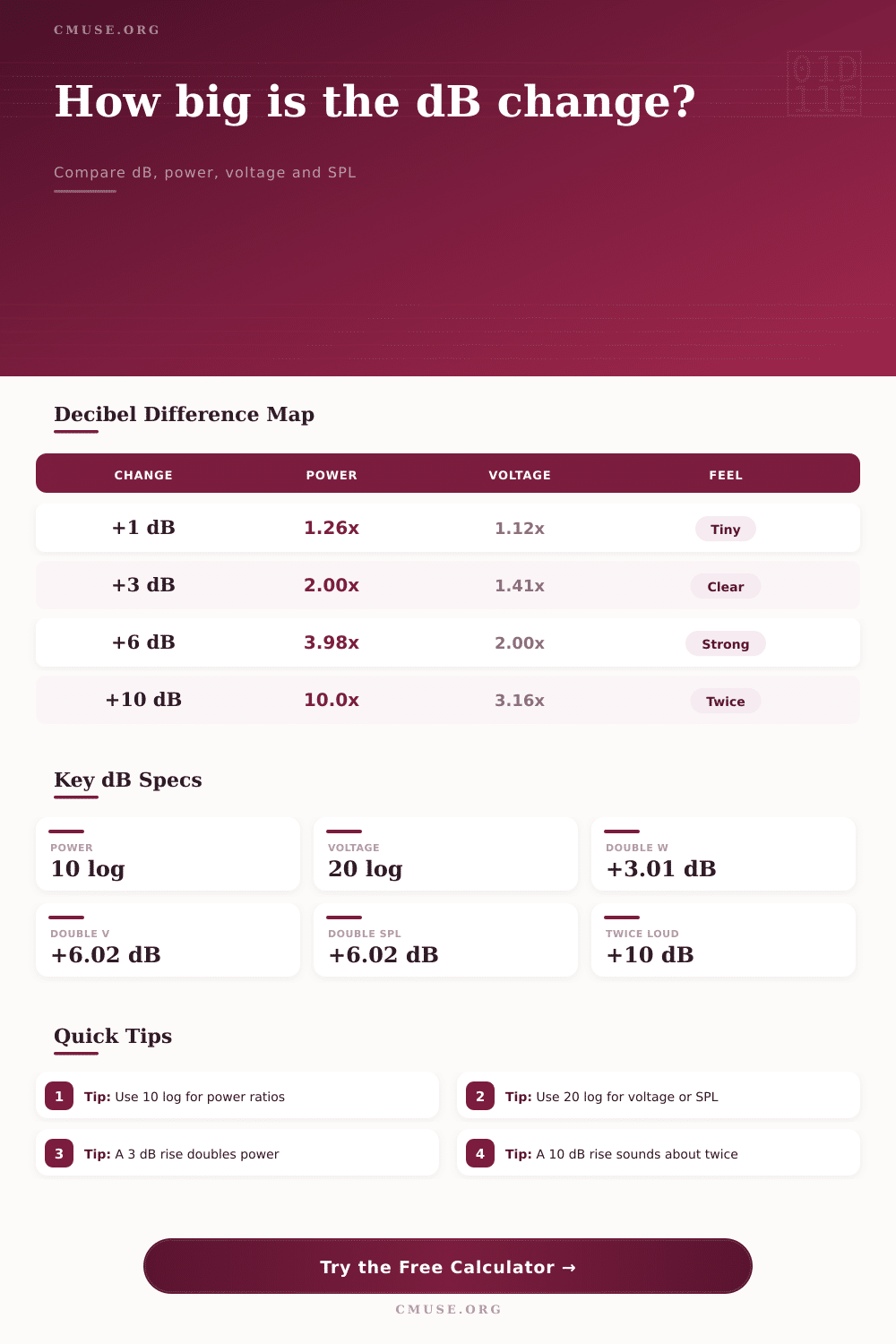
Formula focus: use 10 log10 for power ratios and 20 log10 for voltage, amplitude, pressure, or SPL ratios. This calculator shows both views from the same dB difference.
⚙ Audio level inputs
Decibel difference breakdown
🎧 Current audio comparison grid
📊 Decibel difference quick table
| dB difference | Power ratio | Voltage or pressure ratio | Approximate loudness | Audio meaning |
|---|---|---|---|---|
| +0.5 dB | 1.12x | 1.06x | 1.04x | Fine mix or mastering trim |
| +1 dB | 1.26x | 1.12x | 1.07x | Small but often audible change |
| +3.01 dB | 2.00x | 1.41x | 1.23x | Twice the power, clear level lift |
| +6.02 dB | 4.00x | 2.00x | 1.52x | Double voltage, pressure, or distance loss opposite |
| +10 dB | 10.00x | 3.16x | 2.00x | Often heard as roughly twice as loud |
| +20 dB | 100.00x | 10.00x | 4.00x | Large gain, level, or isolation gap |
⚡ Power ratio table
| Power change | dB formula | dB result | Reverse ratio | Typical audio use |
|---|---|---|---|---|
| Half power | 10 log10(0.5) | -3.01 dB | 0.50x | Amplifier headroom or speaker wattage comparison |
| Same power | 10 log10(1) | 0 dB | 1.00x | No energy change |
| Double power | 10 log10(2) | +3.01 dB | 2.00x | Two equal powered sources in phase-free planning |
| Four times power | 10 log10(4) | +6.02 dB | 4.00x | Large amp power increase for moderate SPL gain |
| Ten times power | 10 log10(10) | +10 dB | 10.00x | Roughly twice perceived loudness in many contexts |
🔌 Voltage, amplitude, and pressure table
| Amplitude change | dB formula | dB result | Power effect | Typical audio use |
|---|---|---|---|---|
| Half voltage or pressure | 20 log10(0.5) | -6.02 dB | 0.25x power | Signal voltage pad or double-distance SPL loss |
| Same voltage or pressure | 20 log10(1) | 0 dB | 1.00x power | Matched input or reference pressure |
| 1.414x voltage or pressure | 20 log10(1.414) | +3.01 dB | 2.00x power | RMS voltage needed for a 3 dB power lift |
| Double voltage or pressure | 20 log10(2) | +6.02 dB | 4.00x power | Line level, microphone pressure, or SPL ratio |
| 10x voltage or pressure | 20 log10(10) | +20 dB | 100.00x power | Large gain stage or acoustic pressure span |
🔊 SPL and source comparison table
| SPL situation | Expected dB change | Power view | Pressure view | Use in calculator |
|---|---|---|---|---|
| Two equal incoherent sources | About +3 dB | 2x acoustic power | 1.41x RMS pressure | Set equal source count to 2 |
| Four equal incoherent sources | About +6 dB | 4x acoustic power | 2x RMS pressure | Set equal source count to 4 |
| Double listener distance | About -6 dB | 0.25x intensity | 0.5x pressure | Set distance ratio to 2 |
| Half listener distance | About +6 dB | 4x intensity | 2x pressure | Set distance ratio to 0.5 |
| Ten dB SPL increase | +10 dB | 10x intensity | 3.16x pressure | Common loudness reference point |
📐 dB formula reference table
| Quantity | Use this formula | Inverse formula | Common units | Watch point |
|---|---|---|---|---|
| Power or intensity | dB = 10 log10(P2 / P1) | P2 / P1 = 10^(dB / 10) | W, dBW, dBm | Use only for power-like quantities |
| Voltage or amplitude | dB = 20 log10(V2 / V1) | V2 / V1 = 10^(dB / 20) | V, dBu, dBV | Assumes same impedance for power comparison |
| Sound pressure level | dB SPL = 20 log10(p / 20 uPa) | p = 20 uPa x 10^(SPL / 20) | dBA, dBC, dBZ | Compare readings with same weighting |
| Digital level | dBFS change is a gain difference | Linear gain = 10^(dB / 20) | dBFS, LUFS trims | 0 dBFS is a ceiling, not a loudness target |
| Perceived loudness | Approx ratio = 2^(dB / 10) | dB = 10 log2(ratio) | Listening estimate | Program material and frequency change perception |
Audio engineering confuses people with its use of logarithmic decibel scale. This is partly because doubling an amplifier’s wattage doesn’t usually make the sound system sound twice as loud. Your ears perceive energy as ratio, not steady steps. That’s where the calculator comes into play. It takes those odd ratio numbers and converts them to hard numbers like perceived loudness, voltage, and power. It close the gap between what happens on paper versus what you sense in the real world.
What’s at the heart of this friction? Amplitude and energy is different things. An increase in sound amplitude require a 6dB change (such as voltage or acoustic pressure). In contrast, an increase in sound energy requires a 3dB change which relates directly to power according to ten log rule. This is where folks burn themselves: A new amp with double the watts of what you have now will give just a three decibel jump, which while perceptible, isn’t anywhere near the sonic leap many anticipate.
How to Use the Decibel Calculator
To do so, it asks you what kind of change you’re measuring, lets you set your target and reference levels, and then lets you choose between sound pressure, voltage, or power. It’s a simple process that requires a little understanding of the inputs so that you can have confidence in the output.
For instance, if you wanted to figure out how many extra speaker you’d need on-stage at a venue to raise the overall sound pressure level three decibels, all you would do is enter one as the source count and two as the target count. Regardless of how powerful each driver happens to be, adding another same-speaker raises the SPL just three dB, the calculator will show you exactly that when you play around with it and fiddle with the source count. Quantity, in other words, builds up logarithmically rather than linearly.
But then there’s perceived loudness. According to how we hear sound, we have to increase the volume by ten decibels to perceive the volume as being double that of the original. That’s a subjective measure and depends on how long we’re exposed to the sound and what its frequency content is. But it’s a good rule of thumb when considering how much to push a mix’s gains. A three-decibel bump on your vocal makes the vocal forward in the mix; a ten-decibel bump make it dominate the mix. On a linear scale of power, the difference between something subtle and something drastic might seem greater then it does on the dB scale.
The same goes for distance. According to the inverse square law, the level drops by 6 dB every time we double the distance from a sound source. In other words, there is a huge decrease in intensity which also means a halving of the pressure amplitude. And if you look at what the calculator turns this into as a ratio, you’ll realize how much bigger an impact a slight physical distance have on the amount of acoustic energy. This makes sense when thinking about volume controls versus monitor placement in a loud room.
The tool also can help plan for headroom. If you want to bring a line level signal up to mixer input or match it to a broadcast loudness standard, you set the target difference. The tool will then calculate how many dBs of gain trim are required. And you get a visual of the voltage ratio as well as the power ratio (all on one output). That’s a nice touch that avoids mistakes while working across the digital-analog divide.
Digital systems use dBFS. This measures a voltage-like amplitude level relative to the clip point (full scale). Analog gear commonly expresses the wattage (a measure of power) and there are multiple ways to convert between the two. Applying the right logarithm makes the conversion possible. The input tables with the reference information included are handy as a check-in. And they remind us that ‘zero decibels’ isn’t the same as no sound at all. It’s actualy ‘no difference’. When there’s no difference in volume, the ratio of voltages and powers will be one, or zero dB. If we have a negative dB figure then this is less than silent. Negative figures aren’t holes, they’re fractions. This is important when learning how to read the meters.
At its heart, the decibel is shorthand for complicated relationships. It condenses huge amounts of energy into digestible digits and the calculator expands those digits back into palatable proportions. From building a massive sound system to cutting a single fader a few tenths of a decibel, understanding how much something has doubled in voltage versus how much it’s doubled in power will prevent you from making expensive mistakes. Once you learn which log to apply, the math is straightforward. Perception is where it gets difficult.