dBZ Calculator
Estimate unweighted Z-weighted sound pressure level from distance, equal-source summing, placement gain, room buildup, and air loss.
🎚Real Audio Presets
📏Sound Level Inputs
📊Core dBZ Reference
| Formula | Use | Expression | Notes |
|---|---|---|---|
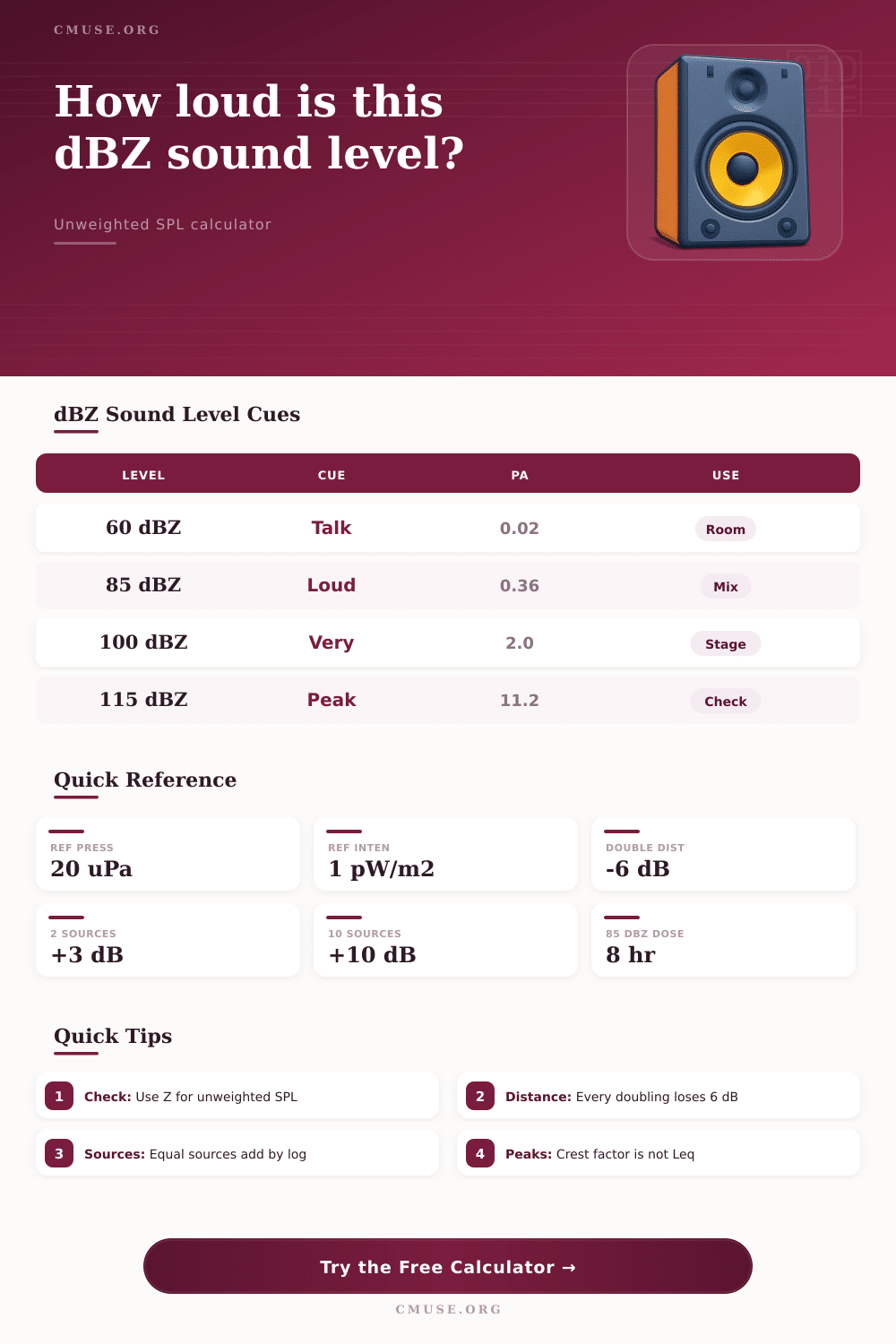
| Unweighted SPL | Pressure to dBZ | Lz = 20 log10(p / 20 µPa) | Z weighting applies no A or C curve correction. |
| Pressure | dBZ to Pa | p = 20 µPa × 10^(Lz / 20) | RMS sound pressure for the calculated level. |
| Intensity | dBZ to W/m² | I = 1 pW/m² × 10^(Lz / 10) | Air reference approximation used for SPL work. |
| Distance loss | Point-source spreading | ΔL = -20 log10(distance / reference) | Best for direct sound before room dominance. |
| Source summing | Equal sources | ΔL = 10 log10(source count) | Assumes comparable levels at the meter position. |
🎵Typical Unweighted Audio Levels
| Scenario | Typical dBZ | Pressure | Calculation Use |
|---|---|---|---|
| Quiet control room background | 30 to 40 dBZ | 0.0006 to 0.002 Pa | Noise-floor reference for recording spaces. |
| Conversation near a microphone | 58 to 68 dBZ | 0.016 to 0.050 Pa | Dialog, podcast, and room-tone checks. |
| Nearfield monitor mix level | 78 to 85 dBZ | 0.16 to 0.36 Pa | Common calibration zone for short sessions. |
| Small rehearsal or live vocal wedge | 90 to 100 dBZ | 0.63 to 2.00 Pa | Check distance and exposure before long use. |
| Close drum kit or loud stage | 103 to 115 dBZ | 2.8 to 11.2 Pa | Short allowable times under 3 dB exchange. |
🔊Placement and Distance Guide
| Change | dB Shift | When to Use | Metric Equivalent |
|---|---|---|---|
| Move from 1 m to 2 m | -6.0 dB | Direct field, point-source estimate. | 3.28 ft to 6.56 ft |
| Move from 1 m to 4 m | -12.0 dB | Useful for PA throw checks. | 3.28 ft to 13.1 ft |
| Two equal speakers | +3.0 dB | Same signal and similar distance. | 2 sources |
| Four equal singers | +6.0 dB | Choir or ensemble average. | 4 sources |
| One boundary nearby | +3.0 dB | Speaker near floor or wall. | Half-space estimate |
| Corner loading | +9.0 dB | Low-frequency boundary buildup. | Eighth-space estimate |
⏱3 dB Exchange Exposure Table
| Level at Ear | Allowable Time from 85 dBZ | Pressure RMS | Use Case |
|---|---|---|---|
| 85 dBZ | 8 hours | 0.356 Pa | Reference calibration or long mix check. |
| 88 dBZ | 4 hours | 0.502 Pa | Moderately loud rehearsal average. |
| 91 dBZ | 2 hours | 0.710 Pa | Small stage or wedge-heavy practice. |
| 94 dBZ | 1 hour | 1.00 Pa | Short live checks and tracking sessions. |
| 100 dBZ | 15 minutes | 2.00 Pa | Loud booth, drums, or DJ monitor zone. |
This calculator estimates acoustic level from standard SPL relationships. Real rooms, arrays, reflections, and source directivity can change measurements, so confirm important results with a calibrated meter.
When measuring the loudness of a sound in a rehearsal room or in a home studio setting, there is several different variables and considerations to keep in mind. Most decibel meter will show the loudness of a space in dBA, which stand for decibels with A-weighting. A-weighting apply filters to the sound to mimic the way in which the human ear perceives loudness.
A-weighting isnt, however, an accurate measurement of loudness with respect to all sound source. For instance, if you are measuring the loudness of a drum kit or an subwoofer, the A-weighting may filter many of those low frequencies out of the measurement. In these instance, dBZ (decibels with Z-weighting) is a better measurement to use of loudness instead of dBA.
How to Measure Sound and Protect Your Ears
Z-weighting measure loudness differently than A-weighting in that it employ a flat response. A flat response indicates that there is no filters applied to the sound that is being measured. Thus, Z-weighting provides a measurement of the actual sound pressure level in the air, regardless of whether the human ear is sensitive to those measured frequencies.
Use of the unweighted measurement of loudness is recommended if the purpose of measuring loudness is to protect the hearing of those who is monitoring the sound. The unweighted measurement of loudness will indicate the level of physical pressure that is hitting a wall in the room, while the A-weighting only indicates how loud the sound will feel to a human being. The physical pressure of the sound is a critical measurement in the determination of how much the ears of an exposed listener will fatigue from the physical pressure of the sound.
Another of the variables of loudness to consider is the distance that the sound travel from the source. Sound level tend to even out and diminish as the distance between the listener and the sound source increases. For instance, if one were to move from three feet to six feet from a loud sound source (as might be found in a home stereo system), the decibel reading will drop in level.
You may utilize a calculator to determine such drop in decibel levels, thus eliminating the need to manually calculate such a value with the sound meters while moving the microphone. Another variable to consider is the type of space in which the sound are playing. Real rooms tend to have some reflecting of the sound by the walls, the floor, and the ceiling.
Thus, if a sound is played within a corner of a room, the walls and floor and ceiling will reflect the sound off of it and may boost the level of sound that is emanating from the speaker. This boost in loudness within the corner of a room is referred to as boundary gain. Boundary gain is problematic because it may make a listener think that the sound equipment are stronger than it actualy is.
Furthermore, sound reflections can boost the sound levels to the point where they become dangerously to the ears without the listener knowing of the change in loudness of the sound. Thus, sound mixers use a room correction factor in sound mixing spaces to account for differences in sound reflection from different spaces. In addition to the sound reflecting off of walls, sound system often include additional speakers to project the sound into different areas of the listening space.
In these instances, the loudness of two identical speaker will not be double the loudness of a single speaker. Instead, the sound levels will add in a logarithmic fashion. Thus, the addition of a second speaker will provide a modest increase in loudness of the sound.
A group of sixteen singer will sound louder than a single singer, but each of the singers in the group of sixteen is not actually louder than the solo singer. Because hearing loss occur not from loud sounds played once, but instead the relationship between loudness and length of exposure to that loudness, the most critical measurement for a human that spends many hour in a recording studio is the exposure dose. The exposure dose can reveal to the listener how many hour of sound monitoring the listener has accumulated.
Furthermore, if that individual calculates their exposure dose based off the three-decibel exchange rate, they can calculate in how many hours their sound exposure will become hazardous to their hearing. Thus, the individual must monitor the exposure dose to ensure that it does not accumulate to the level that cause permanent ringing in the ears. Additionally, because the exposure dose relates to the physical pressure of the sound, it is recommended that individual reviews their exposure dose according to the unweighted sound pressure of the recording or mixing space.