dBu to dBFS Calculator
Convert analog line level to digital headroom, voltage, and safe peak targets for consoles, interfaces, and outboard gear.
Calculation breakdown
- 0 dBFS reference target
- Hot enough for modern DAWs
- Good for clean peak room
- Typical balanced line trim
- Matches many outboard chains
- Works with 18 to 24 dBu ref
- About 12.2 dB below +4 dBu
- Often needs extra gain
- Watch the noise floor
- 0 dBu equals 0.775 Vrms
- 0 dBV equals 1.000 Vrms
- Offset is about 2.21 dB
| Alignment | 0 dBFS Ref | +4 dBu Tone | Peak Room |
|---|---|---|---|
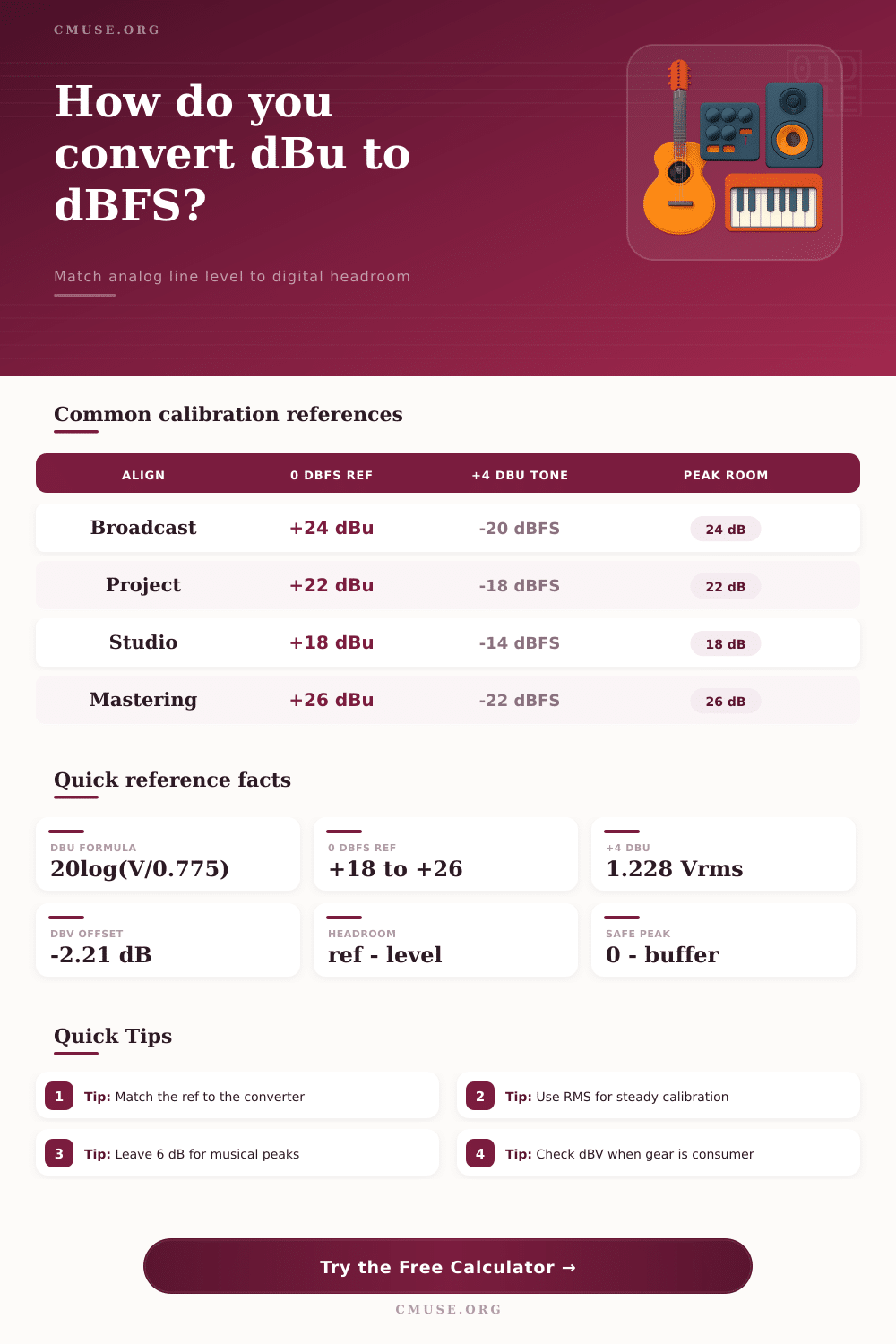
| Broadcast | +24 dBu | -20 dBFS | 24 dB |
| Project studio | +22 dBu | -18 dBFS | 22 dB |
| Modern studio | +18 dBu | -14 dBFS | 18 dB |
| Mastering | +26 dBu | -22 dBFS | 26 dB |
| dBu | Vrms | dBV | Note |
|---|---|---|---|
| -10 dBu | 0.245 | -12.21 | Consumer |
| 0 dBu | 0.775 | -2.21 | Line ref |
| +4 dBu | 1.228 | +1.79 | Pro line |
| +18 dBu | 6.158 | +15.79 | Hot peak |
| Scenario | Nominal | Crest | Safe Peak |
|---|---|---|---|
| Vocal chain | +2 dBu | 12 dB | -6 dBFS |
| Mix bus | +4 dBu | 10 dB | -8 dBFS |
| Drum bus | +6 dBu | 14 dB | -4 dBFS |
| Synth stack | +8 dBu | 9 dB | -9 dBFS |
Pick the calibration reference that matches the actual converter, not just the session loudness.
If peaks clip early, lower the analog send or switch to a hotter 0 dBFS reference.
dBu to dBFS conversion starts with a calibration point. This calculator maps line level to digital headroom, voltage, and peak safety so gain staging stays predictable.
You might find yourself in a situation in which the meter on your console read +4 dBu for a steady tone, yet your digital audio workstation display a clipping signal at –14 dBFS. This clipping occur when the signal level becomes too high for the digital system to process. This can happen due to the difference in scales used to represent analog and digital level.
To avoid clipping errors, it is important to understand the mathematical relationship between analog and digital levels. The level at which the analog to digital converter hit 0 dBFS can determine such a relationship. The unit dBu is used to represent voltage level relative to 0.775 volts RMS.
How to Match Analog and Digital Levels
This is the measurement that most professional audio console and outboard gear use. The unit dBFS stands for decibels relative to full scale and is used in digital audio systems. 0 dBFS on digital audio systems are the maximum level possible.
The specific hardware that are used in the recording and mixing environment determines the relationship between dBu and dBFS. For instance, in one studio interface +24 dBu might equal 0 dBFS yet in a different studio interface +18 dBu might equal 0 dBFS. Thus, if you dont know this relationship for the specific hardware in your situation, you cannot properlyly manage the gain on your analog gear.
The relationship between analog and digital level can be established by looking at the maximum output level that your digital to analog converter can reach. The relationship between analog and digital levels will be somewhere between +18 dBu and +26 dBu. You can use a 1 kHz sine wave to find this relationship in your mixing environment by feeding the 1 kHz sine wave at a level like +4 dBu and adjust the signal until the +4 dBu signal hits a level on your digital audio workstation.
It is important to know the voltage of the signal, as many piece of audio gear use Vrms or dBV in their specifications. For instance, +4 dBu is equal to 1.23 volts RMS. Knowing this information allows you to properly match consumer gear with professional gear and avoid signal mismatch.
Crest factor refers to the relationship of peak level to average level within a signal. Sine wave have a small crest factor since the difference between the RMS level and the peak level is only 3 dB. Yet, musical mixes has high crest factors with peaks that are 10 dB or 14 dB higher than the average level.
Thus, a buffer must be built into the levels of the musical mix to allow for these peaks to not hit 0 dBFS. For instance, you may want to set the levels of the musical mix 6 dB below 0 dBFS to provide headroom for the crest factor of the musical mixes. Since vocal programs have different crest factor than synthesizer programs, for example, you will have to adjust the levels accordingly in your mixing console.
It is common for people to make the mistake of assuming that +4 dBu represents -18 dBFS in a digital audio environment. However, this is only true for situations in which the reference level of analog levels is +22 dBu. Other professional environment use other reference points for these levels.
For instance, +24 dBu is another common reference level. At this reference level, +4 dBu will measure -20 dBFS. Thus, using the wrong reference point can lead to the analog to digital converter clipping the analog signal or the introduction of digital gain error and noise to the signal.
You can utilize voltage bridge to help convert analog values into digital values. Voltage bridges will relate dBV to dBu with dBV using 1 volt as its reference. Thus, dBV measurements are 2.21 dB more higher than dBu measurements at the same value.
Consumer audio gear tends to use -10 dBV as its standard level. Thus, -10 dBV is equivalent to -12 dBu. These conversion tool can assist with the swapping between digital units and analog units.
These conversions will be helpful when viewing the return path or insert loops of certain digital audio processing equipment. It should of been noted that there are many physical variable within a recording and mixing studio that mathematics alone cannot account for. For instance, analog to digital converter can drift in their measurements due to the temperature in the recording studio.
Similarly, op-amps can change the sound of a signal if push to high levels. For steady tones, RMS meters will provide the most accurately measurements. Yet, true peak meter should be used for musical programs.
An extra buffer should be provided in the levels of the musical programs for the drum within the mix since drums have high transients. Once you have properly balanced analog and digital levels, the analog faders will remain stable while the digital faders will control the balance between the different audio program in your mixing environment.