dBC Sound Weighting Calculator
Convert octave-band SPL into C-weighted level, compare dBZ and dBA, and adjust for distance and duty cycle.
🎛Measurement Presets
📏Distance and Time
📊Octave-Band SPL Input
🏚Key Sound Metrics
📐C and A Weighting Reference
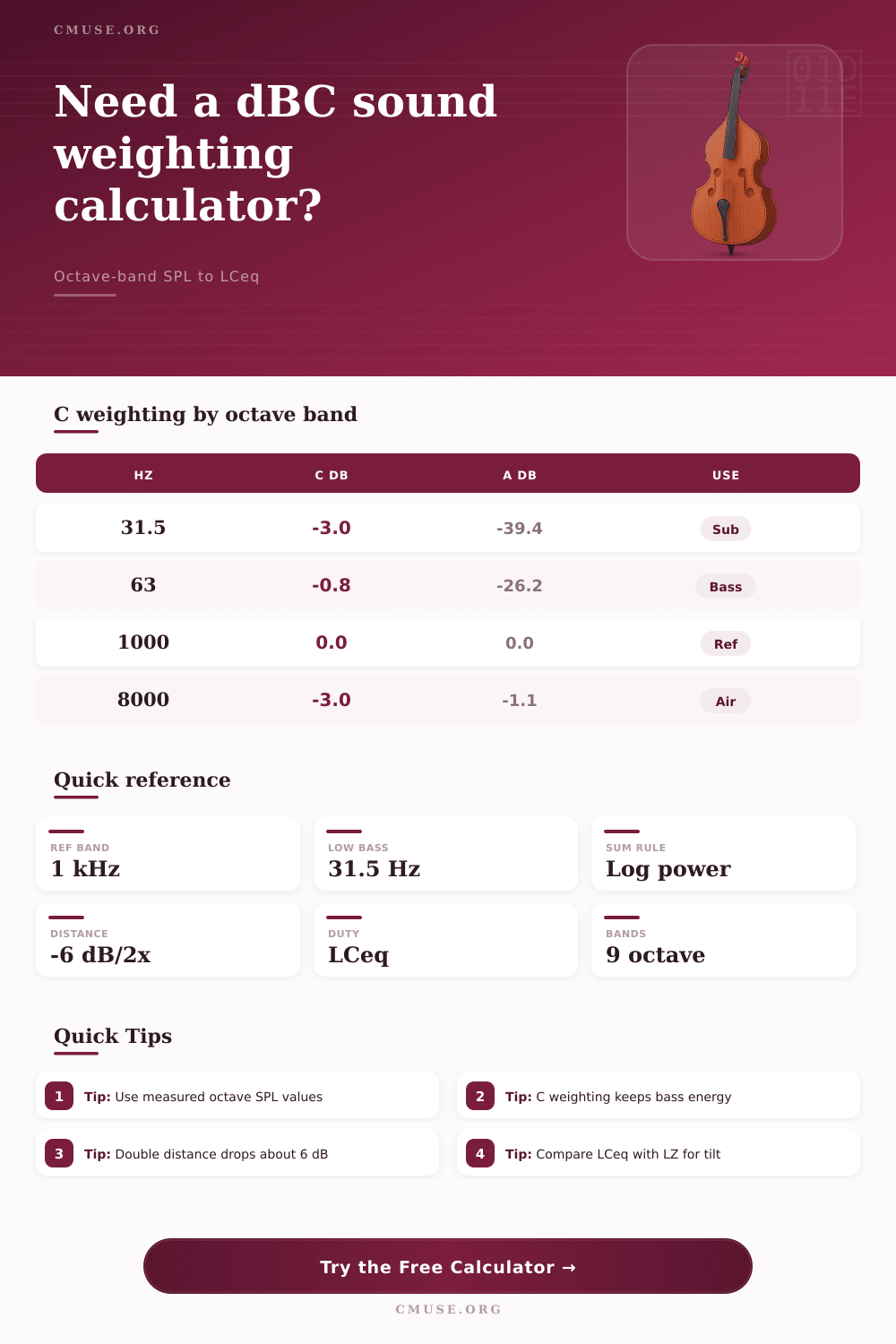
| Octave band | C weighting | A weighting | Musical relevance |
|---|---|---|---|
| 31.5 Hz | -3.0 dB | -39.4 dB | Sub fundamentals, LFE rumble |
| 63 Hz | -0.8 dB | -26.2 dB | Bass guitar, kick weight |
| 125 Hz | -0.2 dB | -16.1 dB | Floor toms, male vocal body |
| 250 Hz | 0.0 dB | -8.6 dB | Low-mid warmth |
| 500 Hz | 0.0 dB | -3.2 dB | Midrange density |
| 1 kHz | 0.0 dB | 0.0 dB | Reference band |
| 2 kHz | -0.2 dB | +1.2 dB | Presence and speech edge |
| 4 kHz | -0.8 dB | +1.0 dB | Attack and definition |
| 8 kHz | -3.0 dB | -1.1 dB | Cymbal air and hiss |
🔎Reading the Results
| Comparison | What it means | Typical clue | Use in audio work |
|---|---|---|---|
| LCeq near LZeq | C curve is nearly flat | Full-band or mid-led sound | Good quick level estimate |
| LCeq above LAeq | Low frequency energy is strong | Subs, kick, bass cabinets | Check room buildup |
| LZeq above LCeq | Extreme lows or highs dominate | Rumble or air-band lift | Inspect octave bands |
| Hourly below LCeq | Duty cycle is intermittent | Short checks or cues | Estimate equivalent exposure |
🎵Common Music and Audio Scenarios
| Scenario | Distance | Expected pattern | Best value to watch |
|---|---|---|---|
| Nearfield monitors | 3 to 6 ft / 1 to 2 m | Controlled mids, modest subs | LCeq versus LAeq |
| Sub alignment | 10 to 30 ft / 3 to 9 m | High 31.5 and 63 Hz bands | LCeq and low-band share |
| Drum rehearsal | 6 to 12 ft / 2 to 4 m | Broad peaks with strong lows | LZeq and LCeq |
| Vocal booth | 2 to 5 ft / 0.6 to 1.5 m | Low mids plus presence | LAeq comparison |
💡Calculation Notes
A-weighting and C-weighting are two different methods for measuring sound levels. Each of these method can result in different measurements of sound levels due to the way in which each of these methods filters the sound frequencys. A-weighting is teh standard setting for most basic sound meter.
A-weighting measurements ignore low-frequency sounds because human ears isnt very sensitive to those low frequencies. For these reasons, A-weighting is a helpful method of measuring damage to hearing, but it is not an accurate method of measuring the total amount of sound energy traveling through a room. C-weighting is another method of measuring sound levels, but the results of C-weighting are essentially flat across the audible frequency spectrums.
How A-weighting and C-weighting Measure Sound Levels
Because C-weighting does not ignore low frequencies, C-weighting measurements are helpful in situation in which raw measurements of bass energy need to be determined. By comparing the A-weighted sound level measurements to the C-weighted measurements, you can understand more about the characteristic of a given room. For example, if the A-weighted measurement is vastly different then the C-weighted measurement, the room is likely bass heavy.
If the A-weighted and C-weighted measurements are similar, the sound in the room is likely balance with a focus on the mid-range frequencies. Most people tend to miss this distinction and only consider one type of measurement. However, by considering both the A-weighted and C-weighted measurements of a room, it is possible to determine whether or not the space has a low-end buildup in its sound characteristics.
Additionally, by comparing these two measurement, it becomes possible to determine whether or not a subwoofer is performing its basic function within a room. Distance from the sound source is another variable in sound level measurements. Distance from the sound measurements changes because sound levels tend to even out as distance from the sound source increase.
For instance, the inverse square law state that if an individual doubles their distance from a sound source, the sound level will drop approximately six decibels. Thus, determining sound levels at three feet from a speaker and attempting to use that measurement to estimate sound levels at ten feet is inaccurate. In order to accurately measure sound levels in a space, you should account for the distance between the sound meter and the listener, as this will provide a more realistic estimate for sound levels in a specific seat within the venue.
The final factor that impacts sound level measurements is the duty cycle of the sound measurements. The duty cycle is the percentage of time that a sound are active. Not all sounds are constantly created by a source, so the sound level readings from a drum kit, for instance, will likely only reach a peak level of 110 decibels because the kit is not continuously producing that sound level for the entire hour.
By factoring in the duty cycle for sound measurements, it is possible to determine whether a specific space is too loud for long periods of time, or whether that space is simply loud in short burst. Presets can be used to compare the sound characteristics of an area to those of a standard home studio or cinema sound setup. These standards are beneficial for sound engineer because loudness is relative to the specific environment that is being measured.
For instance, a vocal booth require a different amount of energy than a drum room. The reference table include information about the different frequencies associated with those spaces. For instance, the 31.5 Hz frequency range includes subterranean rumble, while the 4 kHz frequency range include the energy of a snare drum kit.
Though there is no specific number to which sound engineers must aim in most case, understanding the sound energy of a room allows engineers to manage that rooms sound and ensure that the rumble felt in the space is the energy that is intended from the sound source.