Ctr Rating Calculator
Estimate Rw+Ctr, traffic-spectrum attenuation, composite facade loss, and indoor noise level from catalog or octave-band acoustic data.
🎚Real Ctr Presets
📏Rating Inputs
🏘Facade Or Room Surface
📊Octave-Band Transmission Loss
🧮Current Spec Grid
📐Traffic Spectrum Formula Reference
| Formula item | Calculator expression | Meaning | Typical range |
|---|---|---|---|
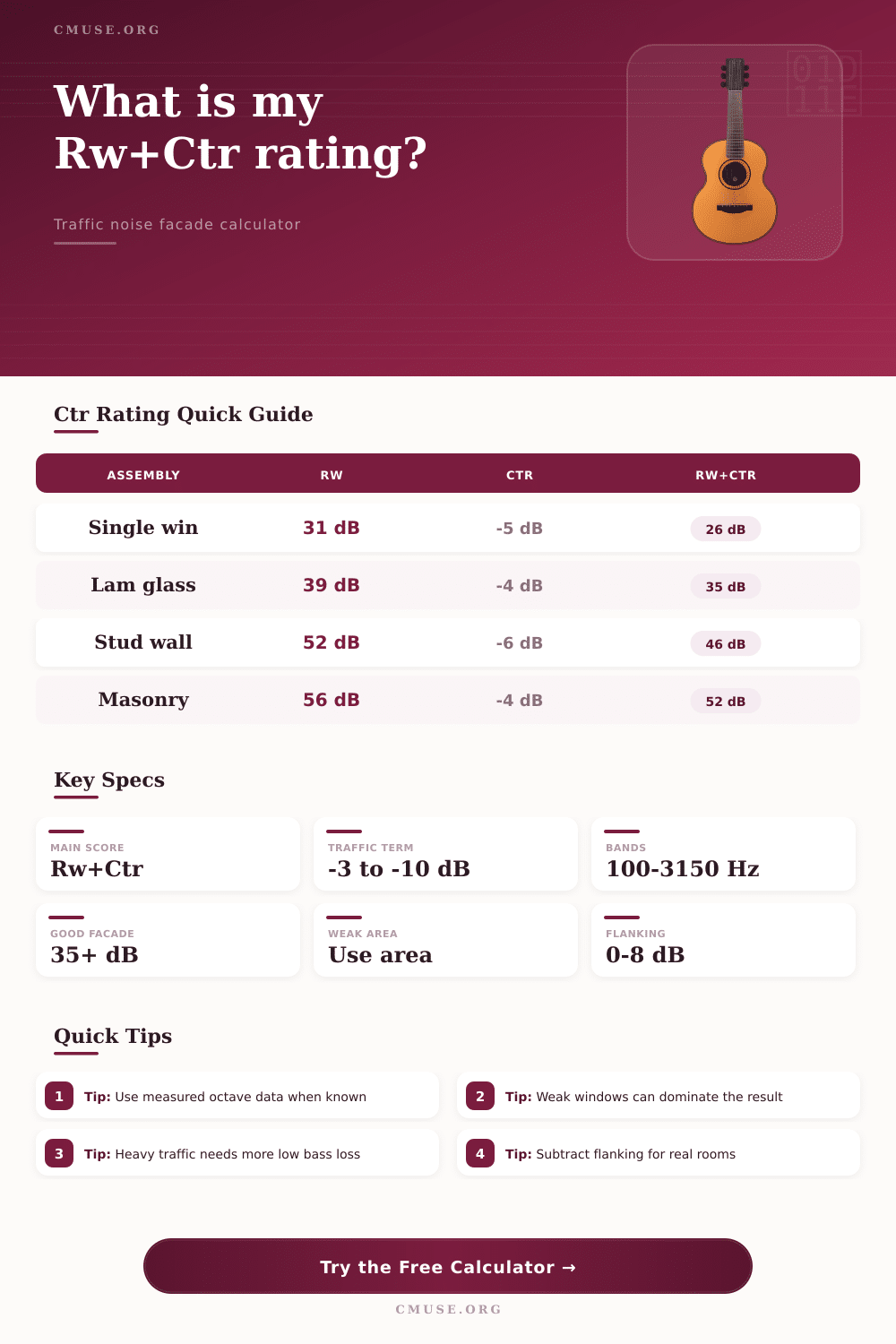
| Traffic rating | Rw + Ctr | Single-number facade rating for road-like low-frequency noise | 25 to 55 dB |
| Weighted TL | -10 log10 Σ(Wi × 10^(-Ri/10)) | Energy average of octave-band transmission losses | 20 to 60 dB |
| Estimated Ctr | Weighted TL - Rw | Spectrum adaptation term produced by the octave curve | 0 to -16 dB |
| Composite rating | -10 log10 Σ(Ai/At × 10^(-Ri/10)) | Area-weighted total facade performance | Weakest area led |
📋Reference Assembly Ratings
| Assembly | Typical Rw | Typical Ctr | Best use |
|---|---|---|---|
| Single 6 mm window | 30 to 32 dB | -5 to -7 dB | Low exposure rooms |
| Laminated acoustic glass | 38 to 42 dB | -3 to -5 dB | Urban road facades |
| Secondary glazing | 45 to 52 dB | -5 to -8 dB | Studios near traffic |
| Insulated stud wall | 48 to 54 dB | -5 to -8 dB | Music rooms and practice spaces |
| Dense masonry wall | 54 to 60 dB | -3 to -6 dB | High mass perimeter walls |
🚦Spectrum Weight Table
| Traffic profile | Low-band emphasis | Primary risk | Use when |
|---|---|---|---|
| Urban road | Balanced 100 to 500 Hz | General facade leakage | Cars, buses, mixed streets |
| Heavy truck route | Strong 100 to 250 Hz | Low-frequency weakness | Freight roads or loading routes |
| Rail or tram | Strong 125 to 500 Hz | Pass-by rumble and wheel noise | Rail corridor facades |
| Aircraft approach | Broad 100 to 1000 Hz | Roof and glazing paths | Low-altitude approach zones |
| Bass-heavy venue spill | Very strong 100 to 250 Hz | Music bass transmission | Clubs, rehearsal rooms, venues |
🏢Common Project Size Table
| Scenario | Surface size | Common rating target | Secondary check |
|---|---|---|---|
| Small practice room | 3.0 m × 2.4 m wall | Rw+Ctr 35 dB | Door seal penalty |
| Home studio facade | 4.8 m × 2.7 m wall | Rw+Ctr 38 dB | Window area share |
| Street-facing venue | 8.0 m × 3.5 m facade | Rw+Ctr 45 dB | Glazing and vents |
| Roof below flight path | 6.0 m × 5.0 m ceiling | Rw+Ctr 42 dB | Low-frequency TL |
💡Calculation Tips
The Rw rating are an average of the performance of a wall with various forms of sound energy, but it fail to account for the energy of road traffic. People uses the Rw rating because it has a generalized number that describes the sound energy blocking capabilities of a wall. However, the Rw rating is misleading because road traffic contain a high amount of bass energy.
To account for the energy of road traffic, the acoustic calculator use the Ctr rating. The Ctr value is a negative number that is subtracted from the Rw rating so that the noise levels that will enter the room is accurately represented. If the Ctr rating is ignored, the Rw rating will represent the sound energy blocking capabilities of the facade in the best case scenario.
Why Rw Is Not Enough for Road Noise
For instance, a building may have a high Rw rating for its facade, but it may have a poor capability of blocking low-frequency energy from urban roads. To determine the Rw and Ctr ratings for a building or facade, there must be a selection of the specific traffic profile that will exist in the building. There is various traffic profiles, each with different amounts of low-frequency energy, for areas with urban roads have less low-frequency energy than areas with train lines or heavy truck routes.
The Rw and Ctr calculations math change because there are different amounts of low-frequency energy. The different types of bass noise that are created in different environments will change the Rw and Ctr calculations. For example, the Rw and Ctr ratings of a building may be sufficient to block the sound of a quiet suburb, but it may not be sufficient for a building located next to a tram line.
Hence, the acoustic planning has to select the specific sound frequency spectrum of the environment to be accurate. A wall’s Rw and Ctr ratings does not reflect the power of a wall to block sound energy if the weakest parts of the wall cannot resist that sound energy. The energy of sound waves add up logarithmically.
This means that the weakest part of a buildings facade can significantly impact the performance of the rest of the facade. The acoustic calculator accounts for this by weighing the area of the weakest parts of a building against the area of the entire buildings facade. For instance, if a building have a large masonry wall and a small window, the window will have a higher impact on the sound energy levels inside the building than the masonry wall.
This is because the window will allow more noise into the building than the masonry wall. Thus, a single weak part of a building can nullify the acoustic performance of the other parts of that buildings facade. Sound energy travel through other paths in addition to the walls of a building.
These paths are referred to as flanking and leakage. For example, sound does not travel through the walls of a building; it also travels through the floors, ceilings, and doors of a building. Because sound energy travels through these different paths, a penalty term must be added to the Rw and Ctr calculations.
This acoustic penalty term account for the fact that even if a buildings facade is the best in the world at reducing the amount of sound energy that enters the building, the sound will still travel to the building through other means. Therefore, if the acoustic penalty term is not subtracted from the Rw and Ctr ratings, the noise levels that will be calculated for the interior of the building will not match the actual decibel levels that will exist in the interior of that building. The goal of acoustic calculations is for the interior of a building to reach a specific target in terms of noise levels.
If the exterior noise level is higher then the sound energy loss of the buildings facade, then there is no margin of safety. This means that the materials used in the construction of the building may need to be changed. The type of glazing that is used in the windows of the building may need to be changed from single glazing to laminated acoustic glazing or secondary glazing.
By accounting for all the factor described above, it is possible to go from guessing the level of noise that will exist inside a building to engineering the building to reach a specific target of noise levels. These specific measurement will allow the acoustic calculations to be accurate and provide acoustic results that meet the needs of the building and its occupants.