Crossover Network Calculator
Estimate passive speaker crossover parts for high-pass, low-pass, and band-pass networks.
🔌 Network Inputs
📊 Formula Reference
| Type | Low/High | Parts | Use |
|---|---|---|---|
| 1st HP | C = 1/(2piRf) | 1 cap | Tweeter |
| 1st LP | L = R/(2pif) | 1 coil | Woofer |
| 2nd HP | C and L | 2 parts | Steeper |
| 2nd LP | L and C | 2 parts | Smoother |
🎵 Common Network Values
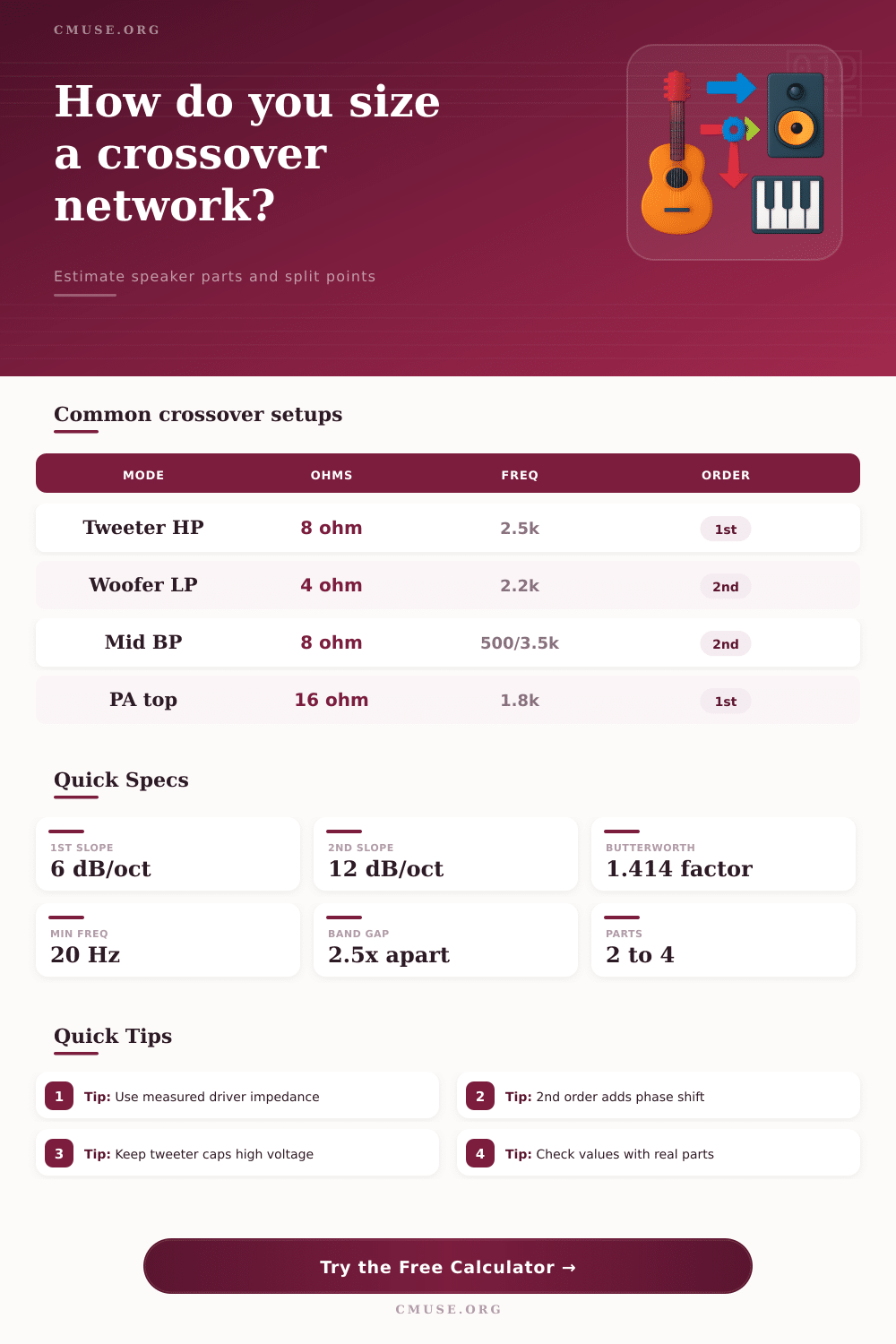
| Build | Ohms | Freq | Notes |
|---|---|---|---|
| Tweeter HP | 8 ohm | 2.5 kHz | Fast start |
| Woofer LP | 4 ohm | 2.2 kHz | Good handoff |
| Mid BP | 8 ohm | 500/3.5k | Band-pass |
| PA Top | 16 ohm | 1.8 kHz | Wide use |
🔧 Component Reference
Crossover network is a circuit that divides the frequency spectrum of an audio signal into two or several parts so that each goes to a different speaker. Imagine the sound as a river that flows through a channel network. Here the crossover acts as a guard that forces the water in different ways.
You occasionally call it the “brain” of the speaker
How a Speaker Crossover Works
Woofer or subwoofer do not reproduce high frequencies well. Tweeter could self-destruct if you ask it to play bass. Hence three- and four-way speaker systems are common in many cars, which requires crossover networks.
The tweeter cares about high sounds, the woofer about low and the subwoofer about ultra-low. The spot where high frequencies pass the low is called the crossover point.
The most speakers have several drivers and use crossover networks to lead right freuquencies to each of them. Combinations of capacitors, coils and resistors direct high frequencies to the tweeter and low to the woofer. You could send full spectrum to all drivers at once, but they would fail to sound well outside their range.
That causes strong distortion and even damage while they struggle. The crossover network simply splits the sound between the drivers.
Passive crossover networks probably are the most common in audio. They are made up of passive electrical components like capacitors, coils and resistors that divide the amplified signal from one power amplifier so that it goes to two or more drivers. In a simple two-way box, the net has a low pass filter for the woofer and high pass for the tweeter.
You can build them from various bits. Even a single capacitor could work as a crossover, but usually the net itself is more important than the drivers.
Crossover points and slopes you choose according to the parameters of the used speakers. Otherwise some drivers would work outside their best range, which brings distortion or wrong rolloff. Designers must carefully choose right drivers and later design the crossover so that everything fits well.
Passive crossovers waste energy and are less efficient than active. Active crossover networks sit before the amplifier and use a separate amplifier for every way. A well made crossover must give a flat response and linear phase.
It lets every driver work in its best range without wasteof power that it could not use.