Course Pair Tension Calculator
Compare the two strings in a mandolin, bouzouki, octave mandolin, or 12-string guitar course using scale length, tuning, gauge, construction, octave spacing, and detune offsets.
Choose a real paired-string starting point, then adjust the course note, scale, gauges, pair interval, and tuning offsets. Tension is estimated with the standard string formula using unit weight, scale length, and frequency.
Course Pair Breakdown
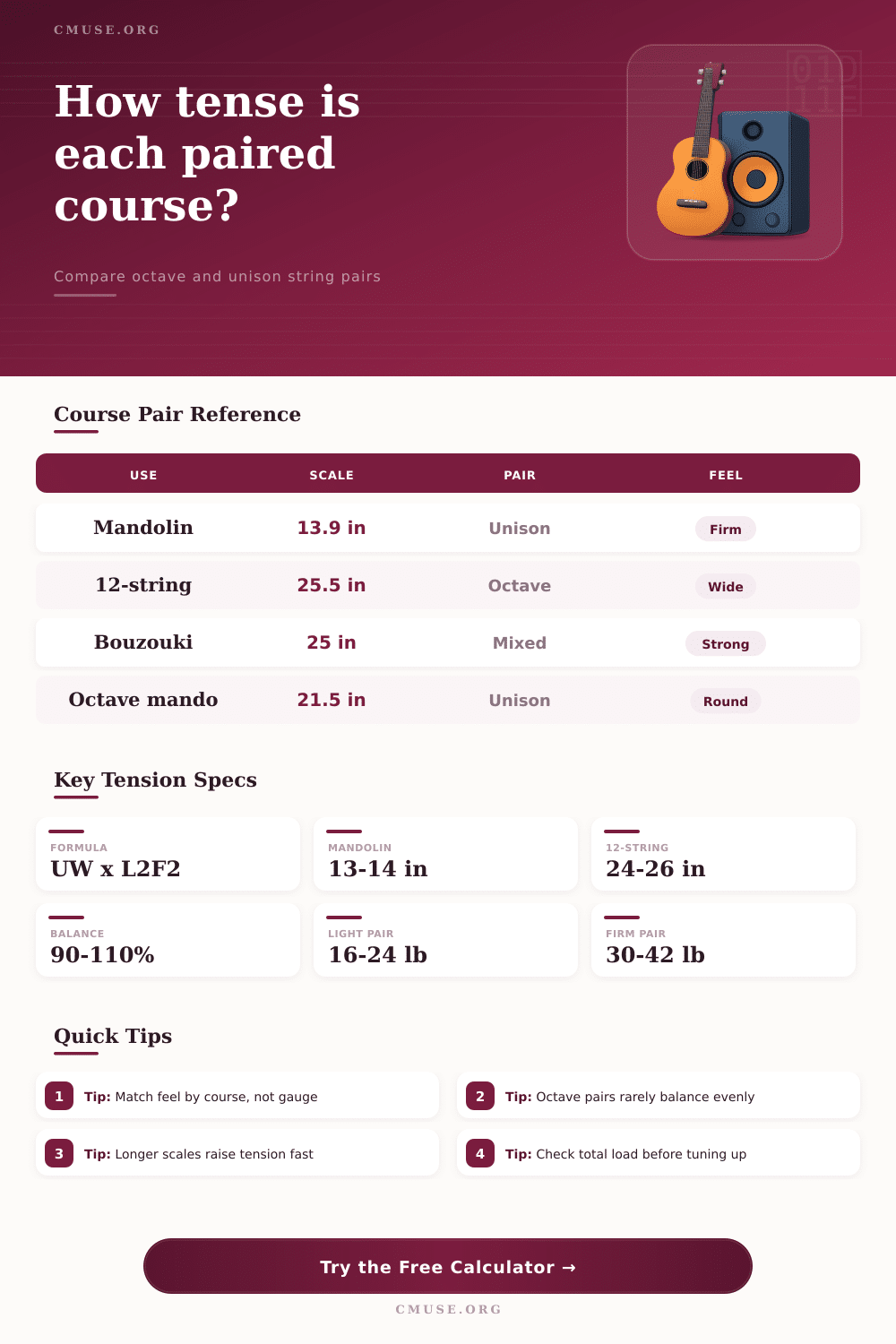
T = UW x (2 x L x F)^2 / 386.4F = A4 x 2^((MIDI - 69) / 12)pair tension = main tension + partner tensionbalance = lower tension / higher tension x 100Inch-pound gravity constant in string formula
Common mandolin scale length
Long-scale 12-string guitar reference
Octave-pair frequency relationship
Comfortable unison pair balance zone
Common octave course balance window
Four-course mandolin-family layout
Six-course octave and unison guitar layout
| Preset | Scale | Course | Typical Gauges | Pair Style |
|---|---|---|---|---|
| Mandolin E Unison | 13.875 in / 352 mm | E5 | .010 / .010 plain | Bright unison |
| Mandolin G Unison | 13.875 in / 352 mm | G3 | .040w / .040w | Firm unison |
| 12-String G Octave | 25.5 in / 648 mm | G3 and G4 | .024w / .010 plain | Octave shimmer |
| 12-String Low E Octave | 25.5 in / 648 mm | E2 and E3 | .047w / .027w | Bass octave |
| Irish Bouzouki D | 25.0 in / 635 mm | D3 | .036w / .036w | Open unison |
| Octave Mandolin A | 21.5 in / 546 mm | A3 | .026w / .026w | Round unison |
| Construction | Model Behavior | Common Pair Use | Balance Notes | Calculator Factor |
|---|---|---|---|---|
| Plain steel | Solid round steel core | Mandolin E, 12-string octave partners | High pitch at small gauges | Full circular area |
| Nickel wound | Steel core with nickel wrap mass | Electric 12-string and mandolin-family courses | Smoother feel than bronze at similar gauge | Wound mass factor 0.74 |
| Phosphor bronze wound | Bronze wrap with higher density | Acoustic 12-string and bouzouki sets | Often needs lighter gauges on long scales | Wound mass factor 0.78 |
| 80/20 bronze wound | Bright bronze wrap mass | Bright 12-string courses | Similar tension trend to phosphor bronze | Wound mass factor 0.76 |
| Flatwound nickel | Dense, smoother wrap profile | Electric octave or specialty sets | Can feel stiffer than roundwound | Wound mass factor 0.84 |
| Silk and steel wound | Lower effective metal mass | Gentler acoustic 12-string courses | Useful when total set load is high | Wound mass factor 0.66 |
| Instrument Zone | Scale Range | Typical Pair Type | Tension Effect | Practical Use |
|---|---|---|---|---|
| Mandolin | 13-14.5 in / 330-368 mm | Unison pairs | Short scale allows high E tuning | Small gauges, crisp double-stop response |
| Mandola | 15.5-17 in / 394-432 mm | Unison pairs | Lower tuning offsets longer scale | Useful for CGDA courses |
| Octave mandolin | 20-22.5 in / 508-572 mm | Unison pairs | Longer scale needs moderated gauges | Warm GDAE octave range |
| Irish bouzouki | 24-26 in / 610-660 mm | Unison or octave mixed | Long scale raises low-course load | Open GDAD and ADAD tunings |
| 12-string guitar | 24.75-25.5 in / 629-648 mm | Octave basses, unison trebles | Total neck load becomes the main limit | Balanced shimmer without overloading top |
| Baritone 12-string | 26.5-28 in / 673-711 mm | Lower octave pairs | Lower pitch helps offset long scale | B or C standard paired courses |
| Balance Result | Meaning | Unison Course | Octave Course | Adjustment Idea |
|---|---|---|---|---|
| Below 65% | One string is much softer | Usually uneven picking feel | Can be acceptable only for special shimmer | Raise the lighter gauge or lower the heavier gauge |
| 65-80% | Noticeably offset pair | Often feels lopsided | Common for some 12-string bass courses | Check octave partner gauge first |
| 80-90% | Slightly uneven pair | Playable with careful setup | Healthy octave-course territory | Use if the sound is intentionally airy |
| 90-110% | Closely balanced | Ideal unison-pair window | Very even octave-course response | Good target for mandolin-family unisons |
| 110-130% | Partner leads the feel | May pull attack to one string | Often still usable for octave sparkle | Reduce the tighter string gauge slightly |
| Above 130% | Strong mismatch | Usually needs a gauge rethink | Can sound sharp-edged and uneven | Rebalance gauges before final setup |
| Instrument | Courses | Common Total Load | Watch Zone | Notes |
|---|---|---|---|---|
| Mandolin | 4 paired courses | 130-180 lb / 578-801 N | Above 190 lb | Small body and tailpiece feel changes quickly. |
| Mandola | 4 paired courses | 130-175 lb / 578-778 N | Above 185 lb | Lower tuning offsets the longer scale. |
| Octave mandolin | 4 paired courses | 120-170 lb / 534-756 N | Above 180 lb | Long scales favor moderate wound gauges. |
| Irish bouzouki | 4 paired courses | 135-190 lb / 601-845 N | Above 205 lb | GDAD sets vary widely by scale and top strength. |
| 12-string guitar | 6 paired courses | 220-300 lb / 979-1334 N | Above 330 lb | Top and neck load matter more than one course. |
| Baritone 12-string | 6 paired courses | 230-320 lb / 1023-1423 N | Above 350 lb | Lower tuning helps but long scales add load. |
Snap! A quick little ping and a string just snapped mid strum. If you have ever plucked away at a twelve string, played a bouzaki or mandolin, this sound is enough to scare the socks off you. But what do we do now? Why did this string break and not it’s partner? The answer lies in math.
It asks how much tension a line can support over a given distance. On a pair of strings sharing the same space, when they are running parallel to each other, one will snap and hold on tight to next. It’s almost never random. Although it appears as such, it really isn’t.
Why Strings Break
It doesn’t matter how well you pick or which picks you prefer; the physics dont give a damn about any of it. It’s all about mass, frequency, and scale length. On a standard mandolin, distance from bridge to nut isn’t far, so it maintain reasonable amounts of tension even when tuned high. But that same gauge on a longer scale will quickly increase in tension.
By entering the details of your set-up, the calculator does heavy lifting for you. No need to remember some formula with gravity constants and unit weight. All you have to know is this: longer = lighter if you want to be good to the neck.
That’s all well and good for the two strings that make up a pair. It gets interesting when you consider how they relate to one another. On a mandolin unison pairs of string are simple; they’re paired and both strings vibrates on the same note. And if you use the same gauge, then they pull equally hard.
It’s a different story on a twelve-string guitar with octave pairs. Because one of the strings is vibrating at double the speed (the octave), that alter the equation. In order for the pair of strings to play evenly without feeling like one is slack and the other taut, the octave partner need to be significantly thinner. You can’t really match gauges on an octave pair and expect it to work unless you want the upper string breaking off instantly or sounding dead and lifeless.
Most folks make set swapping errors. They glance over a set of gauges in a catalog, conclude the thicker sound better, and then think nothing of the added stress it will put on their instruments’ bridge and tailpiece. Remember, there is almost three-hundred pounds of total tension across all six courses on a 12-string guitar. That’s enough mass to dent soft woods if not controlled.
If you use heavier strings to get more depth or volume, they can puts too much stress on a vintage guitar top. It isn’t about loudness, but rather maintaining the integrity of your instrument.
It also understands materials. Casual players may not realize that different types of strings behaves differently. Wound strings aren’t made the same as plain steel ones because of their density and construction. They’re constructed and more denser. So a wound bass string should of been tuned to a higher pitch than a plain steel octave string with the exact same tension.
The unit weight takes into account these material variations and automatically adjusts based off those differences. No need to figure out the relative density of nickel wrap vs phosphor bronze yourself. Just tell it what kind of strings you intend to purchase. The math will adjust to match how that particular metal vibrates and stretches given the tuning you’ve selected.
The feeling of the instrument can be affected slightly by tuning changes as well. Many players prefer to have some shimmer to their instruments which comes from intentional chorus spreads and small amounts of cent offsets. Although having a few cents off won’t make much difference in total tension load, it does impact the way the pair work together on sustain. You may find that a slightly loose string starts to flutter against the neighboring string. This causes a buzz that sounds like an error but is realy just bad balance.
Balancing the percent on the pair gives you an idea if they’ll be singing or fighting each other for dominance in the mix. A paired-course instrument is a dance with compromises. Tension should be high enough to provide stable intonation and clear articulation without being excessive and causing fret-out issues or structural damage. Perfection isn’t the objective of any single digit. Harmony is what’s desired throughout the set.
Once you get it through your head how one string broke when its partner didn’t, then you quit complaining about luck and look at the relationship between pitch, gauge, and scale instead. That mental switch makes what was once a frustrating repair session become a workable setup routine. You will spend less time fixing broken strings and more time playing them all together in tune until the song is over.