Corner Loading Gain Calculator
Estimate low-frequency SPL lift from nearby room boundaries, then check wavelength fit, modal risk, and whether the position behaves like free space, wall loading, edge loading, or deep corner loading.
Placement presets
Room and source inputs
Calculation breakdown
Loading snapshot
Boundary contribution table
| Boundary | Distance | Wavelength fraction | Proximity factor | Gain contribution | Note |
|---|
Axial mode proximity table
| Axis | Dimension | Nearest mode | Mode frequency | Offset | Risk note |
|---|
Placement comparison table
| Category | Boundaries | Typical gain | Best use | Watch for |
|---|
Room loading grid
| Front / side distance | 0.03 lambda | 0.06 lambda | 0.12 lambda | 0.25 lambda |
|---|
Two practical tips
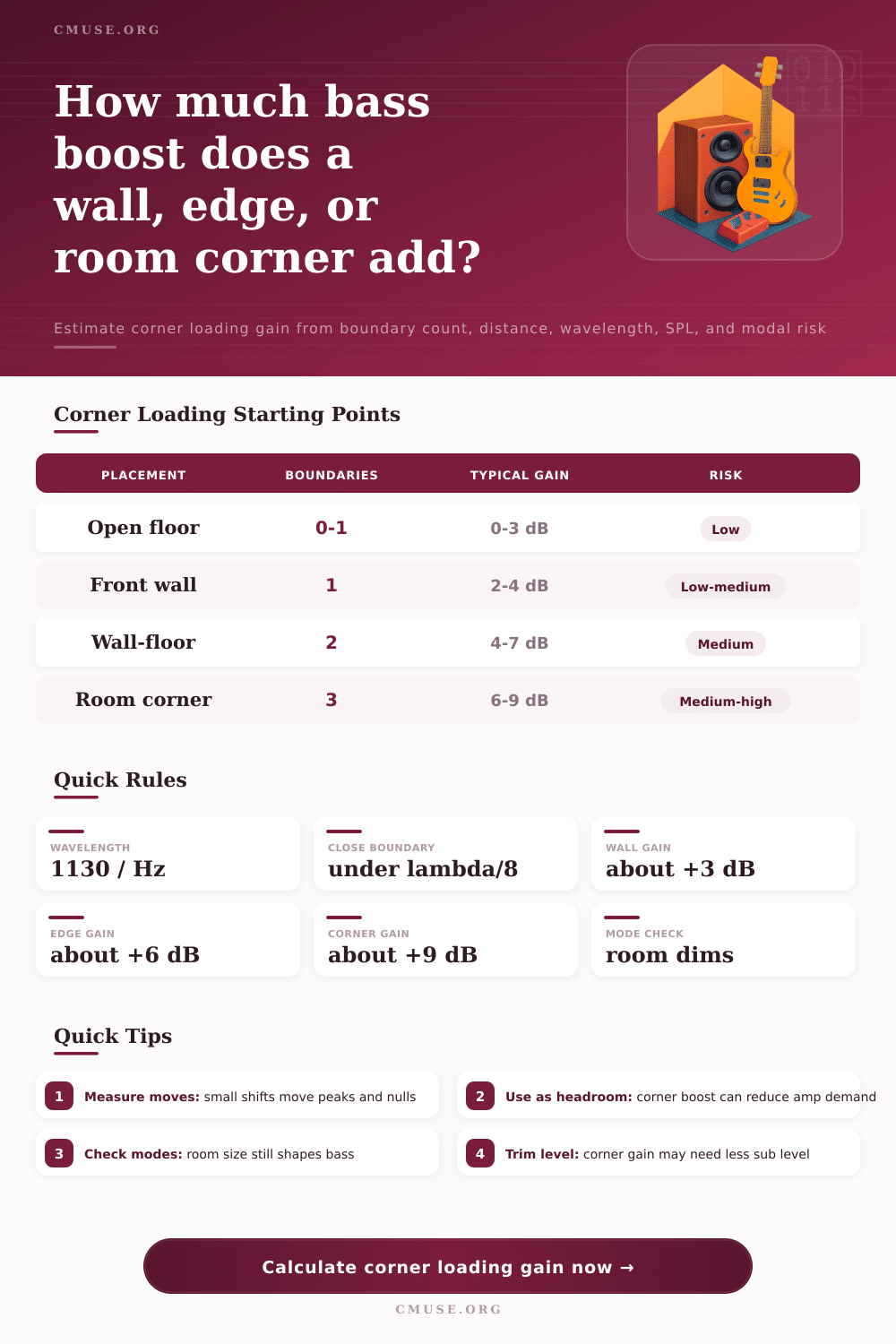
What this means is that before you hear the sound well, you feel it in your chest. Because of the geometry of the room, low-frequency sound interact with the space. When you push bass into a space, you are moving air. The long wavelengths reflect off every wall and floor sending them right back to there point of origin. The reflections builds up to create what we call corner loading gain. You get free power, but watch out for distortion or muddiness.
Physics is straightforward, although applying it is not so clean. Adding a boundary double sound pressure. This happens as long as the distance to that boundary is much smaller than wavelength. A single wall provides three dB of lift. You get six dB on a corner formed by two walls. A trihedral corner theoreticaly provides nine dB. That’s some serious lift.
How Room Corners Boost Bass
You get one-sixteenth the power out of your amp at the same listening level as in free space. The tool do the calculations for your target frequency/ies and distances. Saves you from guessing which way this boost will impact your setup.
What does it mean when I say distance? Well, in this case, it’s not an absolute distance such as six inches. It is related to the wavelength of the sound being produced. The wavelength of bass at 40 hertz is almost thirty feet. So being six inches away from the wall are actualy quite close acoustically speaking. At 200 hertz, that space is pretty much infinite.
Now most folks position their speakers aesthetically not by how the wavelength behave in the room. What happens then is you have uneven response, some notes go into boom while other notes dissapears. You’re putting yourself next to the standing waves formed from your rooms dimensions. Modal risk is when tool asks for the room size to scan for the possibility of room modes. Many times people miss here. They want to chase gain, but they fails to check if the increased frequency matches a room mode.
If you have an axial mode and your targeted bass note also happens to be the same, you’ll see a sharp peak. However, that peak have a location. Move your head three inches left and poof! The peak is gone. You now have a listening experience that is only good in one specific chair.
Here’s where the boundary count impact frequency. Real walls are not perfect reflectors. They have mass and they leaks some sound into adjoining spaces. Depending on construction, they can absorbs some frequencies. The size of the room also play a role. How thick are the walls? Is it heavy construction, or just sheetrock (drywall)? Are there lots of windows and doors? Absorption matters more then you think, depending on what the walls is made of. Keep that in mind when plugging numbers into calculator. Enter a percentage of absorption loss.
Here is an example: Speakers also affect how predictable boundary gain is. Open baffle speakers or dipoles don’t work as well with boundaries due to rear wave cancellation disrupting reinforcement effect. That being said, monopoles are pretty consistent. If you plan to manage boundary gain, then use monopoles. Monopole subwoofers behave more predictably, which is why they are the standard for managing corner gain.
You want boundaries to offload some of the workload from your amp. You’re aiming for a smooth enough frequency response to prevent need for severe equalization. Equalization is a double-edged sword. Too much can phase-shift the signal and cause it to be sluggish in terms of timing. Better balance come from placement, not digital filter curves. Often physical tweaks are bigger than the software fixes.
Use the calculator as your starting place, but ultimately the ears will have the final say. You want headroom gain, but not so much that you amplify resonances of the room. It’s not simply a matter of generating, but harnessing energy. If you know that boundaries reinforce sound, you cease to fight the room. What used to be a boom becomes a tight and controlled rumble in your chest. Respect the geometry, and the gain is there for the taking.