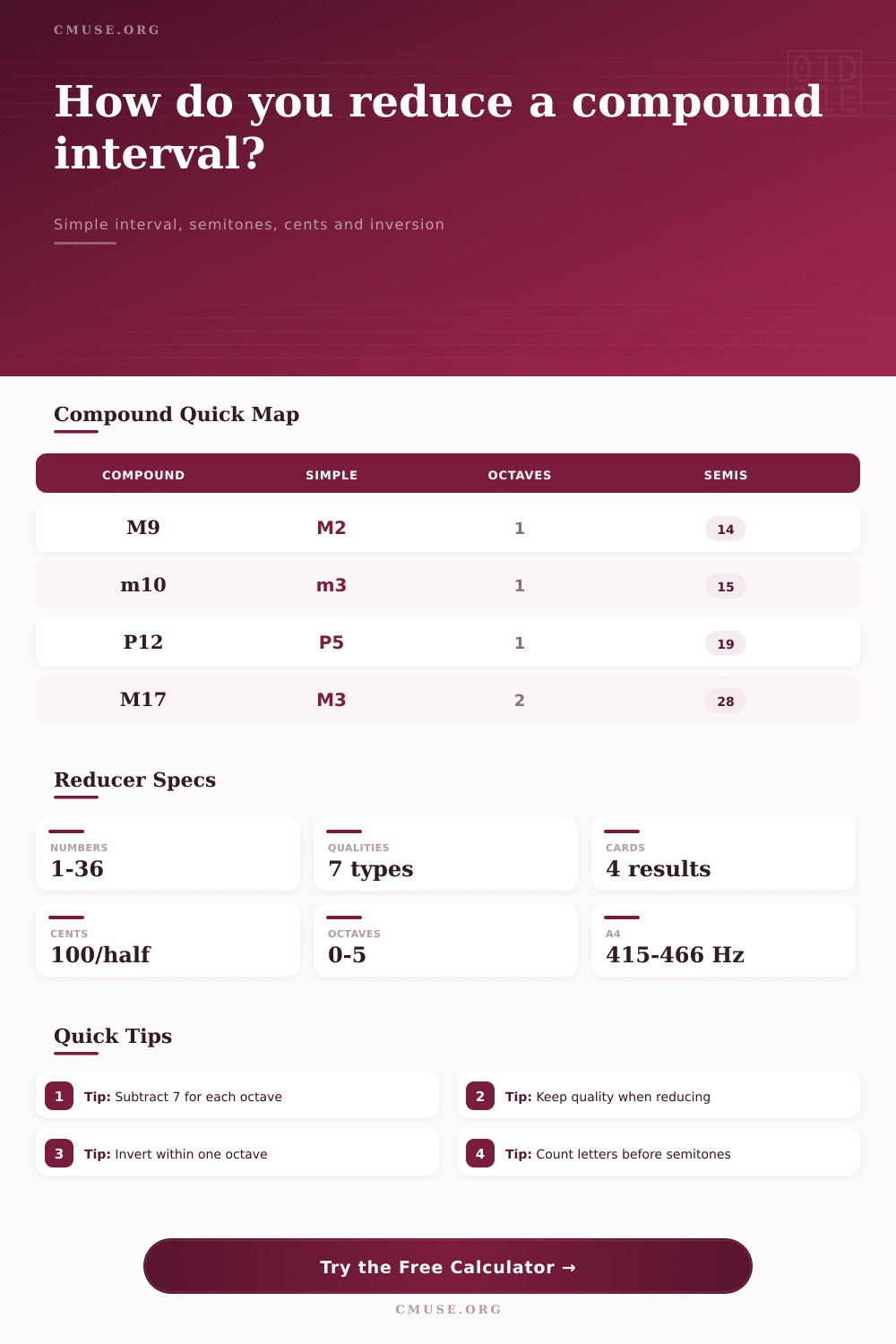
Compound Interval Reducer Calculator
Reduce ninths, tenths, elevenths, thirteenths, seventeenths, and larger written intervals into simple interval names, octave displacement, semitone totals, inversions, cents, ratios, and optional note spelling.
🎯 Compound interval presets
⚙ Interval inputs
Reduction Breakdown
📌 Interval quality comparison grid
Perfect-Type
Unisons, fourths, fifths, and octaves reduce to 1, 4, 5, or 8. Their stable quality is perfect, diminished, or augmented.
Major-Type
Seconds, thirds, sixths, and sevenths reduce to 2, 3, 6, or 7. Their close pair is major or minor.
Compound Name
A 9th acts like a 2nd plus one octave. A 17th acts like a 3rd plus two octaves.
Sounding Class
After removing full octaves, the chromatic class lands between 0 and 11 semitones.
📊 Simple interval reference
| Simple Number | Perfect/Major Form | Base Semitones | Common Compound Forms |
|---|---|---|---|
| 1 | Perfect unison or octave class | 0 | P1, P8, P15, P22, P29, P36 |
| 2 | Major or minor second | M2 = 2, m2 = 1 | 2nd, 9th, 16th, 23rd, 30th |
| 3 | Major or minor third | M3 = 4, m3 = 3 | 3rd, 10th, 17th, 24th, 31st |
| 4 | Perfect fourth | 5 | 4th, 11th, 18th, 25th, 32nd |
| 5 | Perfect fifth | 7 | 5th, 12th, 19th, 26th, 33rd |
| 6 | Major or minor sixth | M6 = 9, m6 = 8 | 6th, 13th, 20th, 27th, 34th |
| 7 | Major or minor seventh | M7 = 11, m7 = 10 | 7th, 14th, 21st, 28th, 35th |
🎵 Compound reduction table
| Compound Interval | Number Math | Reduced Interval | Typical Semitones |
|---|---|---|---|
| Major 9th | 9 - 7 = 2 | Major 2nd | 14 total, 2 simple |
| Minor 10th | 10 - 7 = 3 | Minor 3rd | 15 total, 3 simple |
| Perfect 11th | 11 - 7 = 4 | Perfect 4th | 17 total, 5 simple |
| Perfect 12th | 12 - 7 = 5 | Perfect 5th | 19 total, 7 simple |
| Major 13th | 13 - 7 = 6 | Major 6th | 21 total, 9 simple |
| Minor 14th | 14 - 7 = 7 | Minor 7th | 22 total, 10 simple |
| Perfect 15th | 15 - 14 = 1 | Perfect octave class | 24 total, 0 simple |
🔀 Quality and inversion table
| Quality | Major-Type Adjustment | Perfect-Type Adjustment | Inverts To |
|---|---|---|---|
| Doubly diminished | Major base - 3 | Perfect base - 2 | Doubly augmented |
| Diminished | Major base - 2 | Perfect base - 1 | Augmented |
| Minor | Major base - 1 | Not standard | Major |
| Perfect | Not standard | Perfect base | Perfect |
| Major | Major base | Not standard | Minor |
| Augmented | Major base + 1 | Perfect base + 1 | Diminished |
| Doubly augmented | Major base + 2 | Perfect base + 2 | Doubly diminished |
🏷 Chord extension reduction table
| Written Extension | Reduced Scale Degree | Simple Interval Above Root | Reading Note |
|---|---|---|---|
| 9th | 2nd | Major or minor second | Usually color tone, not chord root repeat |
| 11th | 4th | Perfect or augmented fourth | #11 reduces to augmented fourth or tritone |
| 13th | 6th | Major or minor sixth | Often read as the sixth placed above the seventh |
| 15th | 1st | Octave class | Double octave, same pitch class as the root |
| 17th | 3rd | Major or minor third | Two octaves plus a third |
🧮 Interval spec cards
9ths
One octave plus a second.
10ths
One octave plus a third.
11ths
One octave plus a fourth.
12ths
One octave plus a fifth.
You are in the middle of a busy orchestral score or jazz chart and stumble across a big leap on the staff. You pause, count each line and space until you find the note and your brain begin stuttering. It’s not an uncommon experience for many players and not a pleasant one.
What your ear wants to hear is something easier then what it sees. Simplifying compound intervals make reading music easier. It’s a simple idea.
How to Make Big Music Jumps Easier
The simplest form of repeating a pitch are called an octave. As soon as you go beyond an octave, the interval gets longer (seven notes more), and the quality remain the same. Stretching a major second over an octave become a major ninth. Add another octave underneath a perfect fifth, and you have a perfect twelfth.
Your ear doesn’t have to think about how wide something is; it just has to hear what it sounds like. That big leap becomes a simple interval, and the mental friction go away. You no longer count; you simply hear.
Let’s go back to our initial example. The calculator does all of the maths for us. It removes the octaves, leaving only basic interval inside. You can play without counting out how much you need to subtract in your mind.
There is a catch, and it’s one that catches a lot of people. It isn’t as simple as taking seven away and you are finished. You need to maintain the staff spelling.
So if we had a perfect eleventh then the maths tell us we should of take seven away and we end with a fourth. The quality remains intact. On the other hand, if we have an augmented eleventh then what gets reduced to is an augmented fourth. The calculator understand this and accounts for it to keep the quality.
So you don’t mistakenly call an augmented fourth a perfect fourth because you counted out the semitones and didn’t notice. That makes a difference when trying to analyse the harmony or transposing by ear.
How does this apply practicaly when improvising or arranging? What do you think of when you see a thirteenth chord symbol written on a chart? It is most likely the sixth scale degree.
And that’s right if we’re talking about pitch class, but wrong if we consider function. The thirteenth will frequently be found above the seventh with the harmony sitting high in the texture. So it has different potential voice-leading possibilities compared to a plain old sixth.
Hearing the interval as a sixth help you understand the harmony. However, knowing it is a thirteenth tells you where that note sits in the voicing. It is an extension, not a replacement. This alters the way you’ll choose to approach your chord voicings and also melodic lines.
Another level of refinement in tuning is through frequency and cents. Using these two values, the tool actualy translates the semitone count into cents, which gives you a granular view of the distance between notes. That’s useful if you’re working with non-standard tunings or just intonation as opposed to the majority of pianist who stick to equal temperament.
The tool comes with some handy reference tables that explain relationship simply. These illustrate where the ninths, tenths and elevenths fall in relation to their simpler counterparts.
The inversion part is where you can miss the point easily. If you take number of intervals in each case and add them together they total nine. In compound intervals, the octave displacement change but the principle applies. For example, a major tenth become a minor seventh. This happens because that is what occurs when you invert.
You can see that inversion on the calculator. That will help you visualize how it relates in the opposite direction too. It is handy if you are trying to write out bass lines. You may imagine moving from one note to another as a downward fifth, but for readability, notate it going up by a fourth.
The trick lies in understanding that you are measuring two things at once, pitch distance and staff distance, which might not line up because of accidentals. A double-diminished ninth appear to be a second; it plays as a unison. The calculator help remove this confusion since it displays the intended note spelling alongside actual sounding semitones.
The key to mastering this reduction is that it transforms a tangled mess of lines into a clear map of harmonies. From there you cease looking at walls of notes and begin seeing the bones of the harmony. There’s no more tripping on an invisible rope: instead, you take a smooth step over something you know about.
After some time, with the reduction learned, the staff itself dissapears. What was hidden behind those compound intervals become visible in their simpler form. The music comes through naturaly and now you’re reading the page while hearing the chord all in one go.
There is no delay.