Cluster Voicing Span Calculator
Measure pitch cluster notes, adjacent seconds, density, register brightness, hand span demand, and dissonance spacing in one voicing.
Cluster Span Results
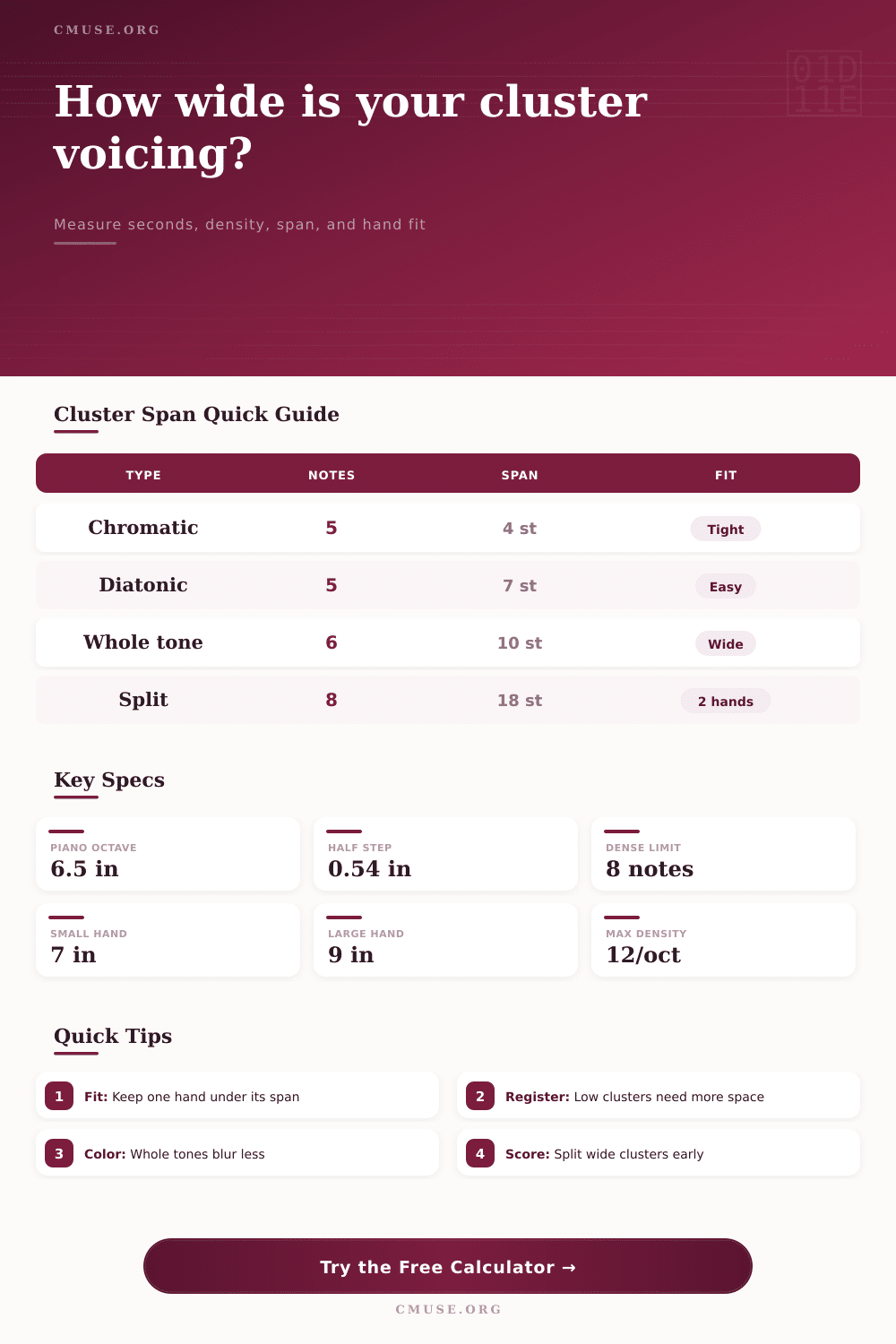
| Pattern | Typical offsets | Second content | Best register |
|---|---|---|---|
| Chromatic seconds | 0,1,2,3,4 | Maximum minor-second bite | Middle to high |
| Diatonic seconds | 0,2,4,5,7 | Mixed major and minor seconds | Middle register |
| Whole-tone cluster | 0,2,4,6,8 | Major seconds only | Middle to high |
| Quartal plus seconds | 0,2,5,7,10 | Open fourths with local rub | Low-middle to high |
| Split polychord | 0,1,4,7,13 | Seconds at each edge | Two hands or ensemble |
| Reach | Approx piano span | Cluster note count | Practical reading |
|---|---|---|---|
| Small hand | 7.0 in / 17.8 cm | 4 to 6 compact notes | Keep span near octave or less |
| Average hand | 8.0 in / 20.3 cm | 5 to 8 compact notes | Dense seconds fit if centered |
| Large hand | 9.0 in / 22.9 cm | 6 to 10 compact notes | Wide ninth and tenth colors open up |
| Two hands | 12 in+ / 30 cm+ | 8 to 14 notes | Split by register or by color |
| Medium | Close seconds | Span limit | Spacing recommendation |
|---|---|---|---|
| Piano keyboard | Very direct | Hand reach or two hands | Track physical inches and octave width |
| Guitar or fretted strings | String layout limits tight stacks | Position and string set | Use open strings or split registers |
| Strings divisi | Controllable by desk | Player count | Assign one stable pitch per player |
| Choir or winds | Harder to tune when low | Breath and section size | Prefer wider low-register spacing |
| Synth or sampler | Unlimited note access | Texture and masking | Use density and register index as limit |
| Scenario | Notes | Span target | Density target |
|---|---|---|---|
| Piano palm cluster | 6 to 10 | 5 to 9 semitones | 8 to 12 notes per octave |
| Jazz left-hand crunch | 4 to 6 | 6 to 12 semitones | 5 to 8 notes per octave |
| Film suspense stack | 5 to 9 | 4 to 16 semitones | 6 to 12 notes per octave |
| String or choir cloud | 6 to 14 | 8 to 24 semitones | 4 to 10 notes per octave |
In your mind’s eye you’ve conjured up some kind of dissonance. It’s a heavy, thick metallic cloud that adds tension but never turn into noise. You attempt to play it on piano, to notate it for strings, and find that the maths doesn’t compute with what you hear. Those black and white keys don’t fit under your fingers all at once and there isn’t room for choir to tune that many minor seconds down an octave.
This little calculator above will do sums for you and turn what you hear in your head into something real. Cluster voicings lies in that grey area between texture and harmony. How does that stack of notes work on a synth yet sound muddied when played on acoustic piano? Sympathetic vibration can help explain it.
How to Use the Cluster Voicing Calculator
This calculation measures how dense and how wide apart those pitches are from one another based off the medium in which you intend to play. As soon as you choose your instrument, it adapt its assumption of what is performable. For example, for piano players, the distance between notes and how far away they are physically must be taken into account. For guitarists, it’s fretboard positions and the layout of strings. For vocal groups, there is issues relating to stable tuning when singing close clusters.
It’s the input side that makes you think less about note and more about your hands. This is important because it anchors the theory into human anatomy, specifically field of hand span. Assuming an average-sized hand, this can extend to eight inches long giving enough space for a tight wad of five or six notes if compressed together. However, if you’re composing for a pianist with slightly smaller hands than that pile isn’t possible unless the notes are redistributed.
When you enter your desired span into the calculator it will flag if your voicing breaches that range. It’ll inform you if the cluster can fit into one hand, be spread across two hands, or be divided among an ensemble. This is important because dividing up a cluster completely alter the harmony blend and rhythmic attack of that cluster.
The register also play an enormous part in how these clusters are recieved. The masking effect and dissonance are increased by lower registers. If notes below middle C are tightly stacked, they will create a rumbling sound that can take over the mix. In higher registers where the overtones do not tend to clash with those around them, they can be more tightly packed together. This is illustrated in the reference table on the page, which suggests greater spacing for lower notes.
To create something more aggressive and biting, perhaps try pushing towards chromatic seconds in the mid-register. For a softer blur, whole-tone clusters in high register are preferable. The other factor here, which distinguishes a good voicing from a muddy one is density.
How dense are the notes in relation to an octave span? Density measures how many notes occupy a given octave span, where high density create a wall of sound but risks losing individual note definition. While this sounds like a wall of sound, it may not help with the definition of individual notes. Low-density voicings feels clearer and more open.
The dissonance index is a measure of the spacing pressure. Too many minor seconds rubbing against each other result in a high index. It is good for tension, but not so good for clarity over time. This allows you to make a judgment about whether to hang onto a cluster or rush it through your chord progression.
Composers often make errors because they forget that what looks good on paper may not be playable. A ten-note cluster across a single hand on grand piano is not physically possible for many players. Wide splits are demanding and need careful coordination even with both hands. By showing the stretch that is needed, the tool can help you avoid such pitfalls. It also prompts you to consider redistribution at an earlier stage of composition instead of having to correct your score after it’s no longer playable.
You should of checked this sooner. At the end of the day, it’s all about balance; you’re looking for the color of dissonance but not the chaos of noise. Experiment with your voicings and how they behave in actual space, such as register behavior and hand size. This helps you know that what sounds cool in your head will work in the room too.
Let the calculator do the math, and let your heart feel the emotion of those rich, complex harmonies. Begin with a basic stack. See the span. Then grow out as far as your players can physically perform.