Clef Transposition Calculator
Convert a written note between treble, bass, alto, tenor, and historic C clefs while checking concert pitch for transposing instruments.
Full Calculation Breakdown
| Item | Source Staff | Target Staff | Formula Used |
|---|---|---|---|
| Written pitch | — | — | Source or concert conversion |
| Clef | Anchor Rule | Bottom Line Reads | Common Instruments or Voices |
|---|---|---|---|
| Treble G clef | G4 on line 2 | E4 | Violin, flute, oboe, clarinet, trumpet, right hand piano |
| French violin G clef | G4 on line 1 | G4 | Early violin parts and historical editions |
| Bass F clef | F3 on line 4 | G2 | Cello, bassoon, trombone, tuba, left hand piano |
| Baritone F clef | F3 on line 3 | B2 | Historical baritone voice and older keyboard sources |
| Sub-bass F clef | F3 on line 5 | E2 | Rare low-bass notation and historical parts |
| Alto C clef | C4 on line 3 | F3 | Viola, alto trombone, some orchestral score excerpts |
| Tenor C clef | C4 on line 4 | D3 | Cello, bassoon, trombone, euphonium upper register |
| Soprano C clef | C4 on line 1 | C4 | Early vocal music and score study |
| Mezzo-soprano C clef | C4 on line 2 | A3 | Historical vocal notation |
| Baritone C clef | C4 on line 5 | G3 | Historical baritone voice and manuscript work |
| Instrument Profile | Written C Sounds | Semitone Offset | Audio Check |
|---|---|---|---|
| Concert-pitch instruments | C | 0 | Piano, flute, oboe, violin, viola, cello, trombone |
| B-flat clarinet or trumpet | B♭ | −2 | Written D4 sounds concert C4 |
| A clarinet | A | −3 | Written E♭4 sounds concert C4 |
| E-flat alto sax or baritone sax | E♭ | −9 | Written A4 sounds concert C4 before octave-range context |
| Horn in F or English horn | F | −7 | Written G4 sounds concert C4 |
| Piccolo | C one octave up | +12 | Written C5 sounds concert C6 |
| Guitar or tenor voice | C one octave down | −12 | Written C4 sounds concert C3 |
| Double bass or contrabassoon | C one octave down | −12 | Bass-clef parts sound an octave below notation |
| Formula Step | Calculator Expression | Meaning | Example |
|---|---|---|---|
| Diatonic coordinate | 7 × octave + note index | Counts letter-name steps, not semitones | C4 = 28, G4 = 32 |
| Clef anchor coordinate | Anchor note coordinate − anchor line position | Locks the clef symbol to its named staff line | Treble: G4 line 2 |
| Staff position | Note coordinate − clef base | 0 is bottom line, 8 is top line | Treble E4 = 0 |
| Clef move | Target position − source position | Positive moves the note higher on the page | C4 alto to treble = lower page move |
| Concert MIDI | Written MIDI + instrument offset | Converts written notation to sounding pitch | Bb written C5 = Bb4 |
| Scenario | Source Clef | Target Clef | Why It Matters |
|---|---|---|---|
| Viola excerpt for treble reader | Alto C clef | Treble G clef | Preserves viola written pitch while moving the note to a familiar staff |
| Cello high passage cleanup | Tenor C clef | Bass F clef | Checks ledger-line burden when returning to bass clef |
| Bassoon orchestral part | Tenor C clef | Bass F clef | Confirms upper-register notes without changing concert pitch |
| Trombone part study | Tenor C clef | Bass F clef | Useful for tenor-clef excerpts and audition preparation |
| Clarinet score reduction | Treble G clef | Treble G clef | Separates written note from sounding B-flat concert result |
| Horn cue checking | Treble G clef | Bass F clef | Tracks F transposition and clef placement together |
| Written Symbol | Pitch-Class Effect | Staff Position Effect | Use in Formula |
|---|---|---|---|
| Double flat | −2 semitones | Same line or space as the letter | MIDI = natural MIDI − 2 |
| Flat | −1 semitone | Same line or space as the letter | MIDI = natural MIDI − 1 |
| Natural | 0 semitones | Same line or space as the letter | MIDI = natural MIDI |
| Sharp | +1 semitone | Same line or space as the letter | MIDI = natural MIDI + 1 |
| Double sharp | +2 semitones | Same line or space as the letter | MIDI = natural MIDI + 2 |
Remember that instant when you see a new piece of music and your mind freezes? There’s nothing wrong with the notes; they’re just alien hieroglyphics. Perhaps it’s an alto clef viola part or perhaps a cello part that abruptly switch from tenor clef for playing higher note. Suddenly it is no longer just musical score, but a test of your patience if you have only studied treble or bass clef music. It occurs regularly in choir practices and orchestral pits. The conductor looks on waiting while you gaze at the page, and the seconds pass as you wrestle with mentally transposing each individual note before picking up your instrument.
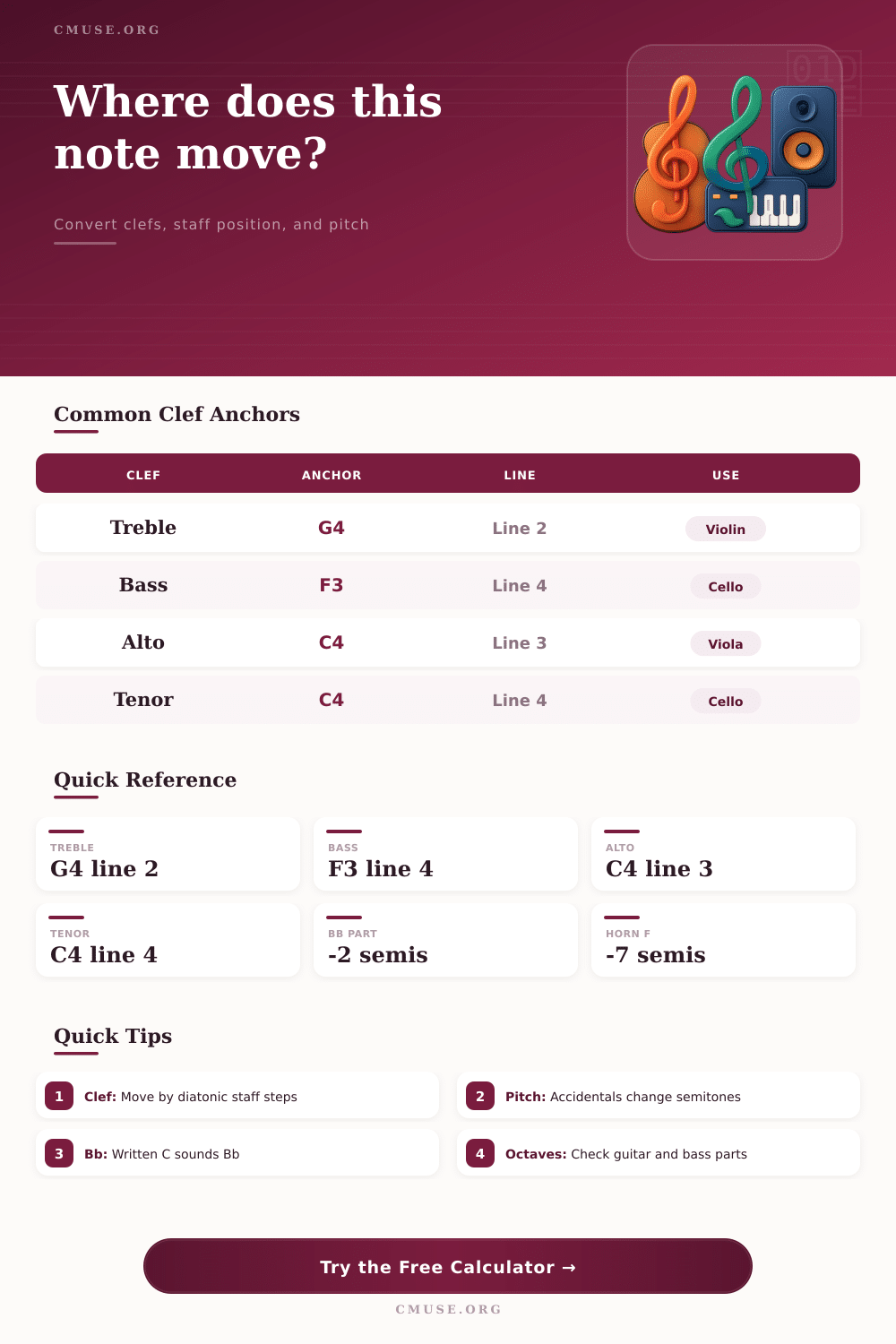
To understand how this works, you need to know the maths of staff rather than merely memorizing the notes. Clefs are not merely symbols; they are coordinate systems. The G clef defines G4 because it wraps around that second line. The F clef hooks underneath the fourth line and marks F3. C clefs place themselves with middle C at their centre, either on the third or fourth line depending on whether it is alto or tenor. Moving a note between clef systems does not change the pitch, only where it resides on grid. This is what the calculator above do for you so you don’t have to count lines and spaces in your head while you’re rehearsing.
Why Reading Music Can Be Hard
Transpose instruments trip up most musician. When they see a C on the staff it’s a B-flat clarinet playing a B-flat. Sounds simple until you add in clefs. What happens when the clarinetist has an excerpt with her part written in tenor clef? Or she wants to copy the part onto paper for piano reduction in treble clef? The offset multiplies. With this tool you simply choose the instrument profile and then choose the source and target clef. So now you can turn an alto clef note into a bass clef note, since the horn is written in F, all at once. You no longer have to mentally do two separate calculations.
Then we have octave displacement, which applies to any instrument. This includes double bass and the guitar, which are both sounded an octave below their notation, or the piccolo, which is sounded an octave above. It’s not just oddness but a practical solution to prevent too many ledger lines cluttering up the page. Choosing the right instrument profile when using the converter set the correct final concert pitch. Unless you remember to include that tick in the box, you could find yourself attempting to play an impossibly low or uncomfortably high note outside your vocal range. This is where reference grid in the interface shows the offsets clearly, allowing you to check if what you’re hearing makes sense before you commit it to paper.
It’s worth remembering too that becoming fluent in reading different clefs will take practice. Many viola players complains the alto clef system is too complicated; however, the reality is that it puts their notes in the middle of the stave, removing unnecessary visual information. For the bassoon and cello, tenor clef performs the same task in their higher registers. Knowing where they match make it easier to pick out the pattern. The third-line C of an alto clef note sounds at exactly the same place as the second-space C of a treble clef note. These become your anchoring reference points making harder scores less intimidating.
In short, it is all about communication. It’s about the composer conveying their vision to the player through notation. In this way, notation should contain no ambiguity regarding the rhythm and pitch of what they are performing. These aids will allow you to check over your writing and ensure the piece comes out exactly as it was imagined. You will spend more time reading the phrasing then trying to decode the grid. This change of perspective is everything if you’re sat in a packed rehearsal room or stood before an audience. All the time spent on that score should of helped us forget about the score and hear just the music.