Clarity C50 Calculator
Estimate speech clarity from room volume, RT60 decay, distance, directivity, and early reflection strength.
🎧Room Presets
🎛Speech Clarity Inputs
Speech Clarity Result
📊C50 Formula Spec Grid
📐Reference Tables
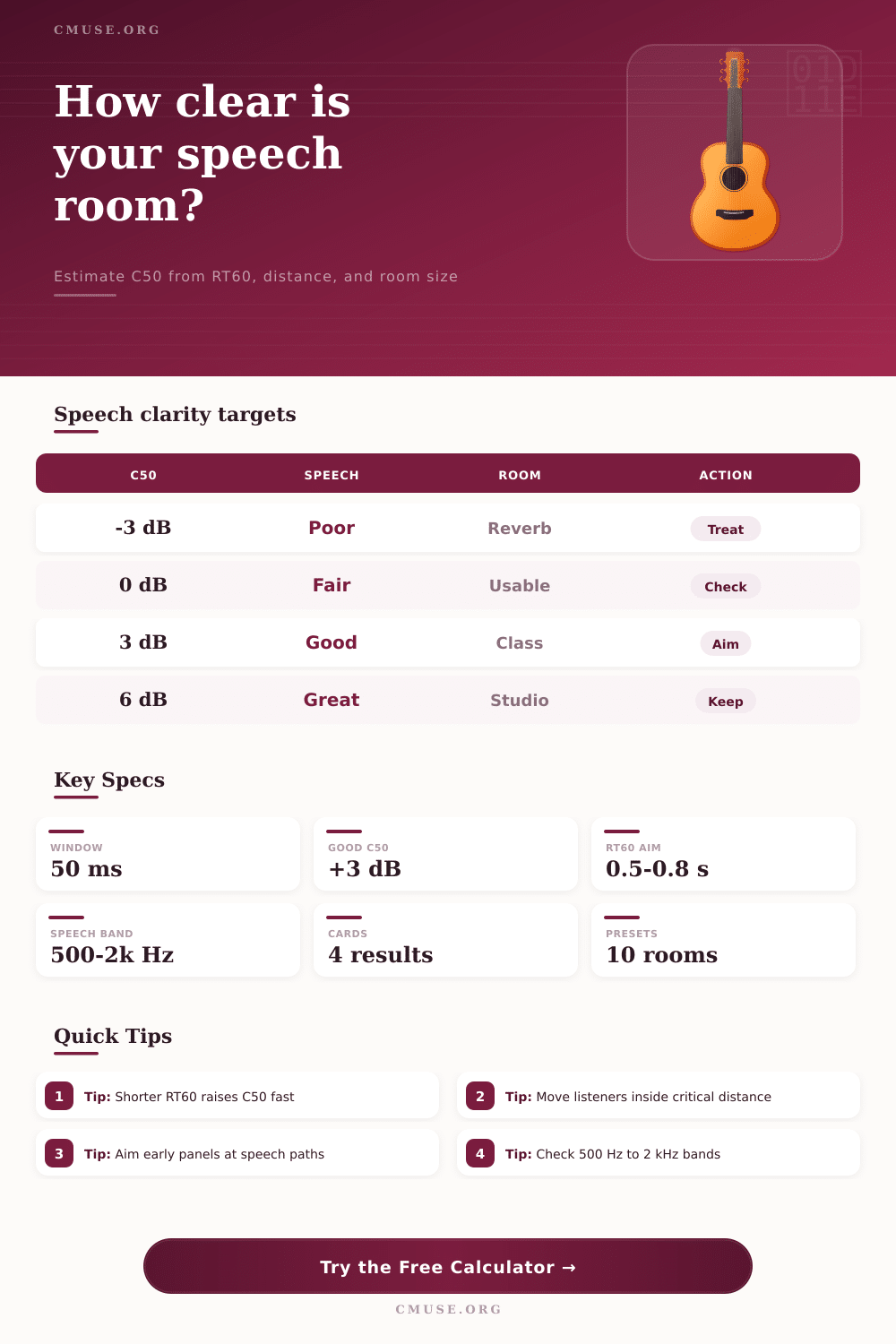
| C50 Range | Speech Result | Typical Room Condition | Best Next Check |
|---|---|---|---|
| Below -3 dB | Poor intelligibility | Late reverberation dominates speech consonants. | Reduce RT60 and seating distance. |
| -3 to 0 dB | Marginal clarity | Speech is usable but tiring in longer sessions. | Add early reflection control and check noise. |
| 0 to +3 dB | Acceptable speech | Most words remain clear for attentive listeners. | Optimize talker position and directivity. |
| +3 to +6 dB | Good clarity | Classrooms, studios, and meeting rooms often aim here. | Confirm across octave bands. |
| Above +6 dB | Very clear speech | Close-mic, treated booth, or strong direct sound. | Check that the room is not too dry for purpose. |
| Room Type | Useful RT60 Aim | Listener Distance | Expected C50 |
|---|---|---|---|
| Voice booth | 0.2 to 0.4 s | 2 to 5 ft / 0.6 to 1.5 m | +6 dB or higher |
| Podcast room | 0.3 to 0.6 s | 3 to 8 ft / 0.9 to 2.4 m | +3 to +8 dB |
| Classroom | 0.5 to 0.8 s | 8 to 25 ft / 2.4 to 7.6 m | 0 to +5 dB |
| Lecture hall | 0.7 to 1.1 s | 20 to 55 ft / 6.1 to 16.8 m | -2 to +4 dB |
| Small church | 1.0 to 1.8 s | 25 to 70 ft / 7.6 to 21.3 m | -5 to +1 dB |
| Directivity Q | Source Example | Direct Sound Effect | Use When |
|---|---|---|---|
| 1 | Omni source | Lowest direct-to-reverb ratio | Unamplified group speech |
| 2 | Forward talker | Natural speech projection | Meetings and teaching |
| 4 | Podium loudspeaker | About +3 dB over Q2 | Small reinforced rooms |
| 6 | Column speaker | More focused coverage | Long rooms or halls |
| 8 | Narrow speech array | Strong direct component | High reverberation spaces |
| Preset | Dimensions | RT60 | Speech Role |
|---|---|---|---|
| Podcast Room | 10 x 12 x 8 ft / 3.0 x 3.7 x 2.4 m | 0.35 s | Close spoken word |
| Classroom | 30 x 24 x 10 ft / 9.1 x 7.3 x 3.0 m | 0.75 s | Teacher to students |
| Lecture Hall | 60 x 40 x 18 ft / 18.3 x 12.2 x 5.5 m | 1.05 s | Reinforced speech |
| Small Church | 70 x 40 x 24 ft / 21.3 x 12.2 x 7.3 m | 1.60 s | Pulpit and spoken service |
💡Calculation Tips
Speech clarity is the quality of sound that allow for the understanding of the word that are being spoken. Speech clarity as a quality becomes noticeable to a person when speech clarity is low. For instance, a presenter with poor speech clarity may sound muffledly to the listener or the teacher may have to repeat the sentence that were just spoken.
Additionally, speech may sound like it is occurring inside a barrel. Speech clarity can be evaluated using a parameter known as C50. C50 is a measurement of the decibel difference between the sound energy that enters a listening area during the first fifty milliseconds of a sound source versus the sound energy that enters the listening area after the first fifty milliseconds of that sound source. If the sound energy that arrive during the first fifty milliseconds is high, speech clarity will be high.
Speech Clarity and How to Improve It
If the late reflections of sound energy after the first fifty milliseconds is high, then speech will not be clear. Where C50 is different from other parameters is its difference from reverberation time. Reverberation time, often referred to as RT60, is the decay time for a room after sound is created and the sound energy within that room is allowed to dissipate.
For instance, a room may have a short RT60 yet have poor speech clarity. This could be due to a listener sitting too far from the talker. Additionally, the loudspeaker may direct the sound energy into the listeners.
Alternatively, a room may have a long RT60 yet have good speech clarity. For instance, the listener may remain within the critical distance from the talker. Furthermore, the talkers may use a directional loudspeaker.
The provided calculator will determine the C50 value for different types of spaces by entering the dimension of the space, the measured mid-band reverberation time (RT60), the distance between the talkers and the listeners, the directivity of the loudspeakers and the early reflections within the space. Each of these variables may be adjusted because each of these factor can impact the speech clarity within a given area. For instance, the volume of the space can have an impact upon the calculation of the C50 value.
The Sabine relation can determine the relationship between the room volume and the absorption coefficients within that room. Because the relationship between the volume and absorption can be established, spaces like lecture halls will have different target value for RT60 compared to small meeting rooms. The distance between the talkers and the listeners can also impact the speech clarity calculations of the C50 value.
For instance, because distance is represented in the equation as a squared variable, adjusting the distance between the talkers and the listeners will have a different impact upon speech clarity than adding absorption panels to the walls of the listening area. Furthermore, the “early-reflection gain” setting can account for the early reflections that enter the listening area before the first fifty milliseconds of the talkers speech. These early reflections before the fifty-millisecond boundary are beneficial for speech clarity.
Additionally, other effects within the space, like HVAC vents, can create noise that impacts speech clarity. Additionally, reflections between walls or objects can create echoes that impact speech clarity. Each of these effects can be adjusted for by the treatment adjustment.
In many cases, people attempt to improve speech clarity by adding absorbers to the walls. However, this intervention may be ineffective if the listener is located either within or outside of the critical distance of the talkers. By adjusting for critical distance using the same absorption coefficients for the space, it is possible to determine whether the listeners should be repositioned before any absorption coefficients are adjusted.
The critical distance value may help to indicate whether the listeners are positioned appropriate for speech clarity. Depending upon the type of room that is being discussed, there are different requirements for speech clarity. For instance, the requirements for a voice booth have different requirements than a classroom.
Classrooms often need to remain lively with students talking to one another so children do not feel left out. Therefore, a classroom may have a more higher target C50 value compared to a voice booth. Small churches or lecture halls have different requirements for speech clarity than a classroom.
For instance, distance and volume within lecture halls can work against the direct sound from the talkers. Reference tables are provided that list the target values for each type of space. Within a space, it is also possible to make mistakes.
For instance, many individuals will measure the reverberation time of a space at the bass frequencies (below 100 Hz) and assume that the mid-band reverberation time (between 100 and 1000 Hz) will be similar. However, speech clarity is only important within the range of 500 Hz to 2000 Hz. Furthermore, speech clarity within that range exists because the vocal formants and consonants is expressed within that range of frequencies.
Therefore, adding bass traps to a space will not necessarily impact the speech clarity within the mid-band range. Additionally, another common mistake is ignoring the directivity of the sound source. For instance, an unamplified human talkers will emit sound equally in all directions.
However, an individual that is using a handheld microphone or small loudspeaker will emit the sound energy in a relatively narrow beam of sound. By focusing the sound energy forward into the listeners, several decibels of sound energy can be added to the system. The fifty-millisecond boundary in the measurements of speech clarity is related to research in the perception of sound reflections.
For instance, researchers have found that human listeners fuse reflections of sound that enter the ears within the first fifty milliseconds. However, if those reflections arrive beyond fifty milliseconds after the initial talkers’ sounds, the reflections may begin to mask the phonemes that follow those initial sounds. Therefore, a calculation of speech clarity splits the reverberant sound energy at the fifty-millisecond mark.
Furthermore, an exponential decay models reverberant sound energy after the fifty-millisecond mark. Finally, the treatment adjustment can be used again to account for other sounds within the space, such as noise generated by HVAC systems, reflections between objects within that space, and other audible noise. In making decisions regarding speech clarity, there may be tradeoffs between some variables and others.
For instance, if the calculated value for C50 is slightly lower than the target C50, shortening the distance between the talkers and the listeners is a much easier solution than adding absorption panels to the walls. If distance cannot be adjusted, the directivity of the sound source can be increased, or a reflector can be added to the space to focus the direct sound energy into the listening area. Another tradeoff may exist between increasing the direct sound energy with absorption of late reflections compared to increasing the direct sound energy with increasing the directivity of the sound source.
Both solutions may provide the same amount of gain in the direct sound energy. These tradeoffs are beneficial when considering different ways of adjusting a space and determining which solution is the most effective. When using the C50 value for any purpose, that purpose should match the way in which the space will be used.
For instance, a studio that records spoken word will have different C50 target values than a rehearsal space. Additionally, a classroom that is used for music lessons will have a different target value for C50 than a classroom used for lectures. Therefore, while the C50 value may help to determine the adjustments that should be made to a space for best speech clarity, the final decision belongs to the individuals that will use the space for speaking and listening.