🎵 Clarinet Value Calculator
Estimate the resale or trade-in value of your clarinet based on type, brand tier, condition, age, and accessories.
| Brand / Model | Level | Value Retention | Notes |
|---|---|---|---|
| Generic / No-Name | Beginner | 20-30% | Low demand, limited resale |
| Yamaha YCL-255/400 | Student | 45-60% | Reliable, popular resale |
| Yamaha YCL-650/SE | Intermediate | 55-70% | Strong demand used |
| Buffet E11 / E13 | Intermediate | 50-65% | Good tone, popular upgrade |
| Buffet R13 / RC | Professional | 65-80% | Most desired pro model |
| Selmer Paris | Professional | 60-78% | Prestigious, holds value |
| Leblanc / Vito | Various | 30-50% | Moderate demand |
| Vintage American | Vintage | Variable | Collector interest varies |
| Condition | Description | Value % | Typical Deductions |
|---|---|---|---|
| Mint | Like new, barely played | 95-100% | None |
| Excellent | Minor wear, fully functional | 80-90% | Cosmetic only |
| Good | Normal use wear, plays well | 60-70% | Minor pad wear |
| Fair | Needs service or minor repair | 35-45% | $50-150 service |
| Poor | Major repair needed | 10-20% | $150-400+ repair |
| Type | Bore Diameter | Key Count | Range |
|---|---|---|---|
| Bb Clarinet (Standard) | 14.65 mm | 17 keys | E3 – Bb6 |
| A Clarinet | 14.65 mm | 17 keys | Eb3 – A6 |
| Eb Soprano Clarinet | 13.2 mm | 17 keys | G3 – Eb7 |
| Alto Clarinet (Eb) | 15.9 mm | 21 keys | Eb2 – Bb5 |
| Bass Clarinet (Bb) | 16.5 mm | 21 keys | Db2 – G5 |
| Contrabass Clarinet | 19.0 mm | 21+ keys | Eb1 – Bb4 |
| Age | Student | Intermediate | Professional |
|---|---|---|---|
| 0-2 years | 55-70% | 65-80% | 70-85% |
| 3-5 years | 40-55% | 55-70% | 65-78% |
| 6-10 years | 30-45% | 45-60% | 55-70% |
| 11-20 years | 20-35% | 35-50% | 45-65% |
| 20+ years | 15-25% | 25-40% | 40-60% |
Clarinets are a lot like cars. They quickly lose around half of their value after the purchase even if one never really played them. After that first drop, the price usually keeps falling over time.
Used instruments widely cost around 50 percent less than brand new. Also the brand has weight, because some brands keep their resale value better than others. The state of the clarinet plays a big role in what one can sell it for.
How Much Are Used Clarinets Worth?
Clarinets rank between the most difficult instruments to estimate exactly their value. There are too many different brands and too many clarinets going around. New they seem expesnive, even the cheaper ones, but they do not keep their value well at all.
Older clarinets usually do not grow in price. Unlike string instruments, wind instruments tend to sink in value over the years, because they have many moving parts that wear out, and even little damages can add up.
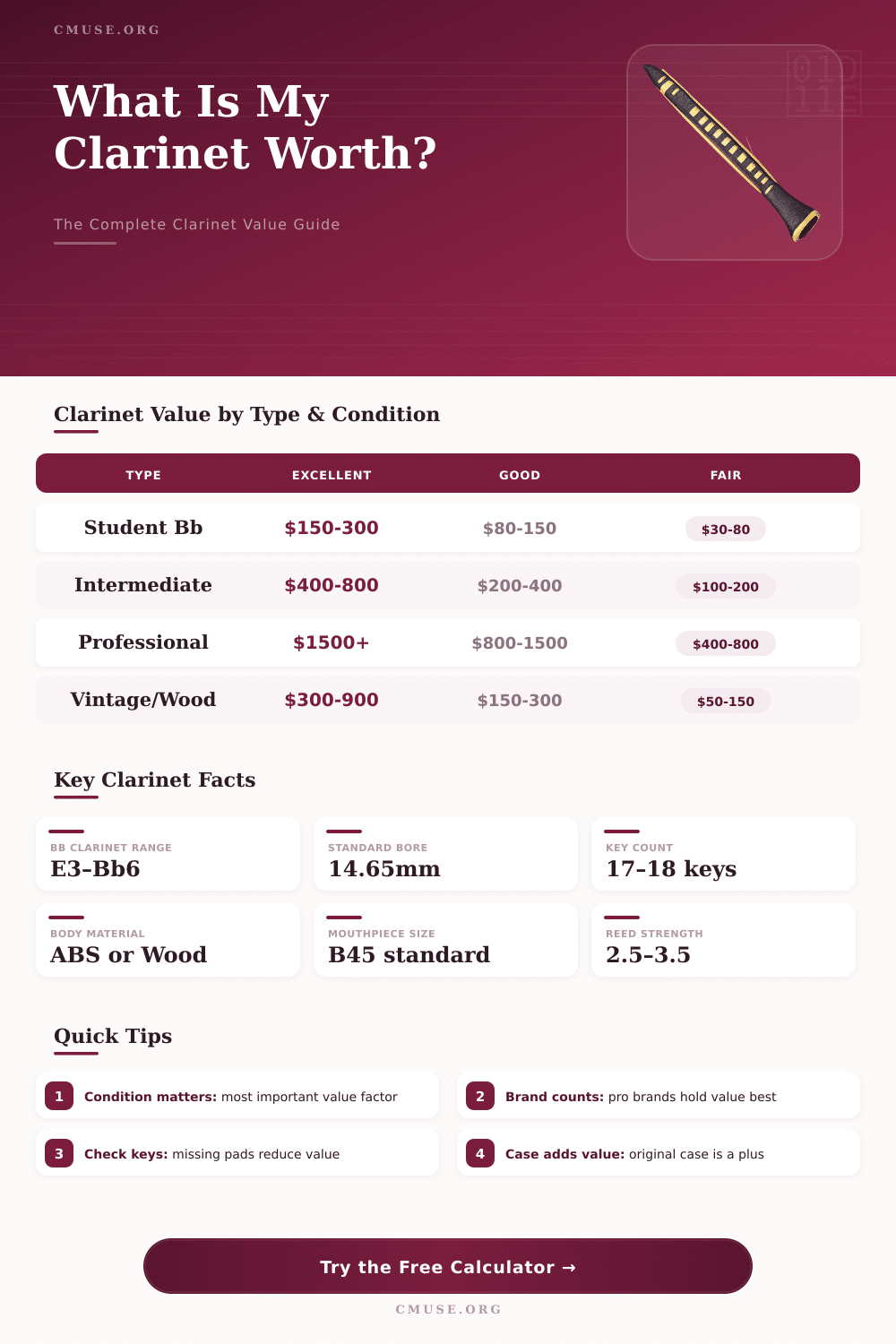
Even so, there are exceptions. A Buffet R13 from around 1960, originally bought for 180 dollars, now can be worth around 800 dollars, if it stays undamaged and playable. The R13 does keep its resale value very well.
Rare vintage or high end models from makers like Selmer Paris, vintage German clarinets or oversized instruments from Backun, LeBlanc or Schwenk and Seggelke in good state can reach from 3,000 too 15,000 dollars or more, depending on rarity, condition and demand. Martin Frères clarinets made before the 1920s in original boxwood, grenadilla or rosewood are very wanted by collectors and can bring thousands of dollars, depending on the clarinet system, number of keys, wood type, materials like real ivory and full set.
A well respected Selmer Paris clarinet in fully playable state, that does not need pad changes or cork changes, can be worth between 800 and 1,200 dollars. For professional level clarinets, plan a budget between 3,500 and 5,000 dollars, seeing as the prices grew.
Student beginner clarinets are another story. Music shops sell beginner clarinets for around 1,400 to 1,500 dollars, but buying a student model at full retail price is not worth it, because they almost have no resale value. A basic renewed student clarinet goes for around 200 dollars.
A used Jupiter student clarinet could sell for around 150 Canadian dollars, and a used Yamaha for around 200. Sellers commonly list them at wholesale price, typical 60 to 70 percent of market value, to make a fast sale.
Spending some hundreds of dollars on used instrument repairs can still spare much money. Having a good repair person, that works carefully, and asking whether they guarantee their work, is always smart. It is also a good idea to use a plasticclarinet for outdoor or marching band use, because plastic holds up better to falls and temperature changes than wood.