🎸 Cigar Box Guitar Fret Calculator
Calculate precise fret positions for any scale length — imperial & metric results
(572mm)
(584mm)
(629mm)
(648mm)
| Tuning Name | String Notes | Style | Best For |
|---|---|---|---|
| Open G | G – D – G | 3-string | Blues, slide, Delta |
| Open D | D – A – D | 3-string | Resonator, lap slide |
| Open E | E – B – E | 3-string | Rock, country |
| GDG Full | G – D – G | 3-string spread | Chording, fingerpick |
| DAD Full | D – A – D | 3-string spread | Folk, Celtic |
| Standard EAD | E – A – D | 3 of 6-string | Standard technique |
| Fret # | Distance from Nut (in) | Distance from Nut (mm) | Interval |
|---|---|---|---|
| 1 | 1.517" | 38.5mm | Minor 2nd |
| 2 | 2.948" | 74.9mm | Major 2nd |
| 3 | 4.298" | 109.2mm | Minor 3rd |
| 4 | 5.570" | 141.5mm | Major 3rd |
| 5 | 6.770" | 171.9mm | Perfect 4th |
| 7 | 8.976" | 228.0mm | Perfect 5th |
| 12 | 12.750" | 323.9mm | Octave |
| 19 | 18.956" | 481.5mm | Octave + 5th |
| Scale Length | Typical Frets | 1st Fret Spacing | 12th Fret Position |
|---|---|---|---|
| 21" (533mm) | 15–17 | 1.179" / 29.9mm | 10.500" / 266.7mm |
| 22.5" (572mm) | 17–19 | 1.263" / 32.1mm | 11.250" / 285.8mm |
| 23" (584mm) | 18–20 | 1.291" / 32.8mm | 11.500" / 292.1mm |
| 24.75" (629mm) | 20–22 | 1.389" / 35.3mm | 12.375" / 314.3mm |
| 25.5" (648mm) | 20–22 | 1.431" / 36.3mm | 12.750" / 323.9mm |
| 26.5" (673mm) | 22–24 | 1.487" / 37.8mm | 13.250" / 336.6mm |
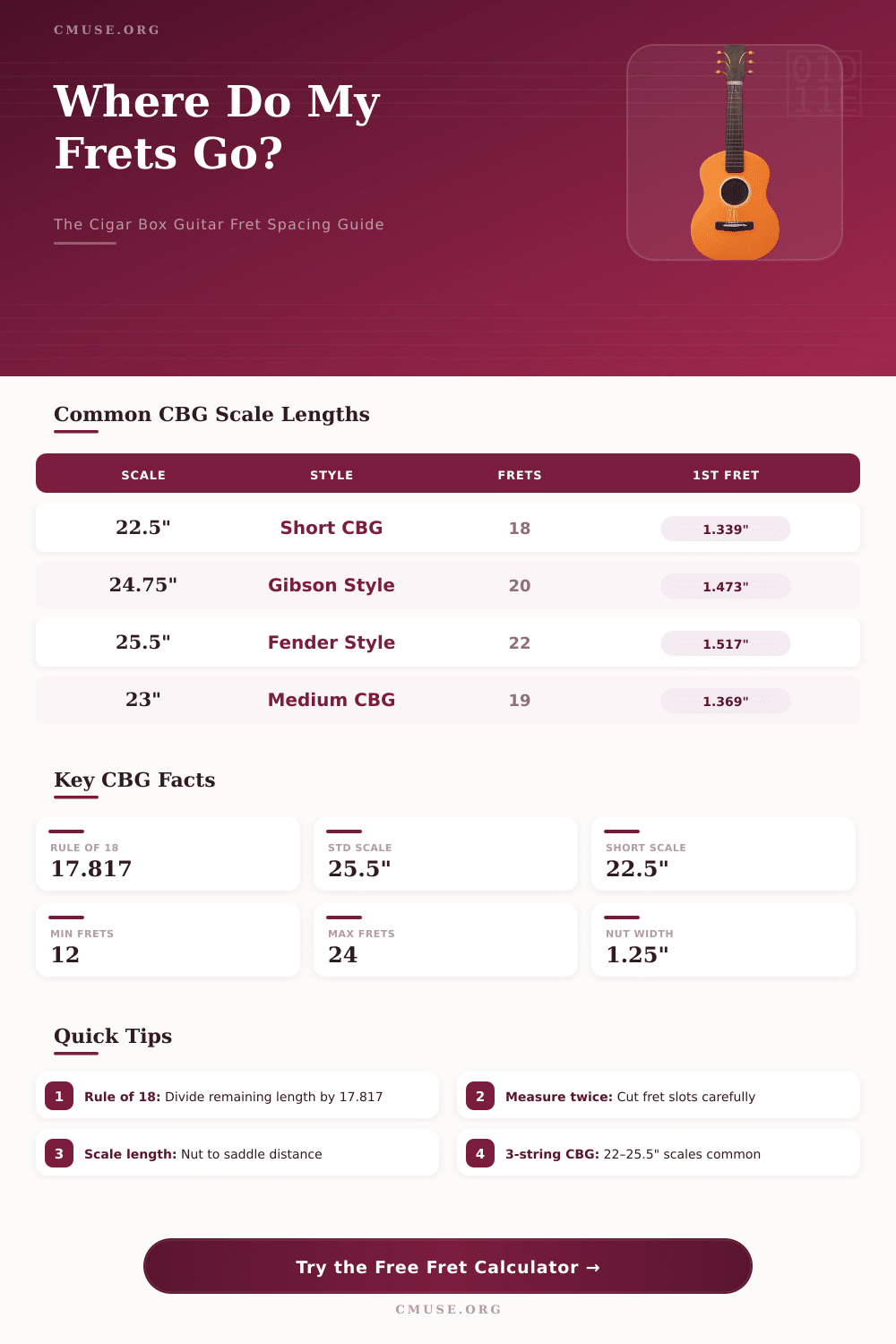
The Fret of a Cigar Box Guitar forms a key part for building and playing those thrilling instruments. It determines the position of the Fret all along the neck. In normal guitar, the gaps between Fret follow a math rule that bases on the 12-tone equal layout.
For a scale length of 24,5 inches. Typical for Cigar Box Guitar, divide it by 17,817 to find the distance to the first Fret. One counts all Fret from the nut.
Fret Basics for Cigar Box Guitars
The most many Cigar Box Guitar own around 18 Fret. Some models have 21 even though they are not very common, because reaching the three last Fret is quite a lot harder. There is also demand for 24 Fret, which adds extra challenges to the builders.
Between the most used scale lengths are around 24 inches, 25 inches and 25,5 inches from the nut to the bridge.
One can buy ready-made fretboards or make them from scratch. For instance, good options are a fretboard long in 20 inches, thick in a quarter inch and with 20 Fret set for a 25-inch scale. They come in various wood types and with three main options for the Fret: unfretted, cut or fully fretted.
For a three-string Cigar Box Guitar, cut and unfretted fretboards include also nut, cherry, oak and sapele mahogany, usually thcik in 6 mm and broad in 42 mm.
The Fret wire comes in different sizes. Between the main types are light, medium, jumbo and super jumbo. A handy purchase is a kit for fretting with six feet of medium wire and a guide for the process.
A good Fret saw does a big difference. Changed average saws for cutting Fret do not work as well as using a special saw four that task.
Some makers play around with materials for Fret. Using a nail gun, one can shoot nails in the right spots, which serve as Fret, although the result usually becomes more of a talking piece. One can also use toothpicks.
The flat part of heavy bobby pins works for Fret in a Cigar Box Guitar. One cuts them to the needed length, polishes the edges to escape sharp corners in the curved slices and superglues them to the fretboard. Fret from copper wire forms another homemade option, that one prepares and installs yourself.
Not each Cigar Box Guitar needs Fret. A version without Fret allows a wider range of sounds, that a fretted guitar does not reach, but it plays harder without a slide and costs around 20 dollars less. Some early Cigar Box Guitar lacked Fret and Fret marks, and one played them mainly by means of a slide.
A diatonic Fret layout is another choice, that simply removes four Fret from a standard fretboard.
When the action is too low, the strings rest on the fretboard during fretting and can not vibrate. To raise the action, one must make the bridge keep the strings higher, or one lays spacer plates under the neck so that it tilts more into the body. A free calculator for Fret helps makers enter their scale length and receive precise spacing, that one can print and applyeasily.
Leveling of Fret and polishing belong to the final process after the setup.