Chorus Rate Calculator
Estimate modulation speed, BPM sync, delay sweep, detune cents, stereo phase offset, and perceived width before you dial in the chorus.
Formula Breakdown
| Sync Value | Cycle Length | LFO Rate | Common Chorus Use |
|---|
| Rate Zone | Hz Range | Cycle Time | Practical Character |
|---|---|---|---|
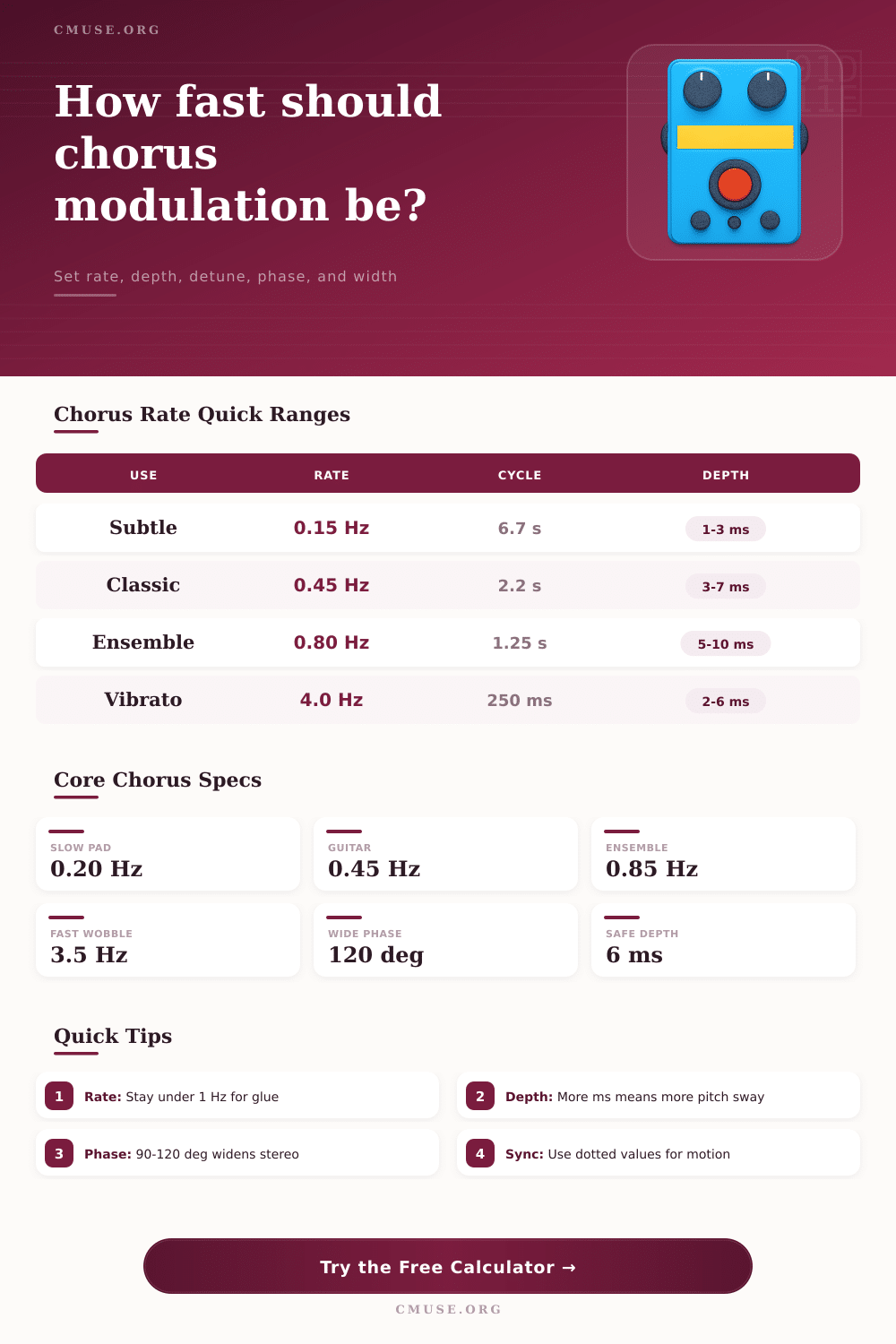
| Static shimmer | 0.05-0.18 Hz | 5.6-20 s | Barely moving stereo haze for pads, bus thickening, and long sustained tones. |
| Slow chorus | 0.18-0.40 Hz | 2.5-5.6 s | Smooth movement that stays behind the part and rarely sounds seasick. |
| Classic chorus | 0.40-0.90 Hz | 1.1-2.5 s | Recognizable guitar, keys, and vocal doubling motion without full vibrato identity. |
| Animated ensemble | 0.90-1.80 Hz | 0.56-1.1 s | Clearly swirling modulation, useful when the effect should be heard as part of the arrangement. |
| Fast wobble | 1.80-5.50 Hz | 180-560 ms | Moves toward vibrato, rotary drift, and special effect textures. |
| Center Delay | Depth | Best Use | Pitch Risk |
|---|---|---|---|
| 7-12 ms | 0.8-2.5 ms | Tight doubling, bass widening, short vocal thickening. | Low until rate exceeds about 1.5 Hz. |
| 12-20 ms | 2.5-6 ms | Classic pedal-style guitar, keys, electric piano, and subtle synth motion. | Moderate; detune becomes audible with fast LFOs. |
| 20-30 ms | 5-10 ms | Wide ensemble layers, pads, strings, and slow stereo wash. | Medium; keep feedback restrained. |
| 30-45 ms | 8-16 ms | Obvious doubling and special effect spread. | High; rhythm timing can smear. |
| Phase Offset | Cycle Offset | Width Behavior | Mix Note |
|---|---|---|---|
| 0 degrees | 0% cycle | Mono-style chorus movement. | Most compatible for bass and centered instruments. |
| 45 degrees | 12.5% cycle | Light stereo separation. | Good when the part should stay focused. |
| 90 degrees | 25% cycle | Balanced left-right animation. | Common starting point for guitar and keys. |
| 120 degrees | 33.3% cycle | Wide ensemble spread. | Useful for pads, synths, and stacked backing vocals. |
| 180 degrees | 50% cycle | Maximum opposing motion. | Check mono because movement can thin the center. |
| Effect Type | Typical Rate | Delay/Depth | Useful Target |
|---|---|---|---|
| Studio chorus | 0.20-0.80 Hz | 12-24 ms center, 2-7 ms depth | Smooth widening without obvious pitch wobble. |
| Ensemble chorus | 0.45-1.30 Hz | 18-30 ms center, 5-10 ms depth | Multi-voice pad, string, and synth animation. |
| Doubling chorus | 0.10-0.45 Hz | 7-16 ms center, 1-4 ms depth | Thicker vocals, bass, and rhythm guitars. |
| Vibrato-like chorus | 2.50-6.00 Hz | 8-18 ms center, 2-6 ms depth | Clearly periodic pitch movement. |
| Flanger-adjacent | 0.05-0.50 Hz | 1-7 ms center, 0.5-3 ms depth | Comb-filter motion when feedback is raised. |
| Source | Rate | Center Delay | Depth | Phase |
|---|---|---|---|---|
| Electric guitar clean part | 0.35-0.75 Hz | 14-22 ms | 3-7 ms | 60-120 deg |
| Electric bass width | 0.10-0.30 Hz | 7-13 ms | 0.8-2.5 ms | 0-60 deg |
| Lead vocal double | 0.18-0.45 Hz | 10-18 ms | 1.5-4 ms | 30-90 deg |
| Synth pad ensemble | 0.45-1.20 Hz | 18-30 ms | 5-10 ms | 90-180 deg |
| Master bus thickening | 0.05-0.18 Hz | 8-16 ms | 0.5-1.5 ms | 0-45 deg |
Getting your hands on this kind of wide, shimmering electric guitar sound found on many pop records from the 80s comes down to adjusting the rate at which the pitch move. The rate is just right so that effect sits well in the mix but isn’t blurred out to a muddy mess. Too slow and the effect is dead, static, too fast, and it becomes a wobble or vibrato distracting from melody. Understanding relationship between musical tempo, delay time, and Hertz is crucial here for getting that right.
With a chorus, they is taking what you give them, copying signal, adding a little delay to one of those copies then mixing it back in to the other. They use an oscillator to change length of the delay. Because sound moves at a set speed, if the delay changes so does the pitch going up or down. If the delay are longer, the pitch goes lower. If it’s shorter, it increase the pitch. How fast do they do this? That’s what the rate setting adjust.
How to Use Chorus Effect Well
For most folks it becomes a random knob to turn around until it sounds good. This is fine for experimenting. When you want the effect to feel like it’s locked into energy of the song, it doesn’t work. At this stage, timing is key. If it’s modulating at 0.5 Hz, then it will take two seconds for the whole cycle to complete, giving a subtle swooshing feeling that add thickness but doesn’t call attention to itself. At 4 Hz (four times per second), result is a distinct vibrato effect.
How do those numbers map back? That’s where the calculator comes in, turning abstract Hertz into concrete values like cycle length and an estimate of how much it will detune. It’ll illustrate exact amount of pitch change you’re creating compared to your track’s tempo. Because modulation that aligns with the beat sounds like intention; modulation that fight the groove sounds chaotic.
Rate and depth are both vital parameters. Depth refers to how far away from the midpoint of the delay time the depth setting move. Set it at shallow depths near a millisecond. This make a barely noticeable thickening change. It is perfect for fattening up a bass line or doubling a vocal while keeping the bottom end clear. At deep depths in the ten millisecond plus range, it produce clear, dramatic pitch changes that work well for adding variation to a synth pad but can be terrible on a kick drum.
It’s an equation of balancing factors. Too much depth and too fast a rate turns your signal into a siren, not a good thing. Too little rate and plenty of depth, and you gets a slow building swelling like the ocean. The reference table here provides safe ranges to start with for various instruments so you don’t make the typical novice error of turning everything up full right off the bat.
Another level of control is stereo phase offset. That’s where you move the modulation waveform to one channel or the other, making for a wider, more immersive image. Generally speaking, 90 degrees is often a sweet spot for this. It provides some separation without causing phase cancellation issues that will thin out your sound if played back on mono speaker. So again, this width parameter isn’t simply about turning up the volume, it’s about making something feel physically bigger.
But with width comes loss of center focus. Too wide can cause the voice to seem to hover above the music instead of sit on top of it if you’re mixing, say, a lead vocal.
At the end of the day, a chorus effect is about controlling motion in a stationary signal. Make them feel the action but not necessarily be able to point out that it’s an effect. Begin with low depths and rates, and add just enough of what you’re looking for until you get the texture you want. The numbers are there to lead you to careful choices; ultimately, it comes down to your ear making the decision. Once it feels like part of the performance instead of another layer on top of it, you’ve struck a chord (pun intended). And that’s where that shimmer comes back into play…on purpose, not actualy.