Chord Quality Recognition Score Calculator
Grade major, minor, diminished, augmented, and seventh recognition with inversions, voicing difficulty, and response speed.
Use the average time from the drill log, not the fastest answer.
Streak adds a small consistency check to the final interpretation.
Count root position, first inversion, second inversion, and third inversion where seventh chords appear.
Weighted Recognition Results
| Chord quality | Recognition cue | Scoring weight | Common miss |
|---|---|---|---|
| Major triad | Stable, bright third above root | 1.00 baseline | Confusing spread major with sus-like spacing |
| Minor triad | Lowered third color with stable fifth | 1.00 baseline | Hearing register darkness instead of chord quality |
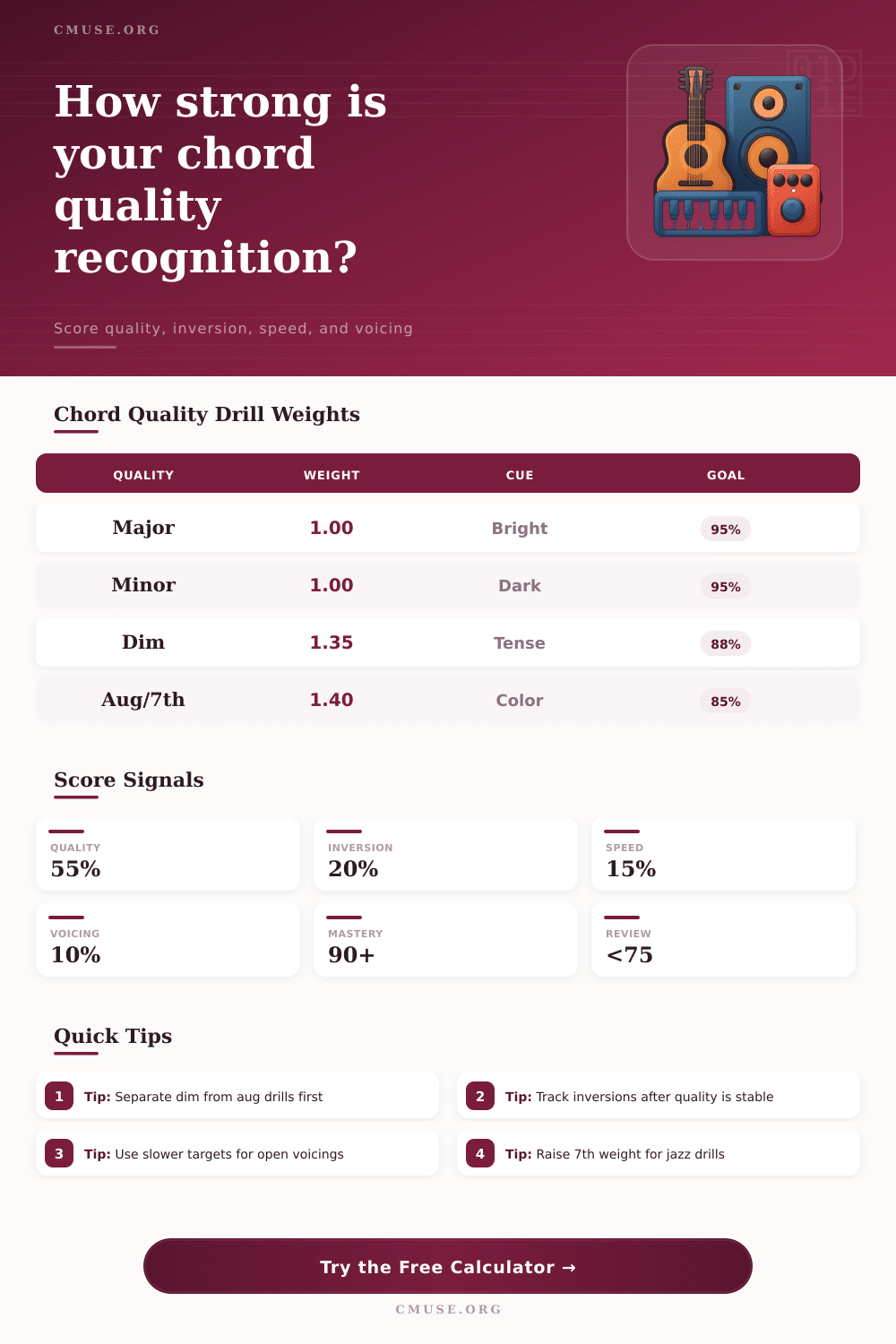
| Diminished triad | Minor third plus flattened fifth tension | 1.35 advanced | Mislabeled as minor when the fifth is hidden |
| Augmented triad | Major third plus raised fifth symmetry | 1.45 advanced | Mislabeled as major in close keyboard voicing |
| Seventh quality | Triad color plus seventh extension | 1.25 to 1.45 by detail | Calling every seventh a dominant seventh |
| Voicing mode | Target response | Difficulty factor | Use case |
|---|---|---|---|
| Block triads | 2.6 seconds | 1.00 | Keyboard and theory class drills |
| Open spacing | 3.2 seconds | 1.04 | Guitar, piano spread voicings, and score reduction |
| Four-part chorale | 3.8 seconds | 1.08 | SATB analysis with doubled notes |
| Drop-2 or shell voicings | 4.2 seconds | 1.11 | Jazz guitar and comping recognition |
| Dense cluster voicings | 5.4 seconds | 1.18 | Ensemble stacks and close-register reharmonization |
| Score band | Reading | Next drill emphasis | Instructor note |
|---|---|---|---|
| 90 to 100 | Performance ready | Raise voicing density or shorten timing | Accuracy is holding under pressure |
| 80 to 89 | Strong recognition | Review weak advanced qualities | Good for most ensemble and theory contexts |
| 70 to 79 | Functional but uneven | Separate dim, aug, and seventh colors | Likely guessing when voicings spread out |
| 60 to 69 | Developing recognition | Slow the drill and isolate thirds and fifths | Do not add more chord types yet |
| Below 60 | Foundation reset | Use major/minor blocks before inversions | Rebuild interval hearing first |
| Preset drill | Typical total | Voicing mode | Main pressure point |
|---|---|---|---|
| Piano Triad Warmup | 60 prompts | Block triads | Clean major/minor separation |
| Jazz Seventh Sprint | 80 prompts | Drop-2 or shell | Dominant, major seventh, and minor seventh split |
| Dim/Aug Focus Drill | 70 prompts | Open spacing | Raised fifth versus flattened fifth |
| Dense Ensemble Voicings | 105 prompts | Dense cluster | Quality hidden by doubling and register |
Even if you’re asleep, chances are good you could recognize a major triad. It’s light and stable and comfortabley nested in the center of tonal gravity. Minor chords follows close behind. They bring a familiar dark coloration to western harmony. And then we come across strange chords. Diminished clusters sounds like they’re tumbling off a cliff. Augmented symmetries sound rootless. Seventh chord add tension and muddle the water. That’s when ear training goes from merely listening to actual problem solving.
It’s here that most student stumble. They view all chords as an equally challenging task, they fail to consider that hearing a block piano triad is a very different mental exercise than understanding a dense jazz voicing. So after plugging in your drill stats, this little calculator takes care of the math. And it spares you from wondering if you really improved or if it was luck.
Why Weighted Scores Help You Learn Faster
In theory then its about giving weight to how difficult something is. The baseline score comes from knowing major and minor chords, which is what the whole thing is based off. If you can’t reliably identify those then nothing else follow. Augmented and diminished chord carry a heavier load because they’re mentally more expensive to pick out. There’s an internal tension against expected sound that has to be resolved. Seventh chords falls roughly midway. Depending again on your focus as a student, you may only need to distinguish them from triads, which is not very hard. Or, you may need to find the middle ground between major seven sweetness and dominant colour, which are harder.
Giving the weighting makes sure this doesn’t create an illusion of competence. It could be that a student gets lots right on easy major chords, but always misses on something with rich textures. Raw accuracy percentages mask that as the easy questions will pull up average. Giving weighted scores uncovers it straight away. Here’s where people make their mistake. They’ll spend their time working on high percentage exercises over easy stuff when their problem at advanced level is structure weakness in their recognition.
Another wrinkle in the mix that catches many intermediate players out is inversions. One moment, you recognize a chord as being in root position. Next time, you have to stop thinking that the chord has same harmony just because the bass note has changed. How many times do we see learners who hear a minor triad in first inversion and think major? Why? Because the top note sound like a major 3rd above the bass. The tool recognizes that quality accuracy (whether it’s a major or minor) is separate from how accurately you can hear inversions. It’s possible to be brilliant at hearing color yet hopeless at where something sits structurally. They are two different skills both needed for practical musicianship but not always easily linked.
Speed and voicing density matter more then most teachers admit. A piano chord presents a clear outline of harmony in block form. A dense texture of choir voices or open guitar voicings spreads these intervals across many different range. By the time your brain stitches the sound back together it can begin classifying the quality. To show this, the page includes a reference table showing how target response time changes as the voicing becomes more complex. Accuracy cannot fall, so faster isn’t always better. If it is sluggish then you’re still doing some interval arithmetic in your head instead of intuitively hearing color. You need the speed to be familiar, not simply rushing through guesses.
Stop mixing the easy stuff with the hard stuff and make sure you isolate what’s holding you back, because then you’re making real progress. If it’s your low scores dragging down your overall percentage, focus on just those. Run a specialized drill focusing solely on them until you can tell the difference between the stress they cause and feeling slightly down. You should of not return to mixed drills until you’ve got that distinction solid.
That’s how the tool helps simulate that environment, from warmup to full-blown exam simulation. How do you use this? Use it to benchmark your true situation, not where you think you might be. Believe the weighted score rather than the raw number. It paints a much truer picture of what’s going on in your ears. You’ll only know it when those augmented and diminished chords sounds different from one another and no longer just generically out of place. Then you’ll realize you were carrying the weight for good reason all along.