Chord Progression Calculator
Map Roman numerals, test cadence pull, and measure loop tension before the arrangement gets crowded.
🎵 Preset Progressions
🎶 Progression Inputs
📊 Progression Spec Grid
📖 Harmony Reference Tables
| Mode | Tonic | Predominant | Dominant |
|---|---|---|---|
| Major | I, iii, vi | ii, IV | V, vii |
| Natural minor | i, III, VI | ii, iv | V, VII |
| Dorian | i, III, VI | ii, IV | v, VII |
| Mixolydian | I, iii, vi | ii, IV | V, bVII |
| Ending | Shape | Pull | Best use |
|---|---|---|---|
| V-I | Authentic | Strong | Final bar |
| IV-I | Plagal | Soft | Lifted close |
| V-vi | Deceptive | Surprise | Hook bait |
| ii-V-I | Turnaround | Very strong | Jazz end |
| Pattern | Degrees | Mood | Landing |
|---|---|---|---|
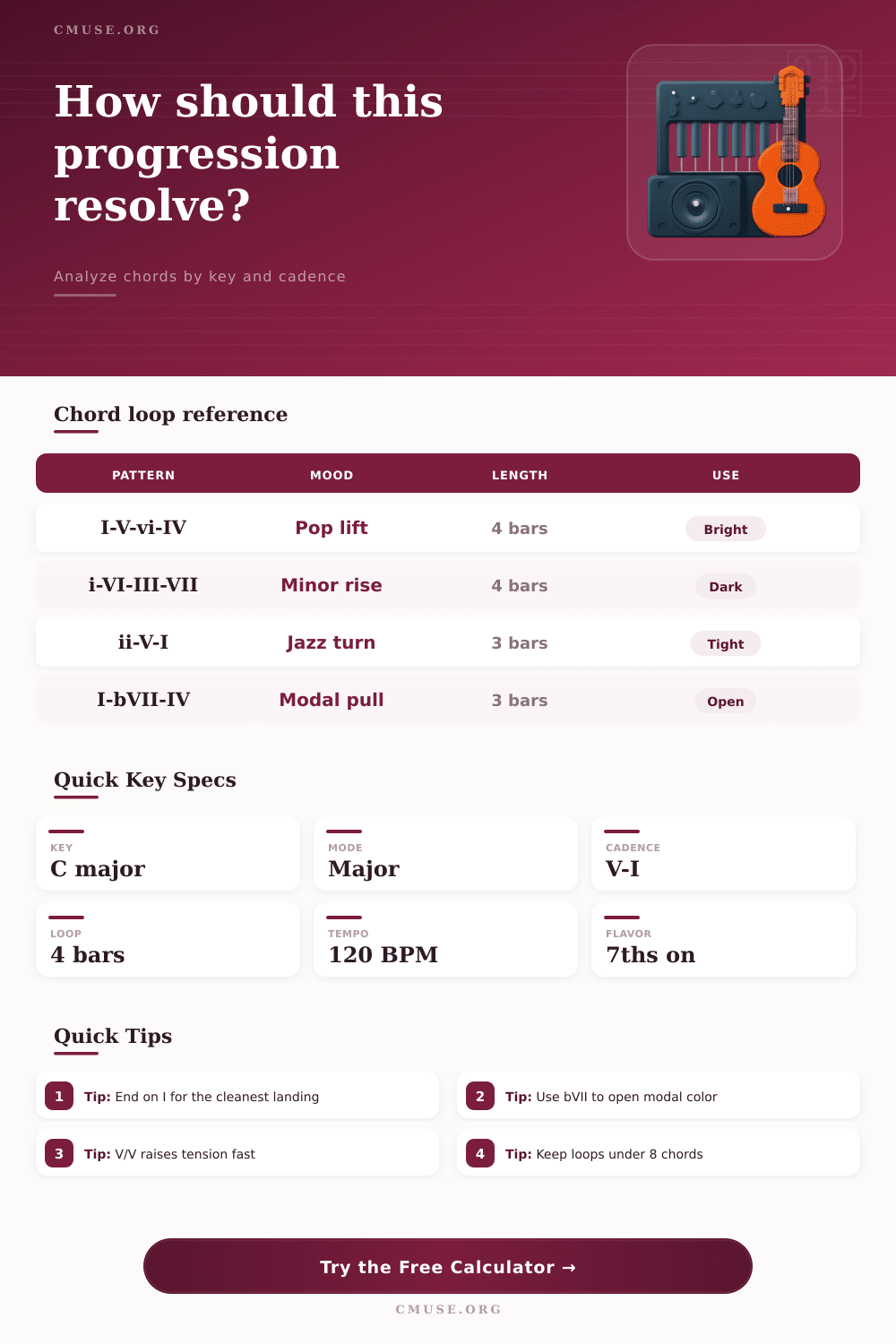
| I-V-vi-IV | 1-5-6-4 | Lift | I |
| vi-IV-I-V | 6-4-1-5 | Forward | V |
| i-VI-III-VII | 1-6-3-7 | Cinematic | VII |
| I-bVII-IV-I | 1-7-4-1 | Open | I |
| Color | Trait | Use | Tension |
|---|---|---|---|
| Triad | Clean | Core loop | Low |
| Seventh | Richer | Soul / jazz | Med |
| Sus4 | No 3rd | Suspense | Med |
| Add9 | Airy | Pop lift | Low |
Chord progression are sequences of chords that is used within a musical loop. Musical loops can become aimless if they does not use chord progressions that contains a sense of direction. However, a musical loop will feel complete if it use tension and release in the chord progression that it create.
Chord progressions use specific role for each chord to create a sense of tension and release for the listener. There are three main type of chords and chord roles within chord progressions: tonic, predominant, and dominant roles. Tonic roles create a sense of arrival within the musical loop.
Using Chord Progressions in Musical Loops
Predominant roles signal to the listener that there is to be some change within a musical loop, but they do not create a resolution to that change. Finally, dominant roles create a sense of tension within the musical loop, and lead the listener back towards the tonic chords that provide that sense of arrival. Cadences are the sequences of chords that typically end each chord progression within a musical loop.
There are five main type of cadences: authentic, plagal, deceptive, half, and 不完 cadences. An authentic cadence typically move from a dominant chord to a tonic chord, and creates a strong sense of resolution. A plagal cadence typically move from a IV chord to a I chord, and creates a softer resolution then an authentic cadence.
A deceptive cadence typically move from a dominant chord to a vi chord instead of the tonic chord. This create a sense of surprise within the musical loop. Finally, a half cadence typically end on a dominant chord, which create a sense of suspension of the musical loop.
Roman numerals can be used to describe each type of chord within a chord progression without relation to the musical key in which it are played. For instance, the progression of I-V-vi-IV will work within any major key. Diatonic chords are chords that relates to the scale in which the musical loop is played.
Borrowed chords are chords from another scale that a composer incorporate to add variety to a musical loop. However, if there is too many borrowed chords, the musical loop may lose a sense of it’s musical key. Tempo and voicing can impact how a chord progression within a musical loop sound.
A slow tempo allows for the chords within a progression to breathe and settle, while a fast tempo can create a sense of urgency within the musical loop. Voicing is the way that the notes within a chord are arrange. For instance, triads contains three notes and are the minimal chord progression, while seventh chord contain more notes than triads.
Sus and add9 chord voicings will create an airy sound to a musical loop, while extended chords will add even more notes to the chords to create a complex sound to the musical loop. Root motion is the movement of the chord with the lowest note within a chord progression. Root motion is one of the essential element of a chord progression.
However, if the chords within a progression have too great a root motion, the musical loop may become disorienting for the listener. Smooth root motion suggest the movement of the root of each chord to another with a close relationship within the musical key, which facilitate the progression within the chord loop without disorienting the listener. Additionally, it is important to avoid cadence blind writing for the same reasons that smooth root motion is encourage.
Each mode change the sound of a chord progression within a musical loop. For instance, the major mode create a bright sound to a musical loop, while the natural minor mode create a dark sound to a musical loop. The Dorian mode incorporate a major sixth note into the scale.
The Mixolydian mode include a flat seventh note within the scale. Finally, the harmonic minor mode include a sharp seventh note to create strong dominant chord within a musical loop. Each mode change the available note within a chord progression, as well as the function of the chords within the musical loop.
The length of a musical loop and the time signatures within a musical loop will impact the chord progression that is create within the musical loop. Four bar loops are the most common length for musical loops. Eight bar loops require internal cadences to maintain the momentum within a musical loop.
Time signatures, such as 4/4, 3/4, or 5/4 will change the pulse of a musical loop. Thus, different time signatures will require adjustment to the chord progression. Finally, it is essential to listen to a chord progression to ensure that the mathematics of the chords match the sound of the musical loop.