Chord Inversion Calculator
Build triads and seventh chords, rotate the bass correctly, and check slash-chord spellings, figured bass, and note stacks at a glance.
🎵 Presets
💻 Calculator Inputs
How it was built
📊 Chord Family Reference
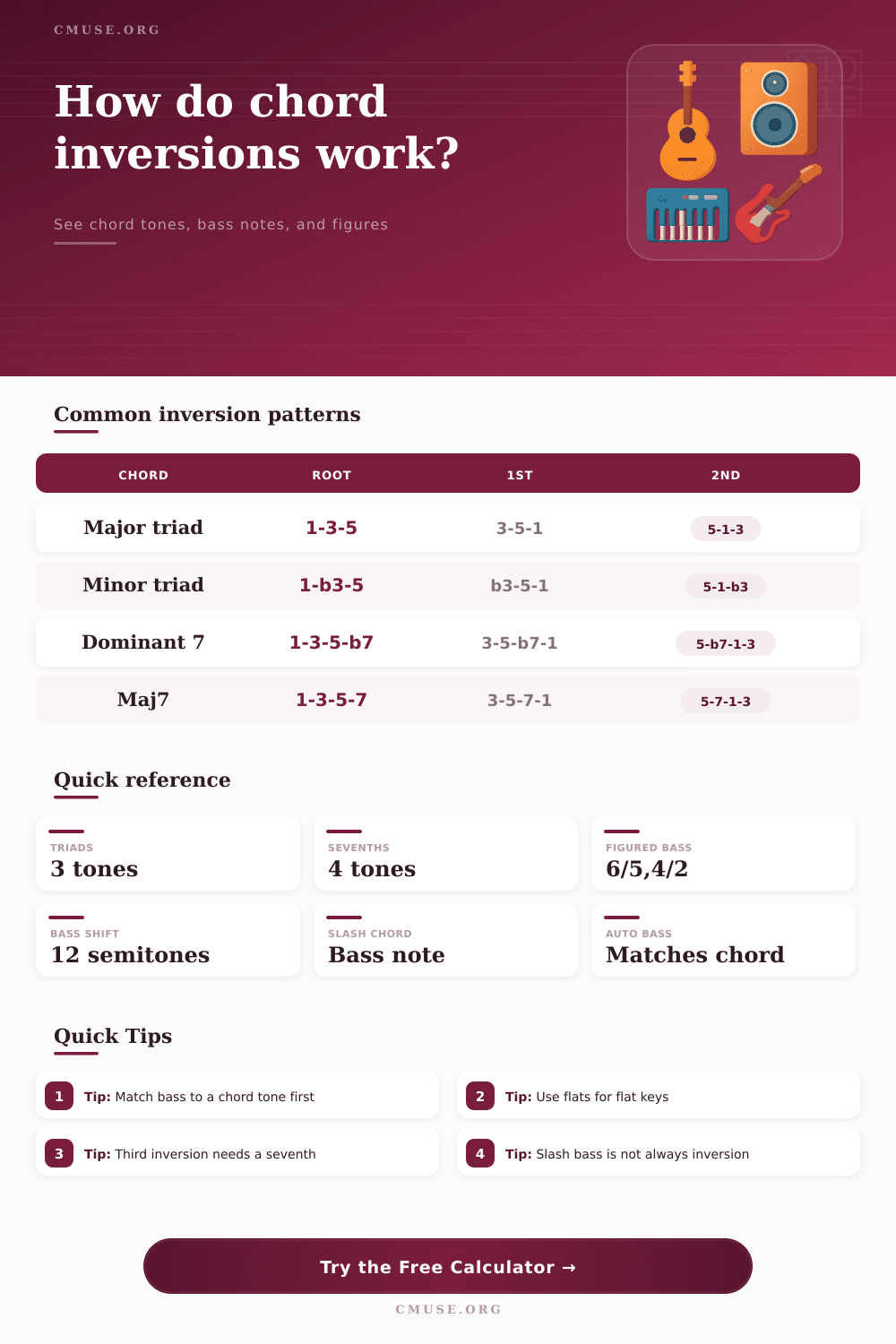
📋 Triad Inversion Table
| Chord | Root | 1st | 2nd | Figured bass |
|---|
📈 Seventh Inversion Table
| Chord | Root | 1st | 2nd | 3rd | Figured bass |
|---|
💬 Tips
Chord inversions is inversions that have the lowest note of the chord not as the root note of the chord. Inversions allow for the order of the notes within a chord to be changed, and changing the order of the chord allow for the bass lines within a song to move smoothly from chord to chord. Chord inversions are often used to create smooth voice leading for chords in a song, as well as to create tension within a song or to make the chord progression within a song more interestinger to listeners.
A chord that contains three note is referred to as a triad. Triads can exist in several different positions. One position for a triad is with the root note of the chord as the lowest note of the chord.
What Are Chord Inversions
For example, a C major chord contains the notes C, E, and G. In a root position, the C note will be the lowest note of the chord. Another position of a triad are referred to as first inversion, wherein the third note of the chord is the lowest note of the chord. Thus, in a first inversion C major chord, the E note will be the lowest note of the chord.
A second inversion triad has the fifth note of the chord as the lowest note of the chord. Thus, in a second inversion C major chord, the G note will be the lowest note within the chord. Seventh chords contain four notes.
Seventh chords have more inversions than triads due to the number of notes contained within the chords. Seventh chords has four inversions: one in which the chord is in root position, one in which the third note of the chord is the lowest note of the chord (first inversion), one in which the fifth note of the chord is the lowest note of the chord (second inversion), and one in which the seventh note of the chord is the lowest note of the chord (third inversion). Each of these inversions can be labeled using figured bass notation.
A chord in root position is labeled with a 7, first inversion chords are labeled with a 6/5, second inversion chords are labeled with a 4/3, and third inversion chords are labeled with a 4/2. The numbers represent the interval between the bass note and the other notes in the chord. These numbers help to analyze the chord.
Slash chords have a chord symbol and an separate note for the bass note. For instance, C/G indicates that the chord should have a bass note of G. To determine if a slash chord is a true inversion, check if the bass note for that chord is a chord tone. If the bass note is a chord tone, then it is an inversion.
However, if the bass note is not a chord tone, then it is a pedal note or an altered bass note. A non-chord tone can be used for the bass notes to support a melody note or to add color to a piece of music. People makes several mistakes when using chord inversions.
Using a low note for a chord to indicate an inversion is one. The low note must be a chord tone to be considered an inversion. Another mistake is to ignore the span of the chord.
A chord with a wide span may sound thin on a guitar but full on a piano with wide range. Chord inversions are helpful for creating chord progressions. A stepwise bass line can be created using inversions.
Deceptive cadences can use inversions since a second inversion chord sound good within a progression. Jazz musicians use third, second, and first inversion chords to create tension and release in there turnaround chords. The best way to learn how to use chord inversions is to practice chords in inversions by ear.
Arpeggiating chords up and down the keyboard will allow ears to recognize chord inversions. Analyze musical charts to identify 6/3 and 4/2 inversions. If a chord progression seem stuck in one place, try flipping the bass note to an inversion.
This will allow musicians to create a more smoother flow in the music.