Choir Section Balance Calculator
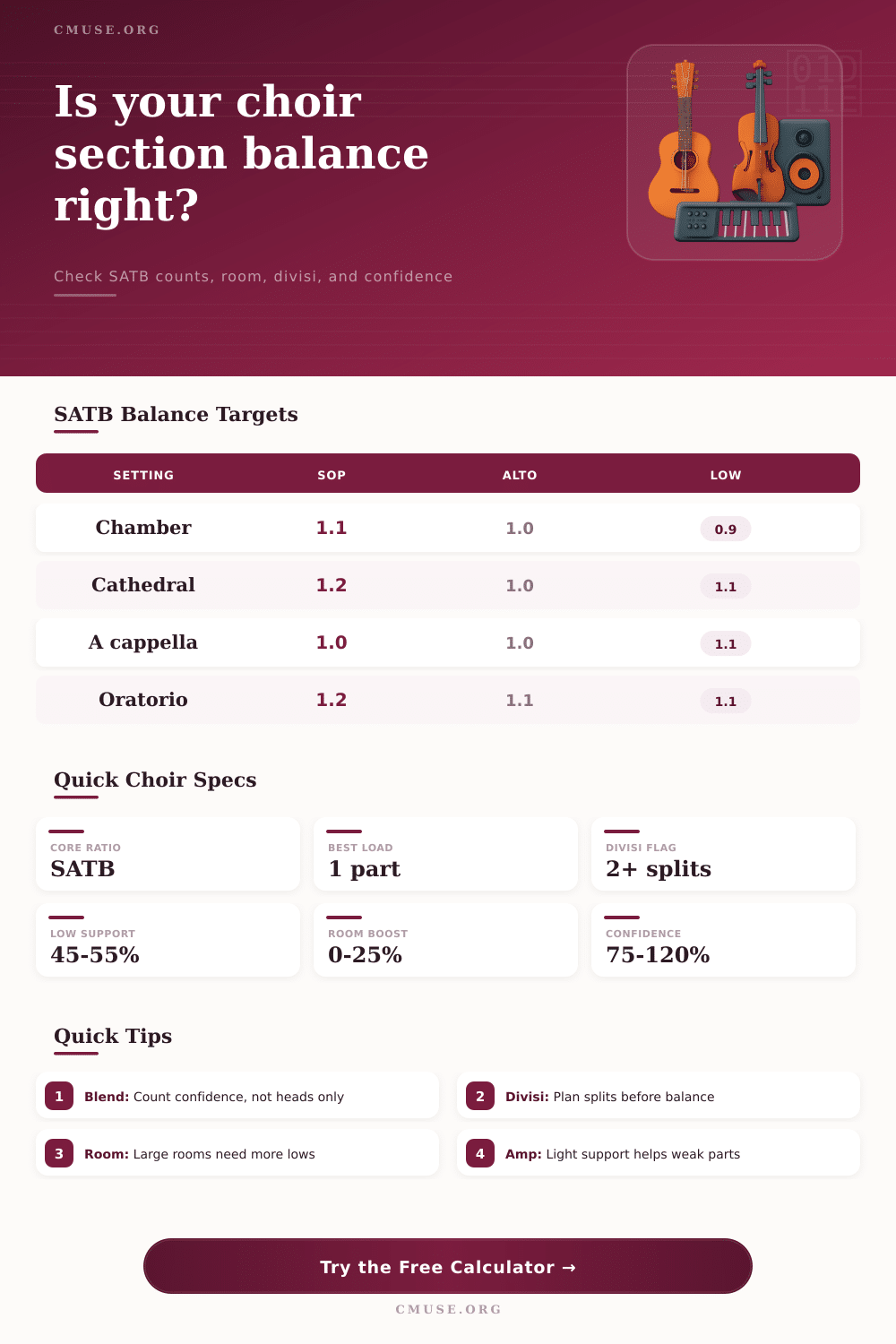
Estimate SATB balance from section counts, repertoire demands, room support, amplification, divisi load, and singer confidence.
🎶Real Choir Presets
🎼Choir Inputs
Balance Breakdown
📊Choir Spec Grid
📘SATB Target Ratio Table
| Repertoire | Target SATB Ratio | Why It Matters | Common Watch Point |
|---|---|---|---|
| Renaissance polyphony | 1.00 : 1.00 : 0.95 : 0.95 | Even lines and imitative entries need close parity. | One thin inner line exposes tuning. |
| Classical mixed chorus | 1.10 : 1.00 : 0.90 : 0.90 | A small soprano edge helps melody without swamping text. | Tenors vanish under high soprano writing. |
| Romantic choral texture | 1.15 : 1.00 : 1.00 : 1.05 | Dense harmony asks for stronger bass foundation. | Altos can be buried by thick scoring. |
| Modern close harmony | 1.05 : 1.05 : 1.00 : 1.00 | Cluster chords need steady inner and lower partials. | Divisi turns balanced counts into thin splits. |
| Gospel or worship set | 1.05 : 1.05 : 0.95 : 1.00 | Amplification can support blend while keeping energy. | Mic placement may exaggerate sopranos. |
| Musical theatre ensemble | 1.15 : 1.00 : 0.90 : 0.90 | Text, staging, and character voicing favor flexible tops. | Absent principals weaken section anchors. |
| A cappella vocal ensemble | 1.00 : 1.00 : 1.05 : 1.05 | Unaccompanied harmony needs low pitch reference. | Bass lightness destabilizes intonation. |
| Oratorio with orchestra | 1.20 : 1.05 : 1.00 : 1.10 | Projection over instruments needs soprano and bass depth. | Tenor fatigue can reduce final chorus clarity. |
🏛Room and Amplification Table
| Space | Low Voice Need | Upper Voice Risk | Amplification Note |
|---|---|---|---|
| Small rehearsal room | Baseline | Low | Natural balance is easy to hear. |
| Chapel or choir loft | Plus 4 percent | Moderate | Light area pickup can stabilize softer parts. |
| Medium sanctuary | Plus 9 percent | Moderate | Section mics help tenors and basses project. |
| Concert hall | Plus 14 percent | High | Natural support depends on shell and risers. |
| Large cathedral | Plus 22 percent | High | Long decay favors clear, grounded lower voices. |
| Outdoor or dry stage | Plus 18 percent | High | Full support may be needed for true balance. |
🔀Divisi Planning Table
| Divisi Level | Planning Factor | Minimum Comfortable Split | Balance Cue |
|---|---|---|---|
| No divisi | 1.00 | All singers on one part | Judge full-section blend. |
| Simple occasional split | 1.15 | 3 effective singers | Check exposed entrances. |
| Moderate two-way split | 1.35 | 4 effective singers | Assign anchors to lower split. |
| Heavy recurring divisi | 1.65 | 5 effective singers | Watch altos and tenors first. |
| Extreme multi-part divisi | 2.10 | 6 effective singers | Rebalance by actual split count. |
🎤Common Choir Size Table
| Choir Scenario | Typical SATB Count | Best Repertoire Fit | Balance Watch |
|---|---|---|---|
| Chamber SATB | 6 / 5 / 4 / 4 | Classical or Renaissance | Every absence changes the chord. |
| Church choir | 10 / 8 / 5 / 5 | Anthems and worship sets | Tenor support often sets the limit. |
| Collegiate chorale | 16 / 14 / 10 / 9 | Mixed concert literature | Divisi should be mapped in advance. |
| Cathedral anthem choir | 18 / 16 / 9 / 10 | Romantic and sacred works | Basses must carry room resonance. |
| A cappella octet | 2 / 2 / 2 / 2 | Close harmony | Confidence matters more than size. |
| Oratorio chorus | 30 / 24 / 16 / 18 | Orchestra-backed masterworks | Projection and stamina affect balance. |
💡Balance Tips
On the other hand, the attendance sheet shows a healthy number of voices but when they sing, you find yourself standing in front of a choir whose bottom end is muddy and whose centre is thin. This is one of those issues where the number of people present do not equal their sound. Twelve confident sopranos can easily outbalance fifteen hesitant tenors as sound doesn’t make for balance alone.
The choir section balance calculator account for raw numbers and confidence levels. It also consider the demands of the repertoire and room acoustics. It shifts the emphasis from simple arithmetic to acoustic reality.
Why Headcount Does Not Equal Sound Balance
Many directors assume that the SATB ratio remain constant for any given set of singers regardless of setting. The transition between a dry rehearsal space and an echoing cathedral soon dispels that myth. In most places, high frequencies travels further and decay slower then their low frequency counterparts. Even when the sopranos is singing at a moderate level, the natural tendency will be for them to take over sound picture.
Taking this into account, tool uses acoustic multipliers depending on room size. Because lower frequencies requires greater mass to pierce the reverberant tail, a large church would of require far greater support for the bass end of the spectrum than say, a small chapel. To create the same perception of balance, you may discover that you will need three or four additional bass voice in a hall as opposed to a classroom.
Most plans fail because of a misunderstanding of confidence. A secure breathing, knowing singer adds more sonic weight than a reader gasping for air between phrases. By treating the anchor sections different from the fragile ones, the calculator reduce the number of working heads in the problem areas. This is not a punishment; it’s acknowledgement that tension lowers output. Even if there are 12 chairs in a section, if your altos is nervous about a new piece, they will be a smaller section acoustically. Knowing this helps plan where to place the anchors without spreading singers out on every stand.
The details of raw numbers don’t capture Divisi at all. Splitting the tenors into two parts does not divide their acoustic strength equally; instead, it often leaves the bottom of the harmony thin and unstable. The table provided with the tool explains the need for larger sections to start with where such heavy division is called for. If you start too small then splitting a section won’t really work as the resultant lines are without the mass to carry the chords. Too many directors discovers this only at the premiere when melody swamps the inner voices. Thinking about these divisions before rehearsals saves precious rehearsal time and ensures the sound doesn’t structurally collapse.
The ratios you aim for are also determined by repertoire. In imitative textures such as polyphony of the Renaissance, each line carry equal weight. Therefore, almost perfect balance is required. Conversely, Romantic choral music frequently calls for a more substantial bass line that sustains rich harmonies and a full orchestral backing. These stylistic variations are what the calculator use to tell you whether your current distribution matches the musical demands. It avoids you having to coax an unbalanced set of singers into sounding like they’re singing something together if they’re not.
When done well, amplification is a game changer. Miking full out lets you control the balance of each part exactly and light reinforcement keeps a weak spot stable but blends with the rest undistorted. But using tech as a solution to an inherently imbalanced choir is a dangerous idea where you’ll end up losing the naturaly blended sound and fighting feedback. Use it to see how far your amplification and room will extend beyond what you have to work with in terms of singers. Use it to help you know if you should go back into rehearsal or recruit a few more basses.
The bottom line? Listening. But when you know what to listen for, it happens faster. No more guesses as to why this or that sounds off. You’ve got a framework that accounts for style, space and people. And there it is: variables processed by the calculator and turned into information that can be acted upon.
It is no longer just about how many people there are. It is about how their presence shifts the sound balance based off confidence levels and room acoustics. It’s the shift in perspective that allows a good choir to become a really cohesive ensemble.