Chime Tube Length Calculator
Calculate tuned wind chime tube lengths from material, diameter, wall thickness, root note, and scale pattern.
Calculation Breakdown
| Tube | Note | Frequency | Final Length | Cut Length | Hole From Top |
|---|
| Material | Elastic Modulus | Density | Chime Behavior |
|---|---|---|---|
| Aluminum 6061-T6 | 69 GPa | 2700 kg/m3 | Bright, long sustain, easy to tune |
| Aluminum 6063-T5 | 69 GPa | 2700 kg/m3 | Smooth tone, common architectural tube |
| Cartridge Brass C260 | 110 GPa | 8530 kg/m3 | Warm, dense, shorter than aluminum for same pitch |
| Copper C110 | 117 GPa | 8960 kg/m3 | Soft attack, warm tone, heavier stock |
| Stainless Steel 304 | 193 GPa | 8000 kg/m3 | Clear, hard attack, weather resistant |
| Mild Carbon Steel | 200 GPa | 7850 kg/m3 | Strong ring, needs finish outdoors |
| Titanium Grade 2 | 105 GPa | 4510 kg/m3 | Lively, light, complex overtone color |
| Bamboo Cane | 12 GPa | 700 kg/m3 | Woody, fast decay, approximate tuning only |
| Tube Style | Outer Diameter | Wall Thickness | Useful Range |
|---|---|---|---|
| Small desktop chime | 0.375-0.625 in | 0.028-0.049 in | C5-C7 bright, short tubes |
| General garden chime | 0.75-1.00 in | 0.049-0.065 in | G4-C6 clear outdoor tuning |
| Deep porch chime | 1.00-1.50 in | 0.065-0.125 in | E3-A4 larger, slower ring |
| Heavy resonance tube | 1.50-2.00 in | 0.083-0.125 in | C3-G4 large-frame builds |
| Pattern | Semitone Steps | Typical Tubes | Use |
|---|---|---|---|
| Major pentatonic | 0, 2, 4, 7, 9 | 5, 6, 8 | Most consonant wind chime sound |
| Minor pentatonic | 0, 3, 5, 7, 10 | 5, 6, 8 | Darker, reflective garden sets |
| Major scale | 0, 2, 4, 5, 7, 9, 11 | 7, 8 | Melodic classroom or tuned sets |
| Natural minor | 0, 2, 3, 5, 7, 8, 10 | 7, 8 | Moody but still structured |
| Blues hexatonic | 0, 3, 5, 6, 7, 10 | 6, 7 | Colorful cluster with strong identity |
| Open triad | 0, 4, 7, 12, 16 | 4, 5, 6 | Simple chordal porch chime |
| Spec | Rule Of Thumb | Why It Matters | Calculator Use |
|---|---|---|---|
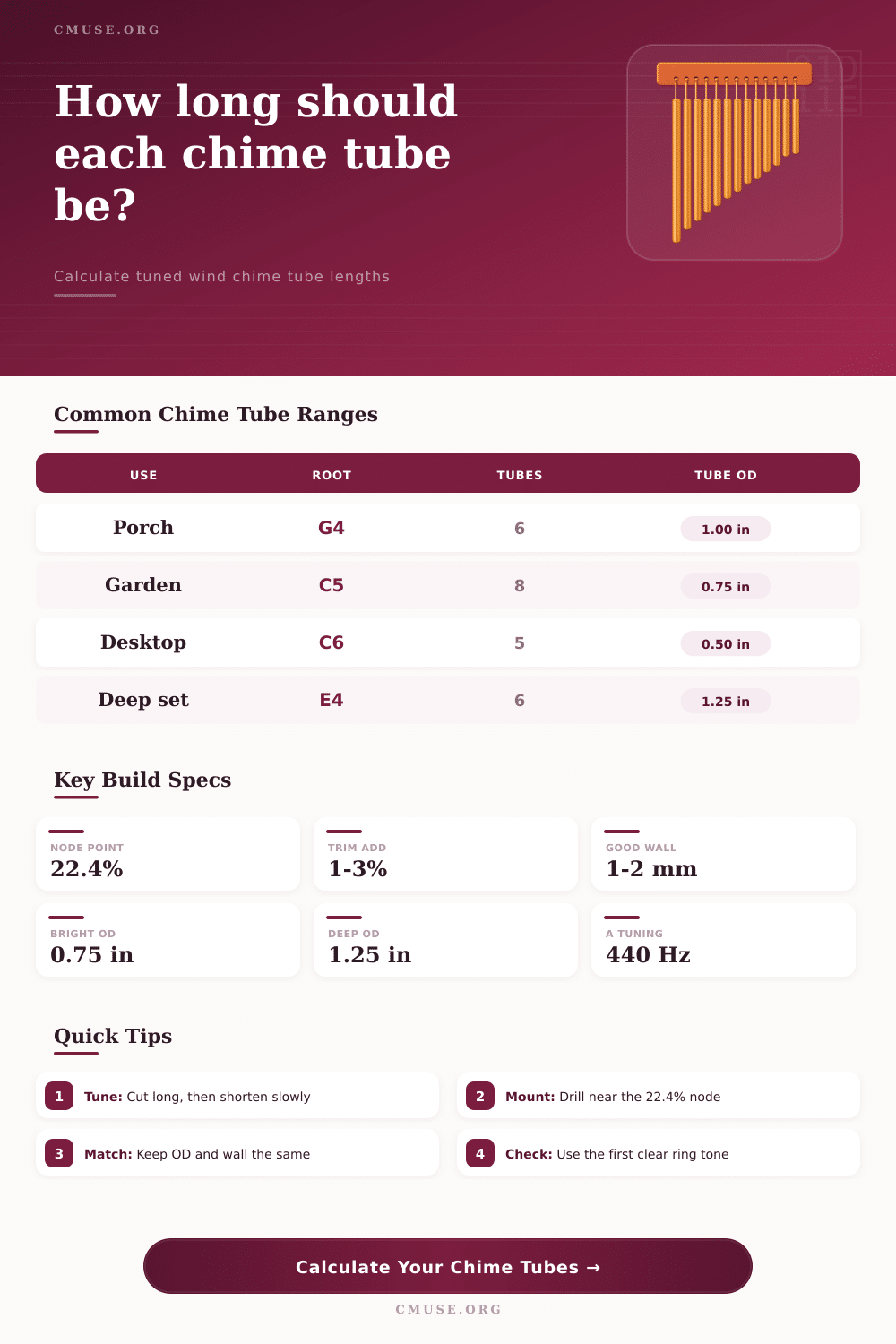
| Suspension node | 22.4% from either end | Lowest bending mode rings freely | Hole column uses this value |
| Drill clearance | 2-3x cord diameter | Prevents binding at the node | Apply after length is marked |
| Clapper height | 45-55% down tube | Excites a full, clean strike | Use longest tube as layout guide |
| Trim allowance | 1-3% extra length | Shortening raises pitch safely | Set with the trim input |
Wind chimes: Most mass-produced windchimes available in big box stores are a tossed salad made from bunch of silverware in the washer; it’s not by design but rather due to physics (tube length vs. The density of materials determines the pitch. As DIYers who make your own, you becomes both an engineer and a luthier.
Millimeters matter, as does the elastic nature of the metal. Determining whether what you create is music or just a cacophony of clangs. Brass produce a richer sound then aluminum. Aluminum is bright and forgiving. Stainless steel has harder attack but can overwhelms the garden soundtrack unless paired with something more mellow.
How to Make Wind Chimes
Don’t worry about deriving equations for how beams vibrate; the calculator does all this math for you. Just choose what kind of material you’re using and pick your desired musical scale (perhaps a natural minor for a moodier sound, or a major pentatonic for clarity). Then it calculates exactly how long each cut need to be to produce those pitches. It even factors in that pitch goes down as the square of length increases. In other words: A small change in length result in a big shift in frequency.
Precision trumps power when it comes to cutting. Material choice determine both the color of the sound and the length of each tube needed to reach a particular note. Aluminum is almost 3 times as dense as brass. This means that if you tune two sets of chimes to the same key, the aluminum set would of been much longer than the brass set. This affects how much eave depth or wall space you have to work with and how visually balanced your installation look.
Heavier metals can pack more music into a smaller physical space when working within limited vertical clearances. They do, however, need stronger suspension hardware since that additional weight will swing harder in higher wind conditions. The majority of the structural and acoustic failures in DIY projects happen because someone suspends something and doesn’t know how or where to do it.
Drilling a hole in a chime tube wherever you want isn’t going to cut it. A chime tube that is suspended at each end (free-free beam) have nodes about 22.4 percent of the way along from each end. This means that suspending your tube closer to one of these nodes allow it to vibrate more freely with less damping. Mounting it straight in the middle kills the sustain by choking the vibration. The calculator identifies these key points for you so that your mounting hardware support the tube in places it wants to vibrate and not interfere with natural vibration.
It’s not all math; cutting technique matter too. Don’t expect to cut right down to finished size on initial pass. Always leave yourself a slight trimming margin, like maybe one or two percent over. You can always make a tube shorter, but you cannot make it longer.
Gently tap the tube against something soft like a wooden dowel or even a mallet and let it find its natural frequency by ear. Is it sharp? File very slightly along the tube’s bottom. Do that again. And then again until it sounds the note you want. Sounds tedious? Yes, it is. But this method of step-by-step improvement is how we gets away from amateur guesswork and towards pro results.
The subtler element here is that the wall thickness affect the tone color too. Thinner walls tend to sound brighter, with a richer and more complex set of overtones. Conversely, a thick wall might sounds a bit dull, though it will be more robust against weathering. When placing them outdoors, you’d like some metal strength so that they can stand up to hail and other debris without denting and thereby permanently detuning the tube. One or two millimeters usually hits the sweet spot on common brass and aluminum stocks between sound quality and structural durability.
In the end, building tuned chimes teaches us all to be patient. Your first several cuts won’t be right; you’ll likely scrap at least one tube along the way. However, after getting a feel for what affects the volume (material density) and what effects the pitch (length), it get pretty simple. Before you grab your saw, you can hear the sound in the wood that will soon become music. It’s worth every millimeter of wasted metal.