Cents Per Peg Turn Calculator
Estimate how many cents a tuning key changes per button turn from tuner gear ratio, post diameter, string gauge, scale length, note frequency, and wrap efficiency.
Choose a realistic starting point, then replace the dimensions with your own tuner, string, and instrument measurements. The result models one tuning-button turn, not one full capstan rotation.
Calculation Breakdown
Post Travel Per Button Turn
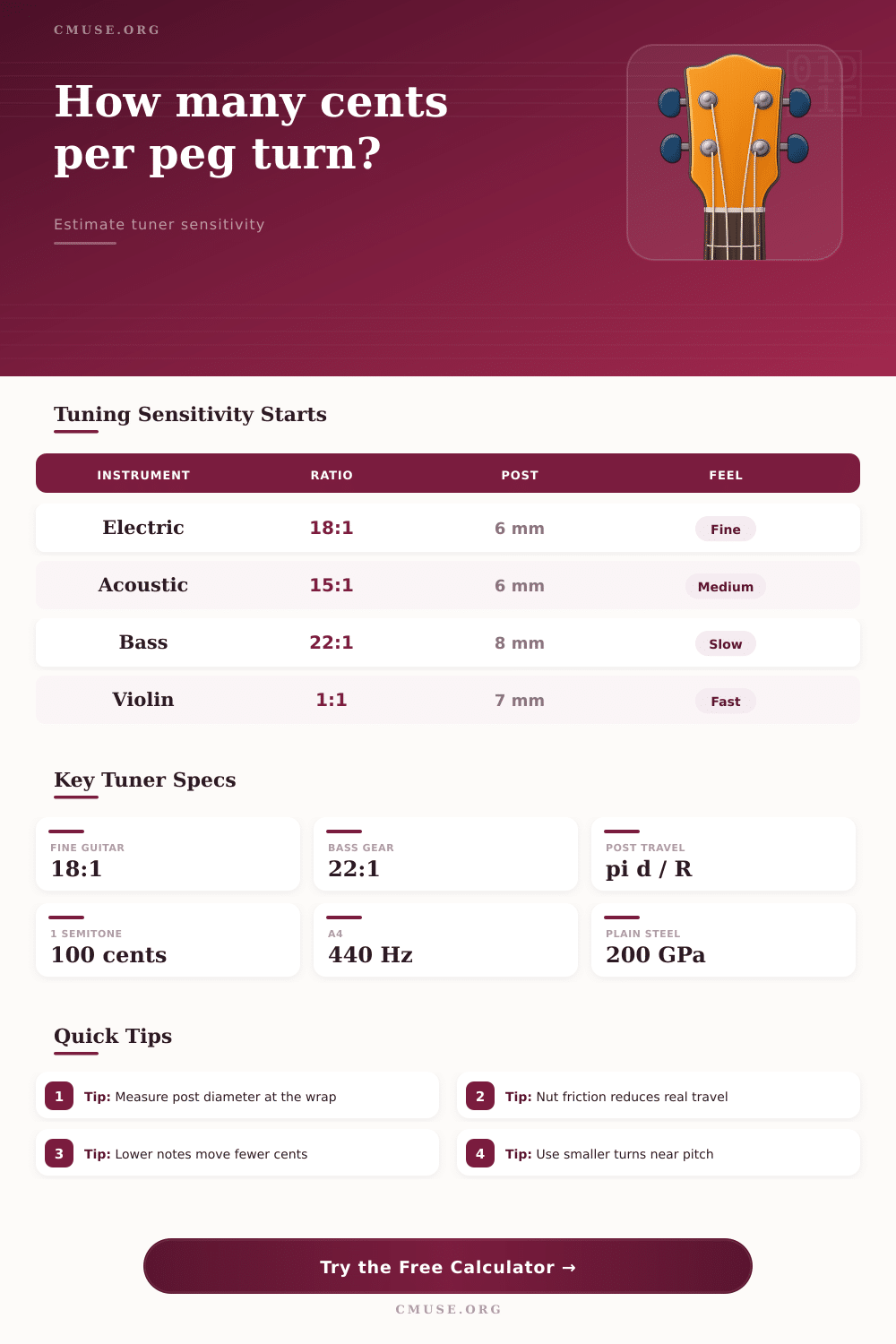
A geared machine head turns the post by one divided by the ratio, so string take-up is the post circumference divided by that ratio, then adjusted for wrap efficiency.
travel = pi x post diameter / gear ratio x efficiency
Pitch From Tension Change
For the same speaking length and mass, frequency follows the square root of tension. The calculator converts that ratio into cents.
cents = 600 x log2((T + deltaT) / T)
| Tuner Type | Typical Ratio | One Post Rev Needs | Practical Tuning Feel |
|---|---|---|---|
| Vintage guitar machine | 12:1 to 14:1 | 12 to 14 button turns | Quick larger pitch jumps per turn |
| Modern sealed guitar tuner | 16:1 to 18:1 | 16 to 18 button turns | Balanced common for setup work |
| High-ratio guitar tuner | 19:1 to 21:1 | 19 to 21 button turns | Fine easier small corrections |
| Bass machine head | 20:1 to 24:1 | 20 to 24 button turns | Slow helpful for heavy strings |
| Direct orchestral peg | 1:1 | One peg rotation | Sensitive use tiny movements |
| Construction | Approx Density | Approx Modulus | Calculator Use |
|---|---|---|---|
| Plain steel | 7850 kg/m³ | 200 GPa | Electric, acoustic, mandolin plain courses |
| Nickel wound steel | 7000 kg/m³ | 95 GPa effective | Guitar wound strings with flexible wrap |
| Phosphor bronze wound | 7600 kg/m³ | 105 GPa effective | Acoustic wound strings |
| Bass roundwound | 7400 kg/m³ | 85 GPa effective | Large wound bass strings |
| Nylon monofilament | 1150 kg/m³ | 2.5 GPa | Classical guitar treble strings |
| Fluorocarbon | 1780 kg/m³ | 5 GPa | Ukulele or compact nylon-family strings |
| Preset | Scale / Note | Tuner Ratio | Why It Feels This Way |
|---|---|---|---|
| Electric guitar high E | 25.5 in / E4 | 18:1 | Thin steel is stiff enough that small post travel changes cents quickly. |
| Electric guitar low E | 25.5 in / E2 | 18:1 | Lower frequency and wound construction make the same turn feel broader and slower. |
| Bass A string | 34 in / A1 | 22:1 | Large string and high ratio keep pitch movement controlled. |
| Ukulele A string | 13.5 in / A4 | 14:1 | Low stiffness means the string stretches more for each small post movement. |
| Violin A peg | 12.9 in / A4 | 1:1 | Direct friction pegs are very sensitive because the post turns without gearing. |
| Pitch Difference | Cents | Typical Use | Peg-Turn Reading |
|---|---|---|---|
| Barely visible strobe drift | 1 to 2 cents | Fine intonation or recording check | Use a small fraction of the shown turn amount. |
| Small tuning correction | 3 to 5 cents | Normal final tuning window | Good target for the last approach to pitch. |
| Clearly off in a chord | 8 to 12 cents | Retune before close harmony | Often less than one peg turn on treble strings. |
| Quarter tone | 50 cents | Microtonal reference point | Use the turns-per-cent result times 50. |
| One semitone | 100 cents | Neighboring chromatic pitch | Large move; approach gradually and recheck settling. |
Have you ever had the experience where you turn a guitar peg maybe a 1/4 of an inch and it goes from perfectly in tune to noticeabley flat? The source doesn’t actualy say that note goes back to being in tune when you adjust it again. It’s like you are trying to thread a needle as somebody keep shaking the table under you.
Most players attribute this to their ears, or lack of ability to hear pitch. However, the problem is never auditory, it is almost universally mechanical. There is a handful of variables that govern relationship between what happens physically with your hand, and how much string tension change. These variables interact in ways that seem unintuitive until you lay them out clearly.
Why Your Guitar Is Hard to Tune
So what’s responsible? It’s mostly due to the tuner gear ratio, a number that represent how many times post will spin with one full turn of button. In essence, the higher the gear ratio (an eighteen-to-one is pretty high), the more detail you’ll get per turn and therefore smaller the pitch change for every turn of the button.
However, there is another factor: the diameter of the tuning post where string winds around it. The bigger the diameter here, the more length of string you pull with every degree of turn, resulting in greater pitch change. That’s why we see some really high-gear-ratio bass tuners that can still be sensitive even though they may have large-diameter posts to fit their thicker strings.
After plugging-in your own numbers, the calculator above does all the math for you so you don’t have to guess about how all those forces balance out on your individual instrument. Interestingly, this dynamic also has a lot to do with how strings themselves are constructed. On one hand, steel strings is very rigid. They don’t stretch much at all when pulled. Any slight change in the pulled string result in a matching big change in tension.
On the other hand, nylon strings are far less rigid and stretch like crazy with applied pressure. The result: they act as a sort of shock absorber that dulls the immediate effect of a tuner’s turn on the pitch. When you twist a nylon-string tuner a fair distance, you won’t hear a huge jump in tone because instead of only becoming taut, string is stretching out too.
Realizing this material distinction helps show why classical guitarists approach tuning different than their electric counterparts. It’s not habit alone. It’s science.
That’s where friction comes in: there is no straightforward way for any formula to account for all the ways it enters a set-up. Wraps, bridge saddle, the nut slot itself (each add to the resistance). As you turn a peg, you don’t always just pull the string tight; some of that effort are spent compressing loose windings, or fighting the static friction between them. That’s also why tightening up to a given pitch can sometimes feel less reliable than approaching it from below. Once the string is snug against the nut, you have a cleaner transfer of motion.
Even with real world variations, the tool comes close to this based off your set-up, and even then it should of be viewed as a guide, not an unchangeable law. While frequency and note are useful concepts to consider when tuning, thinking in cents brings practical advantages. A cent is a hundredth of a semitone which give you a granular scale with which to measure small variations in pitch that can make all the difference when it comes to recording and ensemble performance. And if you have a calculator handy, and it tells you that a full turn is worth 50 cents, then you instantly realize that a quarter-turn will alter the pitch by twelve and a half cents.
This type of mental mapping allows rapid tuning as you’re not guessing anymore but rather calculating. You begin to be aware of exactly how hard you need to turn for a fine adjustment against a coarse correction. In conclusion, knowledge of how your instrument tunes removes one source of stress while performing. You no longer struggle with pegs that is either too tight or too loose; you have a reliable handle on things.
You don’t just want the correct note; you also want to reach it quickly and hold it in place. Your fingers know exactly which keys to turn and what to expect as they do so. How the various combinations of string material, post size, and gear ratio interacts makes tuning more than guesswork. It becomes much more predictable.