
The first time you hear a live Celtic session in a dimly lit pub the sound hits you somewhere behind the ribs. It’s not just melody. It’s the physical punch of a wooden flute cutting through chatter, the heartbeat thump of a goatskin drum, the bright ripple of strings that somehow feel older than the stones outside.
Those sounds come from instruments shaped by centuries of migration, invasion, and pure stubborn survival. Understanding them does more than satisfy curiosity. It lets you hear the music the way the old players intended, and it tells you why certain tunes still raise the hair on your arms.
Celtic folk music stretches from Ireland and Scotland to Brittany, Wales, Cornwall, and the Isle of Man, carrying slightly different flavors in each place. Yet a handful of instruments appear again and again, each one solving a particular musical problem. Some provide the soaring lead lines that make you want to dance or weep.
Others lay down the rhythmic drive that turns a roomful of strangers into a single moving body. The following instruments have earned their place in the tradition because they do their jobs so well that players keep returning to them, generation after generation. Each carries its own demands, its own rewards, and its own small pitfalls.
Essential Celtic Folk Instruments To Know
1. Uilleann Pipes
The uilleann pipes sit at the top of the list for good reason. Developed in Ireland during the 1700s, these bellows-blown bagpipes produce a far more intimate sound than their Scottish cousins. Instead of marching across hills, they whisper, sigh, and cry in the space between your shoulder blades.
You play them sitting down with the bag tucked under one arm, pumping a bellows with the other while your fingers dance across a chanter that has keys for extra notes. The regulators, those extra pipes with keys, let a skilled piper add harmonic accompaniment, turning the instrument into a one-man orchestra. That versatility explains why the uilleann pipes became the undisputed king of slow airs and dance tunes alike.
Yet they are notoriously difficult to keep in tune and even harder on the hands. Many players spend years mastering just the steady air supply before the music begins to flow. The payoff is worth every blister.
2. Tin Whistle
Next comes the tin whistle, an instrument so simple it looks like a child’s toy until you hear it in the hands of a master. Made from a narrow metal tube with six finger holes, it can cut through an entire session with a bright, piercing tone that carries the melody like a banner. The whistle’s great secret is its ability to move between ornamented Irish style and the more rounded Scottish approach with only tiny changes in breath and finger technique.
Beginners can produce a decent sound in an afternoon, which explains its popularity, but the best players treat it like a serious flute, using half-holing, breath control, and lightning-fast rolls to create effects that rival any wooden instrument. Its low cost and portability make it the perfect gateway into Celtic music, though its high D whistle remains the session standard for a reason. It simply balances volume and agility better than any other key.
3. Celtic Harp
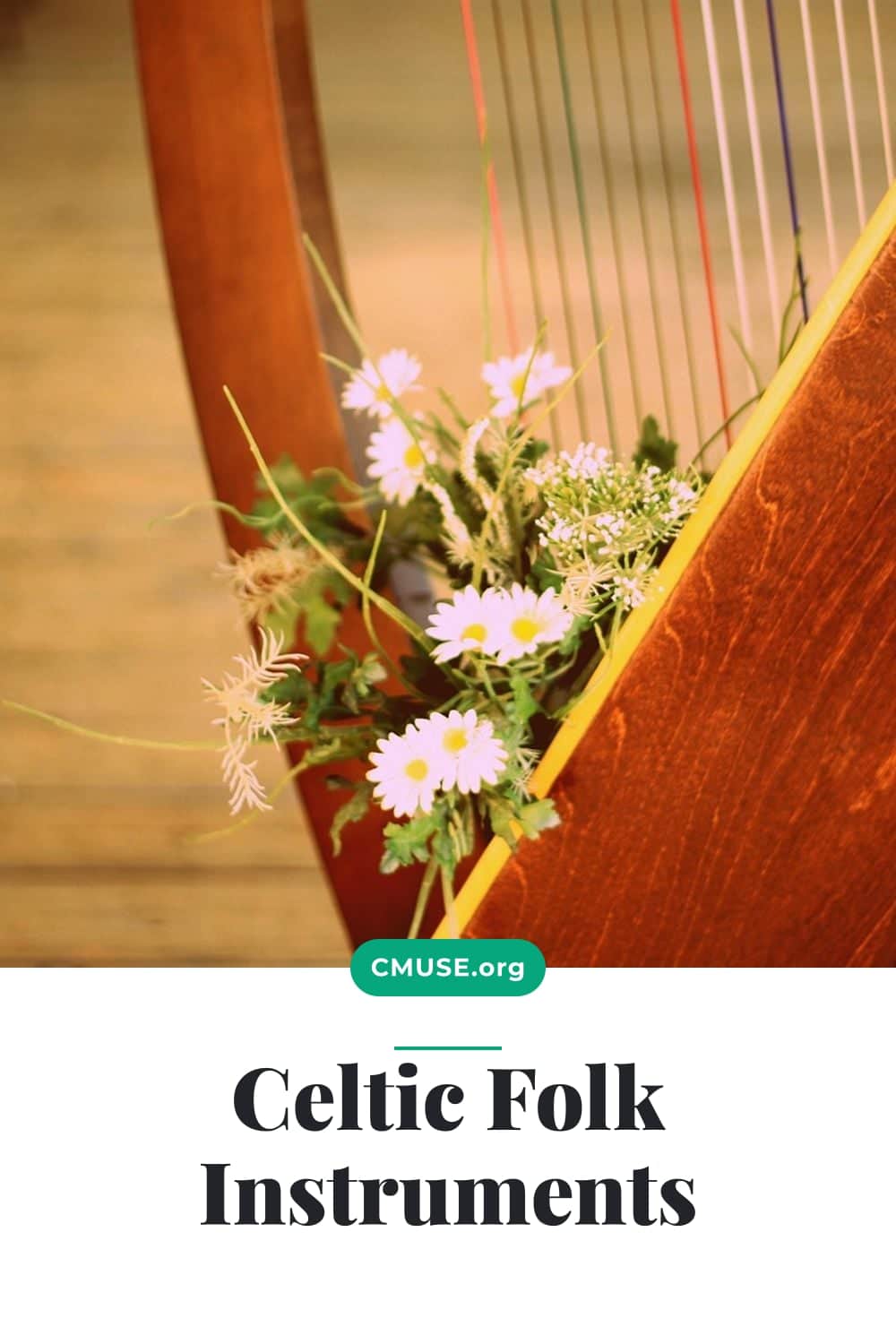
The Celtic harp occupies a different emotional register entirely. Once the instrument of kings and bards, the wire-strung clarsach fell out of common use after the old Gaelic aristocracy collapsed. Modern players have brought it back with a vengeance, using both nylon and traditional wire strings.
The wire-strung version delivers a bell-like ringing that decays slowly, allowing harpists to layer chords and melodies in ways that feel almost orchestral. When you watch a good player, the hands seem to argue with each other, one damping strings while the other plucks new ones, creating cascades of sound that shimmer long after the fingers have moved on. The harp’s place on this list comes from its unique ability to carry both the ancient dignity of court music and the raw emotion of contemporary folk song.
Its main drawback is volume. In a noisy pub session the harp often needs amplification, which can strip away some of its delicate magic.
4. Bodhran
Few instruments embody the raw physicality of Celtic music like the bodhran. This shallow frame drum, traditionally made with goatskin, provides the thumping heartbeat that drives reels and jigs forward. Players hold it upright on their lap and strike the skin with a short double-headed stick called a tipper.
The real art lies in the left hand, which presses against the inside of the drumhead to control pitch and tone while the right hand delivers everything from machine-gun rolls to soft breathing accompaniment. A good bodhran player never simply keeps time. They listen to the melody, anticipate the lift points, and answer the tune with rhythmic conversation.
That dialogue is what separates musical accompaniment from mere noise. The instrument’s recent rise in popularity has brought better construction and synthetic heads that stay stable in changing weather, yet many traditionalists still swear by the goatskin models that react to humidity the way a living thing would.
5. Fiddle
The fiddle comes in at number five not because it is less important but because its demands are so deceptively familiar. To the untrained eye it looks like a standard violin, yet Celtic fiddling uses a completely different technique. Players often hold the instrument lower on the collarbone, keep the bow closer to the fingerboard, and favor short, choppy strokes that create a driving pulse.
Ornamentation happens with the left hand through cuts, rolls, and grace notes that decorate the melody without slowing it down. Regional styles announce themselves immediately. A Donegal fiddler attacks the strings with fierce down-bows while a Shetland player adds Scandinavian lilt and harder drone notes.
The fiddle’s flexibility explains why it has become the lead voice in so many bands. It can sob like the uilleann pipes or skirl like the highland pipes depending on the player’s choices. The instrument’s challenge lies in unlearning classical habits.
Many trained violinists struggle to loosen their grip on the bow and let the rhythm breathe.
6. Concertina
The concertina earns its spot through pure mechanical cleverness. Smaller than an accordion and louder than its size suggests, the English and Anglo-German systems both found homes in Celtic music, though the Anglo dominates in Ireland. Players push and pull the bellows to sound different notes on the same button, creating a bouncy, rhythmic phrasing that perfectly matches the lift of a jig.
Because each button produces two notes, one on the push and one on the pull, the player must constantly think about bellows direction. That constraint forces creative fingering patterns that give Irish concertina music its distinctive clipped phrasing. The instrument traveled from Victorian drawing rooms to rural kitchens because it was loud enough to lead a dance yet small enough to carry on a donkey cart.
Modern makers still build them one at a time, which explains the long waiting lists and high prices. Learning one demands patience, but few instruments reward it so completely.
7. Wooden Flute
The wooden flute brings us to perhaps the most deceptively difficult instrument on this list. Simple in appearance, with six holes and no keys in its basic Irish form, the flute demands perfect breath control and airtight finger technique. Players use a technique called “half-holing” to produce notes between the main scale, and they decorate melodies with rolls and crans that mimic the ornamentation of the uilleann pipes.
The flute’s tone changes dramatically depending on the wood and the maker. A Rudall & Rose copy from the 19th century will sound buttery and dark, while a modern Delrin flute can be bright enough to slice through the loudest session. Its place here comes from its unmatched ability to carry emotion.
A slow air played on a wooden flute can feel like someone telling you their worst troubles without using words. The main tradeoff is its unforgiving nature. Unlike the whistle, a small mistake in finger placement or breath pressure produces an obvious squeak that everyone in the room will hear.
8. Bouzouki
The bouzouki, though a relative newcomer, has earned permanent citizenship in Celtic music. Originally a Greek instrument with a long neck and four courses of strings, it was adapted by Irish players in the 1960s to provide chordal accompaniment with a bright, ringing tone. Tuned like the top four strings of a guitar but an octave lower, the bouzouki allows for wide, open voicings that leave space for the melody instruments.
Players use flat picks and driving rhythms that cut through the mix without stepping on the lead lines. Its inclusion on this list reflects how traditions evolve. What began as an experiment became standard because it solved a real problem: how to add harmonic depth to sessions that previously relied on just melody and rhythm.
The main challenge for new players is overcoming the wide stretch required for some chords and learning to mute strings quickly to stop them ringing into the next change.
These instruments have survived because each one answers a different musical need while still speaking the same ancient language. The uilleann pipes and harp carry dignity and depth. The whistle and flute deliver melody with piercing clarity.
The fiddle bridges classical training and wild expression. The bodhran and concertina supply the physical drive that makes feet move. The bouzouki adds modern color without breaking the spell.
Pick one that calls to you, accept that it will fight back at first, and keep at it. The music has been waiting for centuries. It is patient, but it only reveals its secrets to those willing to sit in the kitchen until the small hours, learning the difference between a tune that is merely correct and one that is truly alive.
When you finally get it right, the old stones seem to lean in a little closer, listening along with you.