Cello String Tension Calculator
Estimate C2, G2, D3, and A3 cello string tension from scale length, reference pitch, tuning offset, and direct formula unit weight.
🎻 Named Cello Presets
⚙ Scale, Pitch, and String Inputs
📊 Live String-by-String Tension
| String | Target Pitch | Frequency | Formula Unit Weight | Tension | Share |
|---|---|---|---|---|---|
| C | C2 | 65.41 Hz | 0.00000245 | 31.0 lb | 23.2% |
| G | G2 | 98.00 Hz | 0.00000108 | 30.6 lb | 22.9% |
| D | D3 | 146.83 Hz | 0.00000055 | 35.1 lb | 26.3% |
| A | A3 | 220.00 Hz | 0.000000265 | 37.9 lb | 28.4% |
🎼 Cello String Spec Grid
| String Set Preset | C UW | G UW | D UW | A UW | Typical Use |
|---|---|---|---|---|---|
| Medium steel orchestral | 0.00000245 | 0.00000108 | 0.00000055 | 0.000000265 | General full-size cello setup |
| Solo bright steel | 0.00000262 | 0.00000116 | 0.00000060 | 0.000000285 | More resistance and carrying power |
| Warm synthetic core | 0.00000230 | 0.00000100 | 0.000000505 | 0.000000245 | Rounder response at moderate load |
| Gut-core lower tension | 0.00000215 | 0.00000096 | 0.000000490 | 0.000000235 | Flexible feel and early-music color |
| Heavy steel projection | 0.00000280 | 0.00000123 | 0.000000640 | 0.000000305 | Higher load for strong projection |
| Target String | Pitch | Frequency at A440 | Pitch Role | Common Tension Aim |
|---|---|---|---|---|
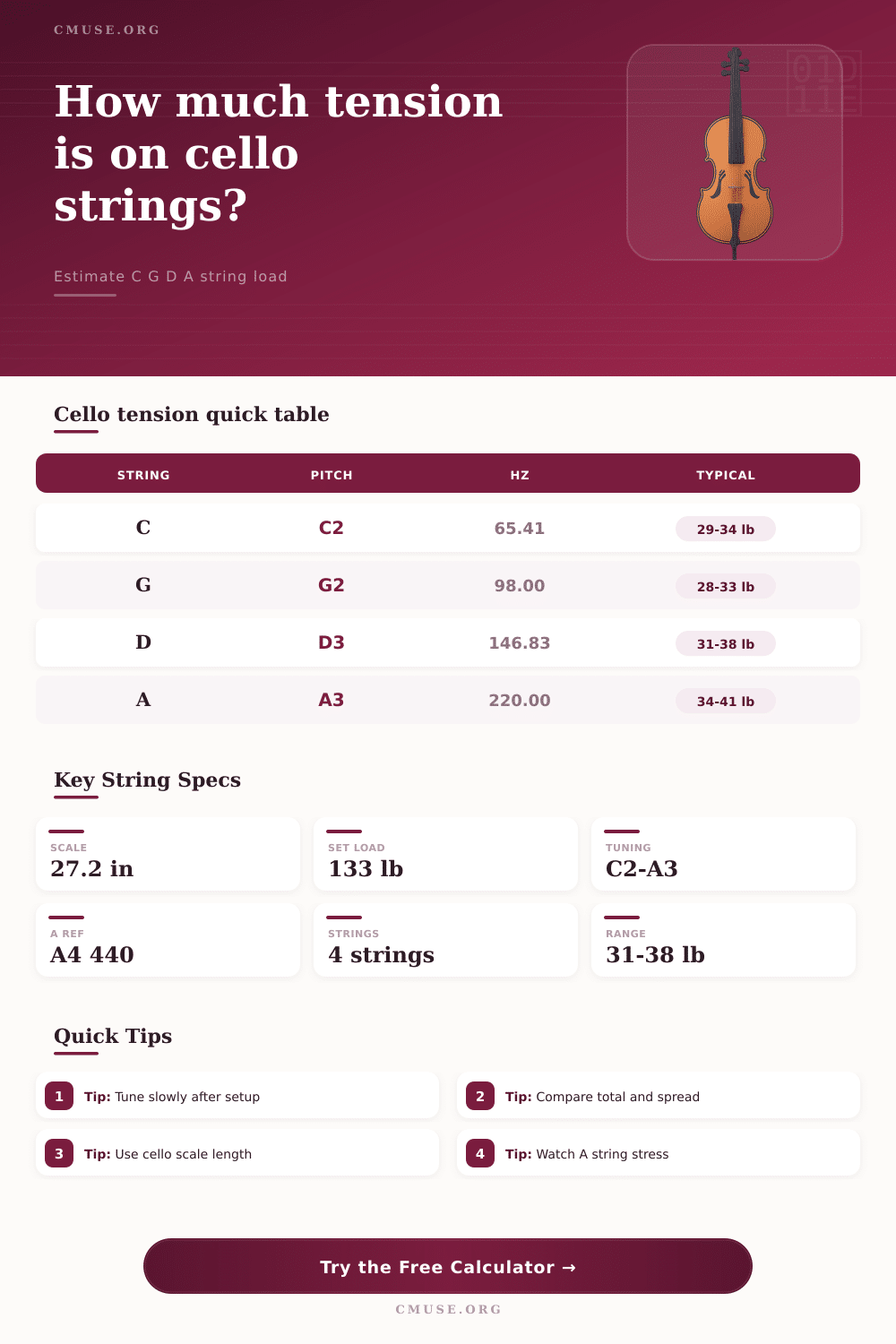
| C string | C2 | 65.406 Hz | Lowest cello register | About 29-34 lb |
| G string | G2 | 97.999 Hz | Lower middle register | About 28-33 lb |
| D string | D3 | 146.832 Hz | Upper middle register | About 31-38 lb |
| A string | A3 | 220.000 Hz | Top cello string | About 34-41 lb |
| Cello Size | Scale Length | Metric Length | Medium Set Load | Best Fit |
|---|---|---|---|---|
| 4/4 full size | 27.20 in | 69.1 cm | 133 lb | Adult orchestral and solo use |
| 7/8 cello | 26.50 in | 67.3 cm | 126 lb | Smaller adult hand span |
| 3/4 student | 24.80 in | 63.0 cm | 111 lb | Intermediate student instruments |
| 1/2 junior | 22.80 in | 57.9 cm | 94 lb | Younger players and short scale |
| Preset Comparison | Scale | A4 / Offset | Feel | Expected Result |
|---|---|---|---|---|
| Full Size Medium Steel | 27.20 in | 440 / 0c | Balanced | Moderate total load |
| Soloist Bright Steel | 27.20 in | 442 / 0c | Firm | Higher A and D load |
| Baroque A415 | 27.20 in | 415 / 0c | Soft | Lower total load |
| 3/4 Student Cello | 24.80 in | 440 / 0c | Comfort | Short-scale reduction |
String tension are a measurement of the load placed upon the strings of a cello. The tension of the strings impacts the way that a cello sound and how it feel to the player. By changing the tension of one of the strings on a cello, the tension of that string will impact both how the whole cello respond to the bow and how the whole cello respond to the player’s left hand.
By replacing a set of strings on a cello, it is possible that one of the strings will be too tight or too loose in comparison to the other string. The string tension calculator use parameters like the scale length of the cellos, the reference pitch of the cellos, the tuning offset of the cellos, and the unit weight of the cellos to calculate the tension of each of the strings of the cellos. The player of the cello must understand each of these parameter, as these parameter will impact the string tensions that are calculated.
Cello String Tension Basics
Scale length is the distance from the nut to the bridge of the instrument, and is approximately 27 inches on full size cellos. Scale length can be shorter on smaller size cellos. Because the tension of a string is inversely related to the length of that string, small change in scale length can have a large impact upon the tension of the cellos’ strings.
Thus, it is possible for a set of strings to feel comfortable upon one cello but uncomfortable upon another cello. By using the calculator, players can adjust the scale length of their cellos to view how their total string tension will change. Unit weight is the mass of the string per unit of length.
Strings of different materials will have different unit weights. Strings with more unit weight will require more tension to achieve the desired pitch. There are preset values for unit weight of the strings that the player of the cello can use.
Additionally, it is also possible to enter the unit weights of the string that the player intend to use into the calculator. The calculator will provide the string tension for each of the strings on the cello, as well as the total tension that will be placed upon the instrument. Reference pitch is the standard pitch upon which the cellos are tuned, and tuning offset is the degree to which those cellos are tuned relative to that reference pitch.
Cellos are not always tuned to moddern pitch; some player prefer to use a lower reference pitch and tuning offset, while others prefer a higher tuning offset. Because pitch is related to frequency, and frequency is related to string tension, any change in pitch will impact the tension upon each of the strings on the cello. The A string on the cellos usually has high string tension, so changes in pitch on this string will have an impact upon the tension upon the rest of the strings on that cello.
The condition setting take into account the differences between the scale length of the cellos and the vibrating length of the strings on those cellos. Any cello that has a bridge that is high or a nut that is positioned in a forward position will have a difference between the vibrating length of the string and the length of the string that is measured between the nut and bridge. Because the vibrating length of the string impacts the string tension, the calculator uses this factor to ensure that the string tension values that are calculated reflect the actual tension of the strings on the cellos.
The string tension calculator will provide several different result for the cellos that are played. Total tension will provide information regarding the total load that is placed upon the neck and the top of the cellos. The average tension for each of the strings will provide information regarding the firmness of each of the strings.
The spread of each of the string tensions will indicate the evenness of the tension of the strings for the player with their left hand. A wide spread in string tension may require the player to utilize more bow pressure and/or finger strength to play each of the strings, which can be fatiguing for the player. The calculator allows for two set of strings to be entered into the instrument, allowing the players to view these measurement for each set of strings.
While it may be assumed that the higher the tension of the string for the cellos, the louder and more voluminous will be created by those strings. However, high tension for the strings will cause the string to resist the bow that is played upon the cellos, and will reduce the amount of overtones created by the string. Thus, a string with very high tension will produce very little volume.
For this same reason, a string with medium tension will typically respond more easy to the bow. The target selector at the bottom of the string tension calculator allow for the player to label each of the calculated tensions according to the goal that the player intend to achieve with the strings on their cellos. However, the tension measurements will remain the same regardless of the label for each target.
Thus, the player must decide whether the tension values for each of the strings on the cellos will create the desired sound of those cellos. Many of the factor that relate to cellos have some variable that the string tension calculator does not take into account. For instance, the effect of temperature and humidity upon the length, stiffness, and string tension of the cellos’ strings.
Additionally, the bridge and soundpost of the cellos can impact the way that the tension of the cellos’ strings impacts the tone that is produced by the cellos. Finally, the neck of many of the cellos that are played by experienced cellos player may have changed the shape of the neck over time due to the high tensions that are placed upon those cellos with the strings of the instruments. Because of these variable, string tension calculators are typically used as a starting point for string tension measurement.
Thus, the player of the cellos should calculate the string tensions for the player, and then listen to the cellos during the first few days after installing the new strings. Another important factor related to cellos is to keep notes regarding the string tensions. Each player should write down the scale length of their cellos, the type of strings that are used, and the total tension that the string tension calculator calculates.
By maintaining these notes, the player can determine any pattern in the tensions of the strings that may form on their cellos. For instance, the player may discover that their cellos tend to require lower tension upon the A string, or that their cellos require higher tension upon the C string. Thus, the string tension calculator is a helpful tool that allows players to discover these variable.
Overall, the goal with using the string tension calculator is to find a tension for the strings of the cellos that will make the instrument feel good to play and sound as the player would like it to sound.