🔊 xten AV Ceiling Speaker Placement Calculator
Calculate optimal speaker count, spacing, and coverage zones for any room
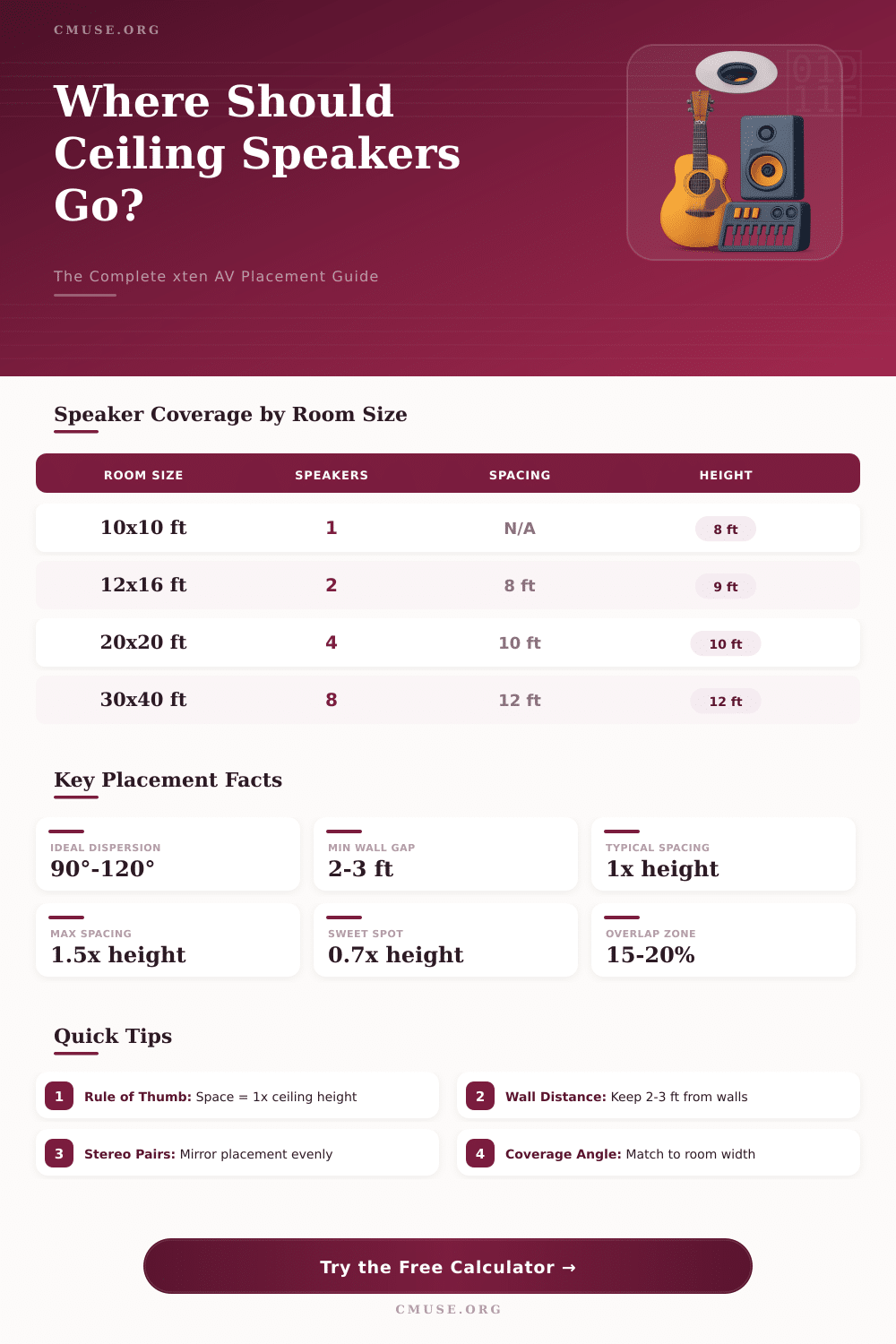
| Ceiling Height | 60° Radius | 90° Radius | 120° Radius | 140° Radius | Coverage (120°) |
|---|---|---|---|---|---|
| 7 ft (2.1 m) | 4.0 ft | 7.0 ft | 12.1 ft | 16.7 ft | ~459 sq ft |
| 8 ft (2.4 m) | 4.6 ft | 8.0 ft | 13.9 ft | 19.1 ft | ~606 sq ft |
| 9 ft (2.7 m) | 5.2 ft | 9.0 ft | 15.6 ft | 21.5 ft | ~764 sq ft |
| 10 ft (3.0 m) | 5.8 ft | 10.0 ft | 17.3 ft | 23.8 ft | ~942 sq ft |
| 11 ft (3.4 m) | 6.4 ft | 11.0 ft | 19.1 ft | 26.2 ft | ~1,144 sq ft |
| 12 ft (3.7 m) | 6.9 ft | 12.0 ft | 20.8 ft | 28.6 ft | ~1,357 sq ft |
| 14 ft (4.3 m) | 8.1 ft | 14.0 ft | 24.2 ft | 33.4 ft | ~1,841 sq ft |
| 16 ft (4.9 m) | 9.2 ft | 16.0 ft | 27.7 ft | 38.1 ft | ~2,410 sq ft |
| Application | Recommended Spacing | Overlap | Notes |
|---|---|---|---|
| Background Music | 1.0× ceiling height | 10–15% | Even coverage, subtle |
| Home Theater | 0.7× ceiling height | 20–25% | Immersive, tight grid |
| Speech / Paging | 0.8× ceiling height | 15–20% | Intelligibility first |
| Music Listening | 1.0× ceiling height | 15% | Balanced stereo field |
| Studio Monitoring | Equilateral triangle | N/A | Ear-level preferred |
| Retail / Commercial | 1.0–1.2× height | 10–15% | 70V line preferred |
| Gym / Sports | 1.2–1.5× height | 10% | High SPL, wide angle |
| Restaurant | 0.9–1.1× height | 15–20% | Warm, even feel |
| System Type | Impedance | Best For | Max Run (Wire) | Typical Power |
|---|---|---|---|---|
| 8Ω Full-Range | 8 ohm | Home, studio, small rooms | ~50 ft | 20–100W/ch |
| 8Ω Studio Monitor | 8 ohm | Recording, mixing | ~30 ft | 30–150W/ch |
| 70V Commercial | 70V line | Retail, offices, restaurants | 1000+ ft | 2–16W/tap |
| 100V Commercial | 100V line | Large venues, outdoors | 1500+ ft | 2–20W/tap |
| Stereo Pair | 8 ohm | Dedicated listening rooms | ~50 ft | 50–200W/ch |
| 5.1 Surround | 8 ohm | Home theater rooms | ~75 ft | 75–150W/ch |
| 7.1 Surround | 8 ohm | Dedicated HT rooms | ~100 ft | 75–200W/ch |
| Dolby Atmos OH | 8 ohm | Atmos overhead channels | ~50 ft | 50–100W/ch |
| Room | Size (ft) | Area | Ceiling Ht | Speakers (120°) | Grid Layout |
|---|---|---|---|---|---|
| Small Bedroom | 10 × 10 | 100 sq ft | 8 ft | 1 | 1×1 center |
| Master Bedroom | 14 × 12 | 168 sq ft | 9 ft | 2 | 1×2 |
| Living Room | 18 × 15 | 270 sq ft | 9 ft | 2 | 1×2 |
| Home Theater | 20 × 16 | 320 sq ft | 9 ft | 4 | 2×2 |
| Conference Room | 24 × 18 | 432 sq ft | 10 ft | 4 | 2×2 |
| Restaurant (sm) | 40 × 30 | 1,200 sq ft | 12 ft | 6 | 2×3 |
| Retail Store | 50 × 40 | 2,000 sq ft | 12 ft | 8 | 2×4 |
| Large Gym | 60 × 40 | 2,400 sq ft | 14 ft | 8 | 2×4 |
Right positions for ceiling speaker placement truly change the sound of your system. The place where you put them affects the sound quality that you receive, and in big rooms the challenges grow. For small areas two speakers are enough even so four of them give more balanced sound that spreads more well than most many folks think.
Ceiling speaker placement speakers sit flat with the ceiling, which helps to keep the room clean and without messes. What is the trade-off? They stay set for always.
Where to Place Ceiling Speakers
You can not fix their angle or move them later, so good plan the position from the start not only helps but is needed.
Your surrounding speakers must be at the same distance from one another as your front left and right. During setup of wall or ceiling speaker placement speakers, put them at least 45 to 60 centimetres away from walls and corners. Before you cut holes, find the ceiling beams first…
That svaes many problems later.
For Dolby Atmos, the two ceiling speaker placement speakers sit a bit before your seat and spread just as broadly as the front. Dolby gives clear guide for the angles between left and right, and here is the secret: they point straight to the ear height. On sloping ceiling you can turn the speakers at equal angle, so that they point to the listening area instead of to empty space.
When the placement gets hard, directional speakers with adjustable tweeters and high sounds help a lot. Good ceiling speaker placement speakers naturally are directional, and great planning is useful for them, even though they form bigger sweet spot that works for casual hearing or background music. Room problems however can complicate everything.
7.1 setup includes two extra surrounding speakers between the front and back, forming a pair of mid-surrounding to the left and to the right. Subwoofers are more flexible, because bass sounds do not have strong direction, truly, you can lay a subwoofer almost anywhere and it will still work well.
Different rooms and ceiling materials need different methods. High built-in speakers often need professional help, and hiring someone with good design and install experience is worth every penny. Coverage calculators are useful tools, they study you’re room and seat position for ideal speaker spots.
Some programs even show the coverage in 3D before you make one hole.
Speakers beside the television sound best, if they are equally far from your main watching and listening spot. For background music in kitchen or dining room, putting two stereo speakers at about quarter and three-quarter of the center line keeps things simple and workswell. Perfect placement is not always possible even so, lights, vents and other ceiling objects often get in the way.