Car Audio Wire Gauge Calculator
Size amplifier power cable from RMS output, amplifier efficiency, battery voltage, one-way run length, copper resistance, return path, voltage-drop target, and fuse margin.
🚙 Named Car Audio Install Presets
⚙ Amplifier, Cable, and Voltage Inputs
📊 Current Install Spec Grid
🔌 Gauge Comparison for This Install
| Gauge | Drop | Drop % | Ampacity Check | Status |
|---|
🧮 Copper Resistance and Ampacity Reference
| Wire size | OFC resistance | Typical car audio ampacity | Best use | CCA note |
|---|---|---|---|---|
| 12 AWG | 1.588 ohm / 1000 ft | 25 A | Small processors, short accessory feeds | Usually too small for power amps |
| 10 AWG | 0.999 ohm / 1000 ft | 40 A | Small four-channel or powered sub | Use only for very short low-current runs |
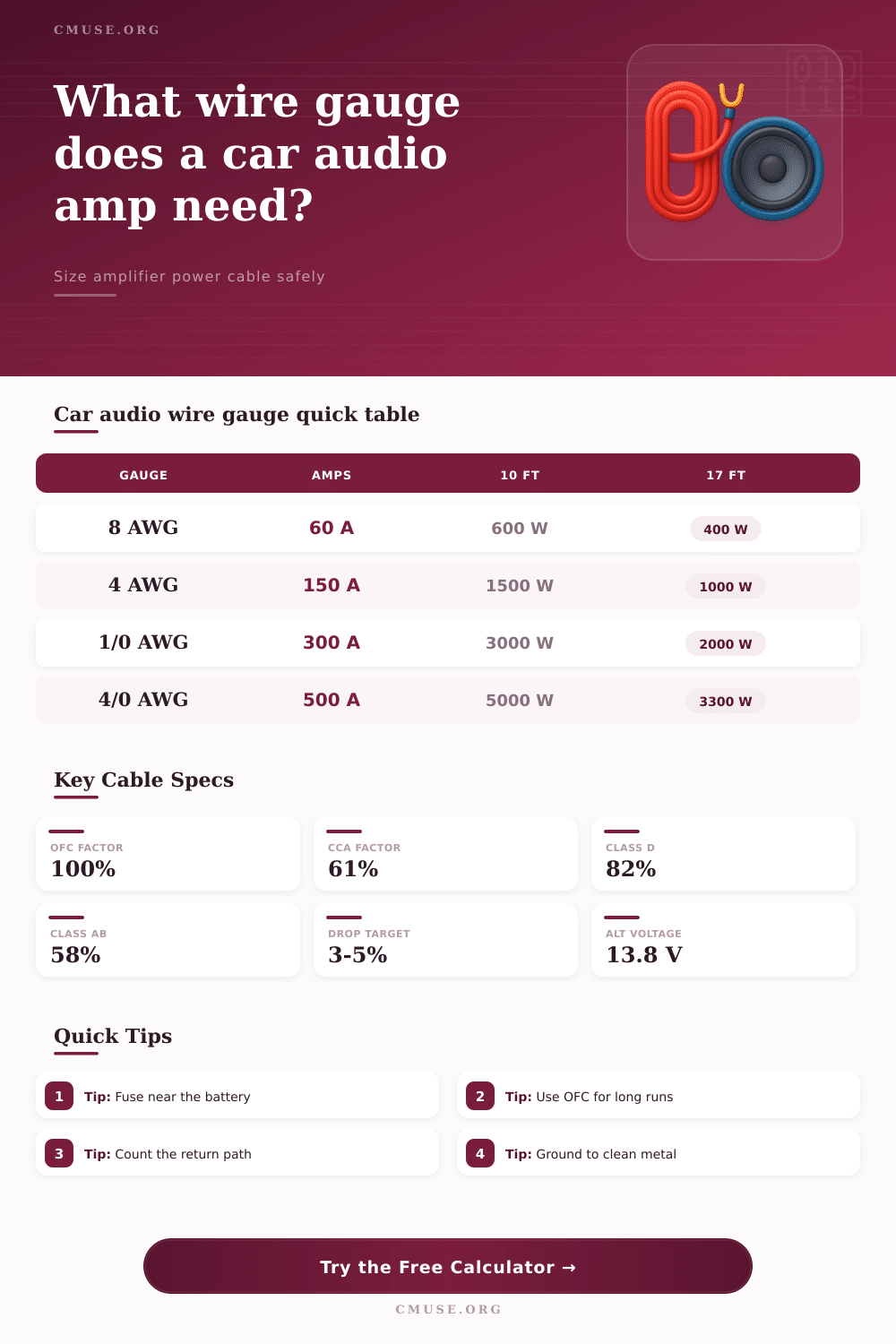
| 8 AWG | 0.628 ohm / 1000 ft | 60 A | Compact sub amp or modest full-range amp | CCA behaves closer to a smaller cable |
| 4 AWG | 0.249 ohm / 1000 ft | 150 A | Common 600-1500 W daily install | Often needed when CCA replaces 8 AWG |
| 1/0 AWG | 0.098 ohm / 1000 ft | 300 A | Large mono amp or two-amp trunk system | Better for long runs and high current |
| 4/0 AWG | 0.049 ohm / 1000 ft | 500 A | Competition power or multiple parallel amps | Rarely practical as CCA |
📐 Amplifier Efficiency and Current Reference
| Amplifier type | Typical efficiency | 1000 W current at 13.8 V | Cable implication | Notes |
|---|---|---|---|---|
| Class D mono sub amp | 78-86% | 88 A at 82% | 4 AWG often passes short daily runs | Efficient for subwoofer power |
| Full-range Class D | 72-82% | 93 A at 78% | Similar to Class D mono, slightly more draw | Common in compact multi-channel amps |
| Mixed Class D and AB | 65-75% | 101 A at 72% | Plan one gauge larger on long runs | Typical sub plus front-stage system |
| Class AB full-range | 50-65% | 125 A at 58% | Needs more cable for same RMS watts | More heat and idle draw than Class D |
🚗 Install Preset Comparison
| Preset | RMS power | Run length | Efficiency | Likely cable |
|---|---|---|---|---|
| Compact Hatch Sub | 500 W | 11 ft / 3.4 m | 82% | 8 AWG or 4 AWG with growth |
| Sedan 1000W Mono | 1000 W | 17 ft / 5.2 m | 82% | 4 AWG OFC |
| Daily Two-Amp System | 1500 W | 18 ft / 5.5 m | 72% | 1/0 AWG OFC |
| Rear Battery Rack | 2800 W | 5 ft / 1.5 m | 82% | 1/0 AWG or larger distribution |
| Competition 5k | 5000 W | 14 ft / 4.3 m | 82% | 4/0 AWG or parallel 1/0 |
💡 Cable Sizing Tips
When choosing a power cable for your amplifier, there are several factors to consider. While many people will consider the wattage of their amplifier when choosing an power cable, this isnt the only factor that needs to be considered. Other factors to consider include the efficiency of the amplifier, the lengths of the power cable, the material of the power cable, and the return path for the current.
The efficiency of the amplifier will determine the amount of current that the amplifier will draw from the car battery. For instance, a Class D mono subwoofer amplifier might be 80% efficient at converting the power from the battery to audio. A Class AB full-range amplifier might only be 50% efficient at performing the same task.
How to Choose a Power Cable for Your Car Amplifier
Because the Class AB amplifier are less efficient, it will draw more current than a Class D amplifier in order to output the same amount of RMS watt. The length of the power cable will impact the amount of voltage loss along the power cable. Power cables can range from 10 feet for short installations to over 20 feet for long installations.
As the length of the power cable increases, the resistance in the cable increase which reduces the voltage at the amplifier. A longer power cable will need to be thicker in order to minimize the voltage loss. Another factor to consider is the return path for the current, which is the ground cable for the amplifier.
A short ground strap to the car chassis is desirable. A long negative battery cable to the car chassis will create a longer return path for the current. The material for the power cable will change how much resistance the power cable presents for the current.
If the power cable use pure oxygen-free copper, it will have very low resistance. CCA cable contains an aluminum core and will have higher resistance than oxygen-free copper cable. The CCA cable will need to be thicker than an oxygen-free copper cable of the same gauge.
Using a thin CCA cable will result in a voltage drop at the amplifier. People often aim for a voltage drop of 3% or less for there amplifier application. Others allow a 5% voltage drop at the amplifier.
Those aiming for a smaller voltage drop will be recommended to use a thicker gauge power cable. Another factor to consider is the path of the power cable. The path of the power cable may be longer than the length of the power cable because of the path of the power cable through the firewall grommets.
The power cable will also experience heat in some installations that will reduce the ampacity of the power cable. Common mistakes include only looking at the wattage of the amplifier when purchasing a power cable. Many people will purchase a power cable that is too thin because they only consider the wattage of the amplifier.
Another mistake is to neglect the ground side of the installation. If the ground side is neglected, it will become a bottleneck in the current. A bottleneck in the ground will cause the same problems as a bottleneck in the positive power cable.
You should of considered the positive power cable and the ground return path for the amplifier. Another factor to consider is whether or not you would like to add more amplifiers in the future. If you would like to add another amplifier in the future, the power cable may need to be replaced.
One way to avoid having to replace the power cable in the future is to purchase a power cable that has a larger gauge. Adding a margin for growth in the power cable will ensure that it can handle the current of any additional amplifier that may be added to the car’s audio system in the future. The tables provides information regarding the voltage drop of power cables of different gauge sizes for cars of different lengths.
These tables will show how different gauges of power cable can perform in various applications. However, the tables are not shopping lists for power cables. Instead, you can use them to compare the specifications of the amplifier to the power cables available to determine if it will meet the specifications of the amplifier.
By entering the specifications of the amplifier along with the length of the power cable and the material that you will use in the power cable into the calculator, it will output the size of the power cable needed to supply the amplifier with stabile voltage.