Car Audio Fuse Size Calculator
Estimate amplifier current draw, main power fuse size, branch fuse size, fuse headroom, selected wire ampacity, and fuse-to-cable coordination for car audio power installs.
🚙 Named Install Presets
Model: the calculator converts amplifier RMS power into electrical current, adds selected fuse headroom and future growth, rounds to the nearest practical fuse rating, then checks whether the selected wire can be protected by that fuse.
⚙ Amplifier, Fuse, and Wire Inputs
📊 Live Fuse Spec Grid
🧮 Live Fuse Size Comparison
| Fuse Rating | Headroom vs Draw | Wire Coordination | Family Fit | Status |
|---|
🔌 Wire Ampacity Coordination Table
| Wire Size | Typical OFC Ampacity | CCA Planning Ampacity | Common Fuse Range | Install Use |
|---|---|---|---|---|
| 12 AWG | 25 A | 15 A | 15-25 A | Processor, relay, or very small accessory power. |
| 10 AWG | 40 A | 25 A | 30-40 A | Small powered sub or compact four-channel amp. |
| 8 AWG | 60 A | 35 A | 40-60 A | Mild sub amp and short low-current runs. |
| 6 AWG | 100 A | 60 A | 80-100 A | Intermediate size when 8 AWG is tight. |
| 4 AWG | 150 A | 90 A | 100-150 A | Common daily 600-1500W Class D power run. |
| 2 AWG | 200 A | 120 A | 150-200 A | Large mono amp or two moderate amplifiers. |
| 1/0 AWG | 300 A | 180 A | 200-300 A | Large trunk systems and high-current distribution. |
| 4/0 AWG | 500 A | 305 A | 350-500 A | High-power demo systems or parallel distribution. |
📐 Fuse Family and Rating Reference
| Fuse Family | Useful Range | Best Fit | Strength | Watch Point |
|---|---|---|---|---|
| ATO or ATC blade | 5-40 A | Small accessory and remote circuits. | Easy to source in low ratings. | Not for main amplifier power runs. |
| Mini-ANL / MIDI | 30-200 A | Compact daily systems and branch outputs. | Clean distribution blocks and moderate current. | Check holder temperature at high current. |
| ANL | 35-500 A | Main battery fuse for most amplifier installs. | Wide rating range and common audio hardware. | Holder quality matters on 250A plus loads. |
| Class T | 110-600 A | Very high current and lithium battery systems. | High interrupt rating and compact protection. | Use holders and ratings matched to the battery. |
🔊 Amplifier Current Reference Table
| RMS Power | Class D at 13.8V | Class AB at 13.8V | 20% Headroom Fuse | Planning Note |
|---|---|---|---|---|
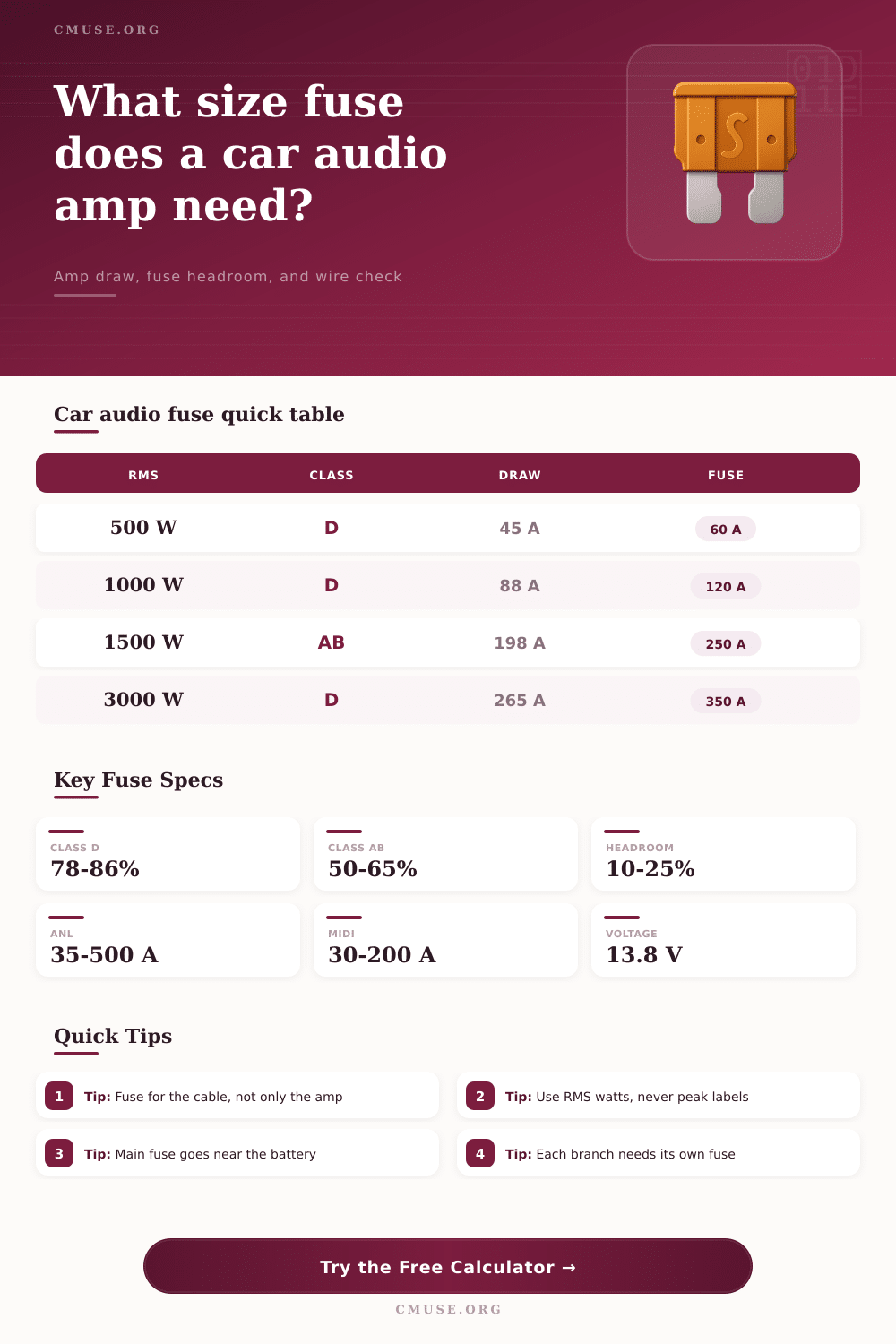
| 500 W | 44 A at 82% | 62 A at 58% | 60-80 A | 8 AWG or 4 AWG depending on route and growth. |
| 1000 W | 88 A at 82% | 125 A at 58% | 120-150 A | 4 AWG OFC is the common daily starting point. |
| 1500 W | 133 A at 82% | 187 A at 58% | 175-250 A | Check 4 AWG carefully; 1/0 AWG often coordinates better. |
| 2500 W | 221 A at 82% | 312 A at 58% | 300-400 A | Large main wire, rear battery, and distribution fusing matter. |
| 5000 W | 442 A at 82% | 624 A at 58% | 500A plus | Parallel runs or very large conductors are usually required. |
🚗 Install Preset Comparison Table
| Preset | RMS Power | Efficiency | Wire Selection | Likely Main Fuse |
|---|---|---|---|---|
| Compact 500W Sub | 500 W | 82% | 8 AWG OFC | 60 A |
| Sedan 1000W Mono | 1000 W | 82% | 4 AWG OFC | 125 A |
| Class AB Front Stage | 900 W | 58% | 4 AWG OFC | 175 A may exceed 4 AWG |
| Two-Amp SQL System | 1600 W | 65% | 1/0 AWG OFC | 250 A |
| Competition 5k Pair | 5000 W | 82% | 4/0 AWG OFC | 600 A or split mains |
When building a car audio system, it is critical to choose the apropriate size fuse for your audio system. People often get too caught up in the subwoofer and amplifier when building their audio system, but the fuse is one of the most critical component of the system. If the fuse for your audio system is the wrong size, it will either pop when the system is in use or it will fail to protect the wire in the audio system if there is a problem.
The appropriate size of the fuse for your audio system will depend on the amount of current the amplifier in your audio system will draw. Amplifiers takes electrical power and convert it into sound wave. However, amplifiers do not convert all of the electrical power into sound waves because some of the energy is lost as heat within the amplifier.
How to Choose the Right Fuse and Wire for Your Car Audio
The efficiency of the amplifier will impact the amount of current drawn by the amplifier. For example, Class D amplifiers are more efficient than Class AB amplifiers. Therefore, Class D amplifiers will draw less current than Class AB amplifiers in order to produce the same amount of sound.
Amplifier fuse and wire size calculators can help you determine the apropriate size fuse for your audio system. These calculators will ask for information about your amplifier, such as the RMS wattage of the amplifier and the efficiency of the amplifier. The calculator will also ask for the voltage of your car audio system.
In addition to these questions, the calculator will also ask for the number of amplifier that will be installed in the car audio system. The calculators will also ask for the size of the power cables that will be used in the audio system. Based off all of this information, the calculator will determine the size of the fuse that should be used in the audio system.
The calculators include a growth margin for the amount of current that the amplifiers will draw so that you wont have to replace the fuse if you decide to install additional amplifiers in the future. The main fuse for your audio system should be located close to the battery. This fuse will protect the length of cable between the battery and the audio system.
If there is a short circuit in the cable between the battery and the audio system, the main fuse should open before the insulation of the cable melts. This would prevent the cable from becoming a heat source. Therefore, the main fuse should not be any larger in size than the capacity of the cable.
For instance, if the power cable can only carry 150 amps of current, a 300-amp fuse should not be used because the 300-amp fuse will not protect the 150-amp power cable. Branch fuses are used for audio system components other than the audio system itself. For instance, once the electrical current from the battery reaches a distribution block, the remaining wires will have a branch fuse that protects each wire from overcurrent.
The size of the branch fuse should be sized for the branch wire and does not need to be sized for the main power cable. Branch fuse size calculators will allow you to input the amount of current that each branch of the distribution block will draw in order to calculate the size of each branch fuse. Using branch fuses will prevent small wires from having excessive current in them that could damage the audio system components.
An error that many audio system builders make is to choose only the specifications of the amplifier’s chassis fuse. This specification is the amount of fuse that the amplifier manufacturer used to protect the amplifier’s internal circuitry. Therefore, it does not protect the power cable between the battery and the amplifier.
Additionally, many audio system builders will choose an oversized fuse for the power cable between the battery and the amplifier because they want to include some head room for the power drawn by the amplifier. However, this is a mistake because using a large fuse with a small diameter power cable can cause the power cable to overheat. The fuse and power cable that are used in audio systems can be affected by the routing of the power cable.
For instance, a power cable that is located within the cool cabin of the car will be able to carry more current than a power cable that is located in the hot engine bay of the car. The heat of the engine bay will reduce the ability of the power cable to shed heat so that the current carried by the power cable does not become too hot. Therefore, fuse and wire size calculators will include a derating factor for the heat of the routing of the power cable to the audio system components.
Finally, when choosing the size of the fuse and the wire that will carry the current to the audio system components, you should also consider the future of the audio system. Many audio system builders will start with one amplifier but may want to add another amplifier at a later date. If you design the fuse and wire for only the first amplifier, you will have to replace the fuse and the wire when you add the second amplifier.
Therefore, including a growth margin in the initial building of the audio system avoids the need to replace the fuse and the wire. There are also reference tables provided that describe the different sizes of fuses and the sizes of the wires that can be used in audio system components. Additionally, these tables describe the load of the audio amplifiers that can be used with these different fuse and wire size combinations.
The reference tables also include the useful range for each type of fuse. For instance, mini-ANL fuses are used in audio systems that do not have too much current drawn from the amplifiers. ANL fuses are used in most audio system installations.
Class T fuses are used in audio systems that require very high currents or that use lithium batteries. Choosing the correct fuse for your audio system requires that you choose a fuse that matches the current that will be drawn by the amplifier, the capacity of the cable, and the physical fuse family. If all three of these factors match, the fuse will function correctly in the background of your audio system.
However, if any of these factors do not match, it will result in music stopping unexpectedly or the audio system cables becoming a heat source. By using an audio fuse and wire size calculator to determine the size of each fuse, you can eliminate the guesswork in setting up your audio system components correctly.