Car Audio Battery Calculator
Estimate amplifier current draw, reserve capacity runtime, alternator contribution, usable battery bank size, and voltage sag for subwoofer and full-system car audio builds.
🚗 Named Car-Audio Presets
Model: RMS amplifier power is divided by amplifier efficiency and charging voltage to estimate current draw. Music duty, alternator surplus, usable depth of discharge, reserve-capacity conversion, and internal resistance are then used to estimate runtime and voltage behavior.
⚙ Amplifier, Alternator, and Battery Inputs
📊 Live Battery Spec Grid
🔋 Battery Type Comparison Grid
📝 Live Calculation Breakdown Table
| Item | Formula | Live Value | Why It Matters |
|---|---|---|---|
| Peak draw | RMS / efficiency / volts | 0 A | Sizes fusing and charging headroom. |
| Music draw | Peak draw x duty percent | 0 A | Closer to real average current. |
| Usable Ah | Bank Ah x depth of discharge | 0 Ah | Sets engine-off listening runtime. |
| Voltage sag | Current x parallel resistance | 0 V | Shows likely drop under audio load. |
📐 Amplifier Current Reference Table
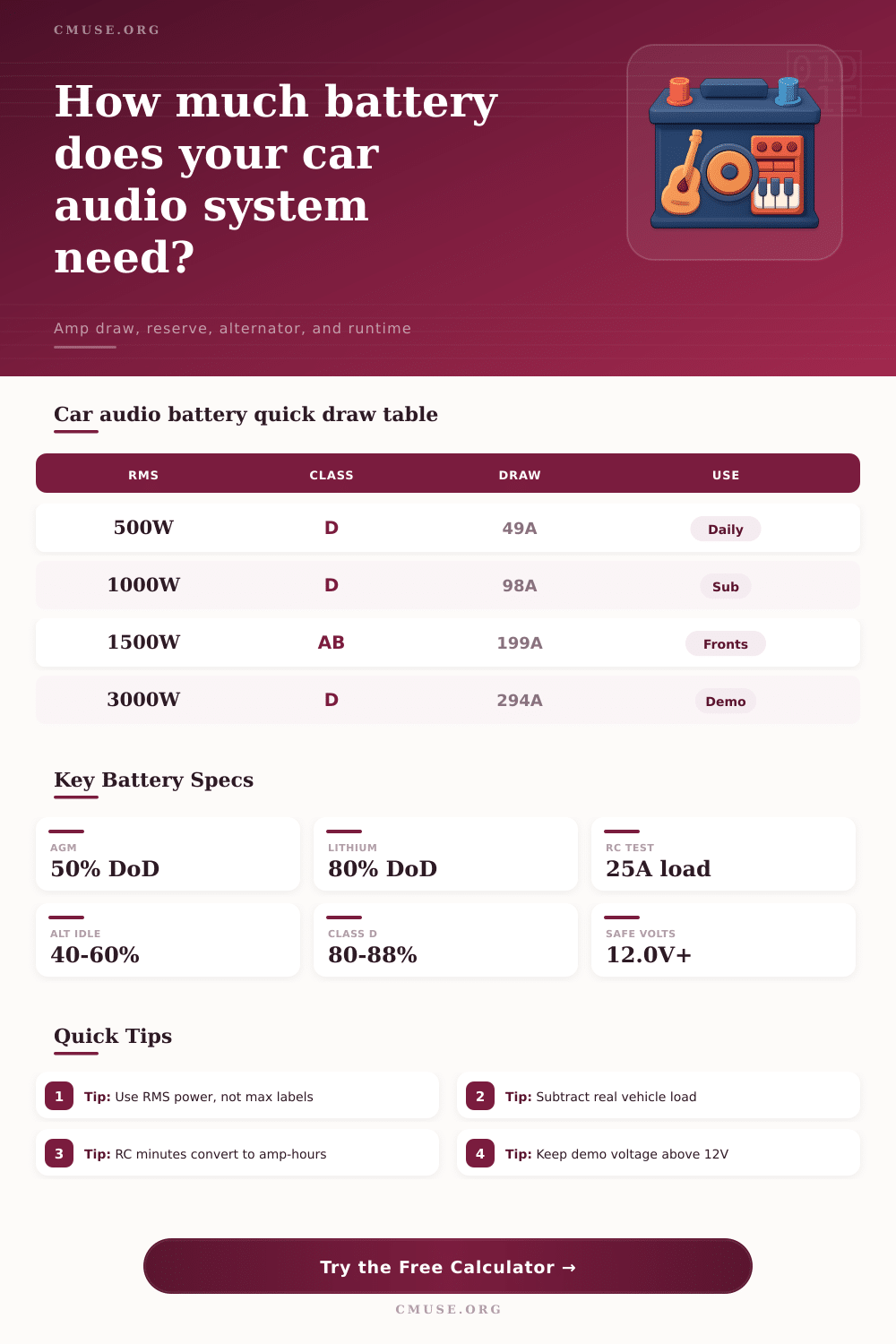
| Amplifier RMS | Class D at 13.8V | Class AB at 13.8V | Practical Battery Note |
|---|---|---|---|
| 500 W | 44 A at 82% | 66 A at 55% | Often works with strong stock battery and healthy alternator. |
| 1000 W | 88 A at 82% | 132 A at 55% | Check alternator surplus and add AGM reserve for demos. |
| 2000 W | 177 A at 82% | 264 A at 55% | Needs upgraded charging, short grounds, and real reserve capacity. |
| 3000 W | 265 A at 82% | 395 A at 55% | Usually requires dedicated battery bank and high-output alternator. |
| 5000 W | 442 A at 82% | 659 A at 55% | Voltage stability becomes a system design problem, not one battery. |
💿 Reserve Capacity and Battery Guide
| Rating or Battery | Approx Nominal Ah | Typical Usable Ah | Best Fit |
|---|---|---|---|
| 90 min RC starter | 37.5 Ah | 18.8 Ah at 50% | Mild factory-plus system with engine running. |
| 120 min RC AGM | 50 Ah | 25 Ah at 50% | Daily subwoofer support and short engine-off listening. |
| 80 Ah AGM | 80 Ah | 40 Ah at 50% | Trunk battery for 1000-2000W music systems. |
| 100 Ah LiFePO4 | 100 Ah | 80 Ah at 80% | Longer listening sessions with correct BMS and charging. |
| 40 Ah LTO bank | 40 Ah | 32 Ah at 80% | Short high-current demos where voltage sag matters most. |
⚡ Alternator Contribution Table
| Alternator Situation | Common Output | After 45A Vehicle Load | Audio Planning Note |
|---|---|---|---|
| Stock idle | 50-80 A | 5-35 A | Battery carries most serious bass demand at stoplights. |
| Stock cruise | 90-140 A | 45-95 A | Enough for moderate Class D systems with sensible duty cycle. |
| HO idle | 120-180 A | 75-135 A | Useful for demos if belt wrap and wiring are upgraded. |
| HO cruise | 200-320 A | 155-275 A | Supports larger amplifiers, but battery reserve still buffers hits. |
🎵 Common Car Audio Scenario Table
| Scenario | Typical RMS | Battery Direction | Voltage Priority |
|---|---|---|---|
| Daily single sub | 500-1000 W | Healthy main battery or one AGM upgrade. | Keep grounds short and charging above 13.2V. |
| SQL two-amp build | 1200-1800 W | Front battery plus rear AGM often balances reserve. | Watch voltage on long bass tracks. |
| Parking demo | 2000-4000 W | Dedicated bank sized by target minutes and duty. | Low resistance matters as much as Ah. |
| SPL burp setup | 5000W plus | High-current bank with very short cable paths. | Momentary sag and BMS current limit dominate. |
When adding an audio amplifier to a car, the audio amplifier need to have electrical power supplied from the car battery and an alternator. Many people may believe that these two electrical components are not importance for the audio amplifier, but they are critical component of the car’s electrical system. An audio amplifier needs to have a constant supply of current for the voltage to remain within an appropriate range.
If the voltage of the car’s battery drop to a low level, the audio amplifier may begin to produce distorted sounds or it may shut down altogether. Consider the number of watt the audio amplifier will use, as well as how long the car can support the audio amplifier when the engine is idling. Using a calculator, determine the electrical requirement of the audio amplifier by plugging in the RMS power of the audio system, the efficiency of the audio amplifier, and the voltage at the audio amplifier’s terminals.
Car Amplifier Power and Battery Needs
These three specification will allow you to determine the peak current that the audio amplifier will draw from the car battery. Additionally, you will also need to consider the music duty cycle. The music duty cycle is the percentage of the time that the audio amplifier is playing music at full power.
For example, the music duty cycle can be 30 to 50 percent when the car is being driven during the day, but it could be a higher percentage when playing long tracks with bass. It is important to consider the difference between the peak and average current draw of the audio amplifier. The fuse on the car battery should be sized according to the peak current draw, but the length of time that the audio amplifier will run is based on an average current draw.
All of the electrical components of the car, including the alternator, will draw power from the same power supply as the audio amplifier. You can calculate the surplus power that the alternator will provide by taking the hot idle output of the alternator and subtracting the power that the fuel pump, the fans, and the lights draw. If the average power draw of the audio amplifier is larger then the surplus power that the alternator can provide, the car battery will begin to discharge while the engine is running.
The calculator will display the net current of the car’s electrical system, which will allow you to see if the battery is being charged or if the audio amplifier is draining it while the car is being driven. Additionally, the calculator will estimate the voltage sag that the battery will experience if you enter the number of batteries and the internal resistance of those batteries into the calculator. The lower the internal resistance of the batteries, the less voltage that the battery will lose when it is supplying current to the audio amplifier.
The chemistry of the battery will have an impact on the audio system. Flooded lead acid batteries tend to be less expensive, but they dont hold up well to deep discharge of their batteries. AGM audio batteries are better at tolerating deep discharges of their batteries, and they exhibit less voltage sag than lead acid batteries.
Lithium batteries have even more usable capacity than AGM batteries, and they have a lower internal resistance. However, using a lithium battery requires a battery management system. Additionally, you must charge the batteries to the proper limit.
The calculator can be used to set the depth of discharge of the battery so that the runtime of the audio amplifier matches the chemistry of the battery that you are using in your car. The battery label will specify the reserve capacity of the battery, and it is measured with a 25 amp load. Using the reserve capacity specification, you can calculate the number of amp-hour the battery will provide.
Multiplying the amp-hours by the depth of discharge will provide the usable energy of the battery. Additionally, you will have to decide the length of time that you want the audio system to play when the engine is off. You may need longer running time to entertain at a party than to provide enough time to stop at a traffic light.
Using the calculator, you can determine the nominal size of the battery bank that will last your target number of minutes with the voltage of the battery bank not dropping below the minimum voltage limit. There are a few complication to the audio system that the calculator will not be able to fully measure. For example, the length of the audio system cables and the gauge of those cables will impact the resistance of the audio system.
Additionally, the amount of heat that is present under the hood of the car will impact the alternator’s output. If you mount a second battery that is located a significant distance from the audio amplifier, that distance will introduce inductance into the circuit, which will cause the voltage to sag. Additionally, it is possible for the voltage to drop at the audio amplifier even though the audio amplifier appear to have a good ground.
These complications can cause the audio amplifier to clip or to shut off entirely while under heavy load. The calculator’s results will give you a starting point for audio amplifier electrical system component. If the calculated length of time for audio playback meets your target length of time with the voltage of the battery bank remaining within the limits, then you do not have to make any changes to the electrical components of your car.
However, if the calculated run time is less than your target, you may have to add more batteries in parallel to the battery bank, upgrade the alternator, or change the music duty cycle. Use the reference tables on this calculator page to see if the electrical components of your car are within the realistic range for your alternator and electrical system. Many audio amplifier enthusiasts will want to increase the wattage of their audio amplifier before they ensure that the electrical components of their car can handle the audio amplifier.
Use the audio amplifier calculator to determine if the electrical components of the car can handle the audio amplifier by plugging in the wattage of the audio equipment that is currently in the car. Based on this calculation, you can decide if you need to add more batteries before you add more watts to your audio amplifier. Ensuring that your audio system has enough power will prevent any problems with the voltage of your audio system.