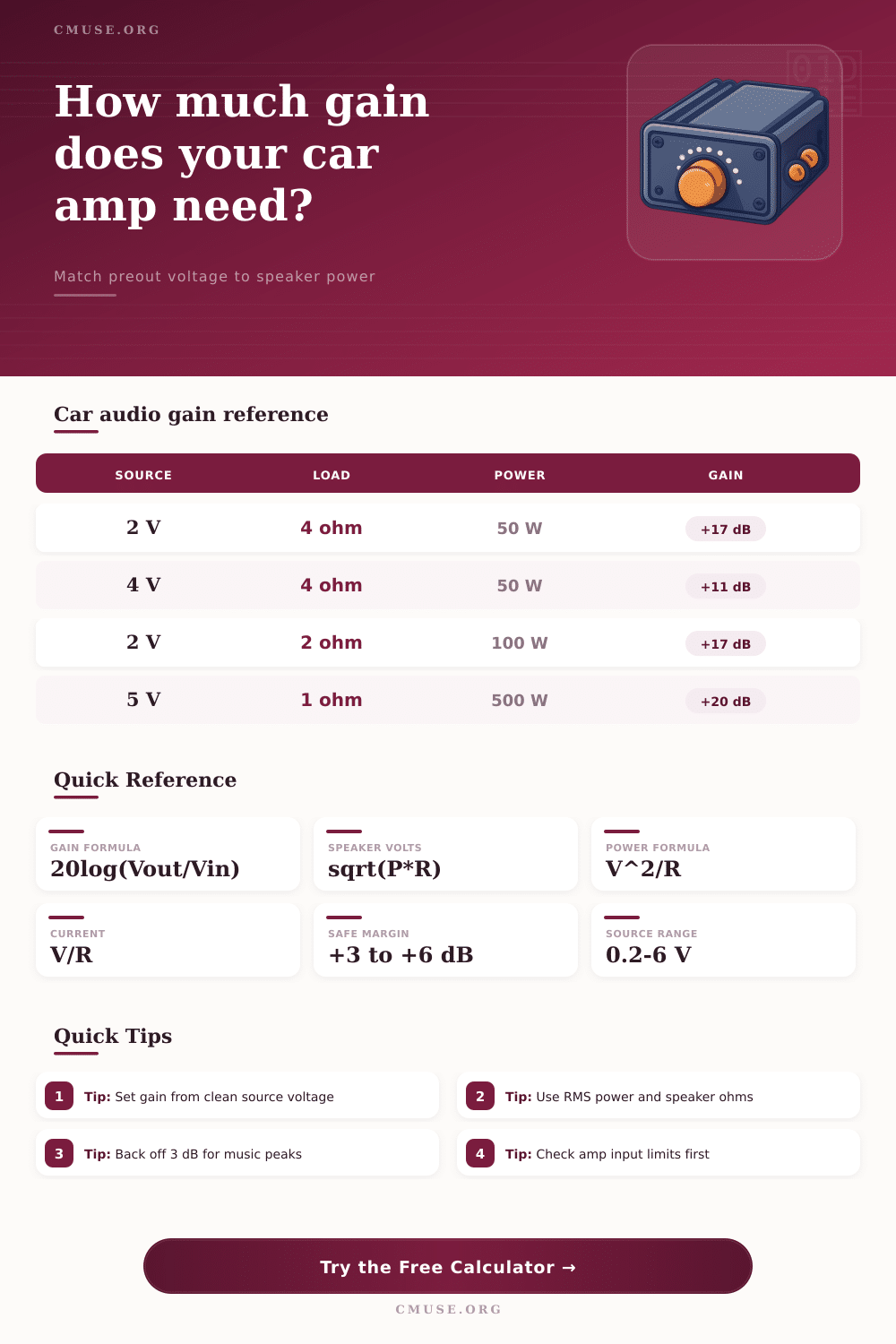
Car Audio Amplifier Gain Calculator
Match preout voltage to speaker load and target RMS power, then see the clean gain setting and safe output for your system.
| Source | Use case | Typical load | Clean gain |
|---|---|---|---|
| 0.5 V | Factory radio | 4 ohm | More gain |
| 2.0 V | Basic RCA | 4 ohm | Mid gain |
| 4.0 V | Strong preout | 2 or 4 ohm | Low gain |
| 8.0 V | Hot balanced | Any amp | Minimal gain |
| RMS W | 4 ohm | 2 ohm | 1 ohm |
|---|---|---|---|
| 50 W | 14.1 V | 10.0 V | 7.1 V |
| 100 W | 20.0 V | 14.1 V | 10.0 V |
| 250 W | 31.6 V | 22.4 V | 15.8 V |
| 500 W | 44.7 V | 31.6 V | 22.4 V |
Factory Radio
0.5 V
Needs more gain
RCA Preout
2.0 V
Common clean signal
High-End Deck
4.0 V
Low gain setting
Balanced Source
8.0 V
Very low gain
Gain is an setting on an amplifier that controls the relationships between the input voltage from a source and the output voltage of an amplifier. Understanding gain are important because gain determines how much signal the amplifier receives from the head unit and how much power the amplifier sends to the speakers. Setting the gain to too high will cause the amplifier to clipping the signal, and signal clipping causes distortion in the sound.
Setting the gain to too low will cause the amplifier to not provide enough power to the speakers, and the speakers will not produce the correct volume of sound. To set the gain properly, a person first has to identify the output voltage of the head unit, which is often referred to as the preamp signal or the RCA signal. The head unit send a signal to the amplifier that is measured in RMS volts.
How to Set the Gain on a Car Amplifier
However, different head units sends different amounts of RMS volts. For example, a factory radio might send only 0.5 volts, but a high-end head unit might send 4.0 volts or more. Because the head unit sends a specific amount of voltage, a person must first identify what that voltage is so they can set their gain to match up with it.
The person setting the gain also has to calculate the target voltage that their speakers requires. The target voltage a speaker requires depends on the RMS wattage of that speaker as well as the impedance of that speaker (impedance is measured in ohms). To get this target voltage number, a person takes the square root of the wattage multiplied by the impedance.
Once someone has this number, they know how much voltage they have to send out to their speakers for them to perform proper. By knowing this target voltage and knowing what voltage their head unit sends out, a person can determine what gain setting they have to use for their particular system to bridge the gap between these voltage. The appropriate gain setting will amplify the source voltage of the head unit up to this target voltage required by the speakers.
The gain setting required is expressed in decibels. For example, if the target voltage is 3 volts and the source voltage is 1 volt, then youll need at least 3 decibels of gain to amplify that source voltage up to meet the target voltage. Other factors can affect what your gain setting should be; for example, impedance affect your gain setting.
If you decrease the impedance on your amplifier, then you might require different voltage level than before. Impedance is crucially important for car audio systems because if it’s too low, then you’ll pull too much current out of your amplifiers and can damage your system; if it’s too high, then you won’t pull enough current, and your audio equipment won’t work correct. The best way to think about this for setting gain is this: If your gain setting is high and your impedance is low, then you’re basically asking your audio system for more than it can handle, and your system might be in trouble.
In addition, people often make the mistake of confusing peak power with RMS power. Peak power is a short burst of power that your audio equipment can produce or withstand; great for sudden loud noises in songs or games; but when it comes to setting your gain, its really all about that steady RMS power (continuous power). Matching your gain setting to peak power instead of RMS power risks distortion because it throws off balance.
As if all this isnt complicated enough already, adding some distorted signal into your mix will distort it even more! Not literally, but… It’s no fun listening to bad sound quality!
It turns out if you turn up your head unit volume too high and it sends out a distorted signal, then your amplifier has to deal with that same distorted signal and… Well, you get distorted output from it too. Gives me a headache just thinking about it!
So when your tuning your system, use a test tone at about 75% volume from your head unit max volume to make sure you get a nice pure signal coming in. Now that you know all about what sets up gain properly for your car audio system, lets talk about finding out what is wrong with your current settings! A really good way to check if you’ve got your settings right with your car audio system is by listening for distortion in your sound output.
Playing certain sounds, like pink noise or a 75 Hz tone, will really help you hear clearly if there is distortion. You can slowly turn up the gain control until you hear that distortion creeps up. When you hear it, back it down just a little bit so youve got some headroom and extra space.
If you want to get super precise (and who doesnt?), get out your calculator and go through those steps I shared. Knowing your wattage, impedance, source voltage; you can really zero in on that perfect gain setting mathematicaly. Using both your ears and some math?
Thats how you make sure your gain setting is just right for your car audio system!