Car Audio Alternator Calculator
Estimate amplifier current draw, vehicle electrical load, alternator output at idle and cruise, battery reserve support, and voltage sag for daily, demo, and SPL car audio systems.
🚗 Named Car-Audio Alternator Presets
Model: The calculator separates peak amplifier draw from music-average draw, subtracts real vehicle load from hot alternator output, estimates reserve battery support, and predicts voltage sag from battery plus cable resistance.
⚙ Amplifier, Vehicle, Alternator, and Battery Inputs
📊 Live Alternator and Reserve Snapshot
| Operating point | Alternator output | Vehicle + audio demand | Margin or deficit | Battery role |
|---|---|---|---|---|
| Idle | 0 A | 0 A | 0 A | Calculating |
| Cruise | 0 A | 0 A | 0 A | Calculating |
| Peak hit | 0 A | 0 A | 0 A | Calculating |
🔌 Alternator Output Reference
| Rated alternator | Typical hot idle | Typical cruise | Best fit | Watch item |
|---|---|---|---|---|
| 90-120 A stock | 40-70 A | 75-110 A | Factory audio, small powered sub | HVAC and headlights can consume margin quickly. |
| 140-180 A upgrade | 70-110 A | 120-165 A | Daily 800-1500 W Class D systems | Idle output may still be tight with fans running. |
| 200-270 A high output | 95-165 A | 175-250 A | Two-amp SQL or demo-friendly builds | Hot case temperature and pulley speed matter. |
| 300-390 A competition | 120-230 A | 260-360 A | Large demo systems and burp setups | Often needs belt grip, wiring, and battery support. |
🎚 Amplifier Draw Reference
| Amplifier setup | Efficiency used | Peak draw at 13.8 V | 35% music average | 60% demo average |
|---|---|---|---|---|
| 600 W Class D sub amp | 82% | 53 A | 19 A | 32 A |
| 1200 W Class D monoblock | 82% | 106 A | 37 A | 64 A |
| 1500 W mixed Class D/AB | 68% | 160 A | 56 A | 96 A |
| 3000 W efficient Class D | 86% | 253 A | 89 A | 152 A |
| 5000 W SPL Class D bank | 88% | 412 A | 144 A | 247 A |
🔋 Battery Reserve and Voltage Sag Reference
| Battery support | Usable depth | Typical resistance | Strong use case | Calculator note |
|---|---|---|---|---|
| Stock flooded starting battery | 30-40% | 10-18 mΩ | Light daily listening | Voltage recovers slower after deep discharge. |
| Single AGM under hood | 45-60% | 5-10 mΩ | Daily system with short demos | Good reserve, but alternator still supplies sustained load. |
| AGM rear bank | 50-65% | 3-7 mΩ | Demo parking sessions | Ground path and cable size strongly affect sag. |
| Lithium audio bank | 70-90% | 1-4 mΩ | High-current demo or SPL systems | Use chemistry-specific charging voltage limits. |
📋 System Comparison Grid
| Preset type | RMS range | Idle priority | Reserve priority | Recommended check |
|---|---|---|---|---|
| Factory plus sub | 300-800 W | Low | Low | Measure voltage with headlights and blower on. |
| Daily monoblock | 800-1500 W | Medium | Medium | Confirm idle surplus after the engine is fully warm. |
| Two-amp SQL | 1500-2500 W | High | Medium | Model Class AB front-stage efficiency separately if needed. |
| Parking demo | 2500-5000 W | Very high | High | Watch voltage recovery between bass-heavy tracks. |
| SPL burst | 4000 W+ | Medium | Very high | Reduce battery and cable resistance before chasing rating. |
A car audio system require a stable electrical system to supply the amplifiers with the power necessary to operate the subwoofers. Many people focus on the amplifiers and the subwoofers when building there desired audio system. However, the electrical components that determines whether the electrical system will remain stable are the alternator and battery.
The electrical system will become the limiting factor in the audio systems volume output if the voltage drop too low. If the voltage drop too low, the headlights on the car will dim, and the amplifiers will clip. The current draw of the amplifier is not a constant number.
Does your car have enough power for the audio system
The current draw will change based off the music that is playing and the efficiency of the amplifier. The current draw will be high when the amplifier is playing peak moment in the music. The current draw will be low during average moments in the music because there will be no peak moments in the music playing.
A calculator can determine the difference between the current draw when the music is playing peak moments and average moments in the music. To use the calculator, the user will have to input the total RMS power of the system, the efficiency of the amplifiers, and the percentage of the power that the audio system is expected to draw. Based on these parameter, the calculator will show the user the difference between a single bass hit in the music and playing the music continuous.
The vehicle electrical loads will also impact the electrical system. Components like the engine control unit, fuel pump, radiator fan, and the HVAC system will all draw electricity from the electrical system. These components will be running continuously, regardless of the loudness of the music playing in the car.
Thus, if the electrical system is already drawn to powering these components, there will not be enough power to supply the audio system. The calculator will ask for the base load of the vehicles electrical system to calculate how much power the alternator can provide for the audio system. If there is not enough power to supply both the audio system and the electrical system of the vehicle, the alternator will have to draw power from the battery when the engine is off or when the vehicle is idling.
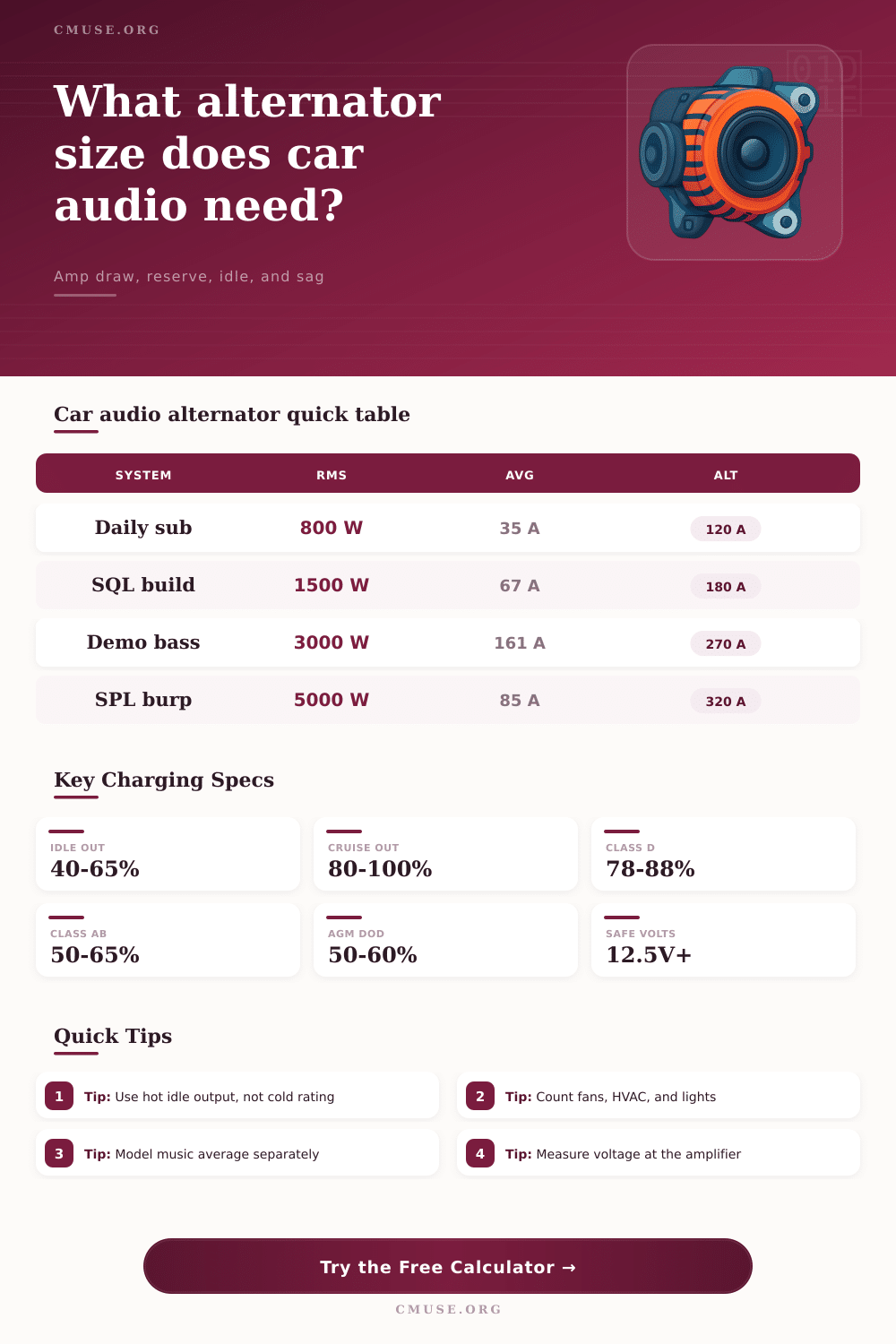
An alternator will not reach its full capacity when the car is warm or when the car is idling. The alternator may be rated at 180 amps, but when the engine is hot and the car is idling, it can only provide 55 percent of its amperage. This phenomenon is referred to as hot idle output.
The calculator will incorporate an idle factor and a heat derate to show the user how much power the alternator can supply when driving versus when the alternator is under theoretical conditions. Using this calculation, if the outcome is a negative number, it indicates that the car battery will discharge when the car is stopped. A discharged battery will result in a sag in the voltage of the electrical system of the car.
The battery provide reserve capacity to the vehicle and acts as a temporary buffer in case the alternator cannot supply the power demanded by the vehicles electrical system. The calculator will show you the usable capacity of the battery, based on the batterys amp hour or reserve capacity rating. The calculator will also show you how long that reserve capacity can play your audio system if the alternator cannot keep up with the demand of the system.
You must also consider the resistance of your wiring. Shorter cables with lower resistance will allow your voltage to remain higher at the amplifier terminals. Higher voltage at your amplifier terminals will allow your amplifier to function more effective.
Many people make mistakes when sizing there electrical systems. Some electrical system builders will size their alternator based off the output requirements of the vehicle at cruise speed. However, they will then forget that the electrical deficit is most common when the vehicle is idling.
Others will treat the battery as a constant source of power for the vehicle. However, the battery is a temporary buffer for the electrical system, and treating it as a constant power source will result in deep discharges of the battery that can result in battery failure. The calculator will show you the idle margin, cruise margin, and voltage sag for your vehicle to help you determine if you need to size your battery and alternator larger to meet the demand of your audio system.
The duty cycle of the music system will determine the percentage of the time that your audio system will require power from the vehicles electrical system. If you are a daily driver, you may want to set the duty cycle to 35 to 45 percent. If you are a demonstration or show car, your duty cycle may be 60 percent or higher.
Entering the correct duty cycle will determine whether your electrical system will have a surplus of power or if it will rely on the battery to supply some of the power requirements of the audio system. By planning your electrical system with the proper duty cycle for your audio system, you can avoid any electrical problems that may develop prior to installing your amplifiers. The reference tables on this page will provide you with information regarding the behavior of alternators of different sizes when idling, the efficiency of amplifiers of different wattages, and the chemistry of batteries of different types.
The calculator will allow you to test these variables for your specific audio system. You want your amplifiers to recieve a stable voltage while your vehicle is idling and cruising. You also want to ensure that you have enough reserve capacity in your battery to handle the power demands of your audio system without causing the electrical system to fail.