Capo Key Change Calculator
Find the sounding key, the right capo fret and the transposed chords for any open shape you play
Pick a real capo scenario to auto-fill the form and calculate instantly.
Open Chords → Sounding Chords
Each common open shape and the chord it actually sounds at every capo fret from 0 to 7. Highlighted column matches your capo fret.
| Shape | 0 | 1 | 2 | 3 | 4 | 5 | 6 | 7 |
|---|---|---|---|---|---|---|---|---|
| Run the calculator to populate the transposition table. | ||||||||
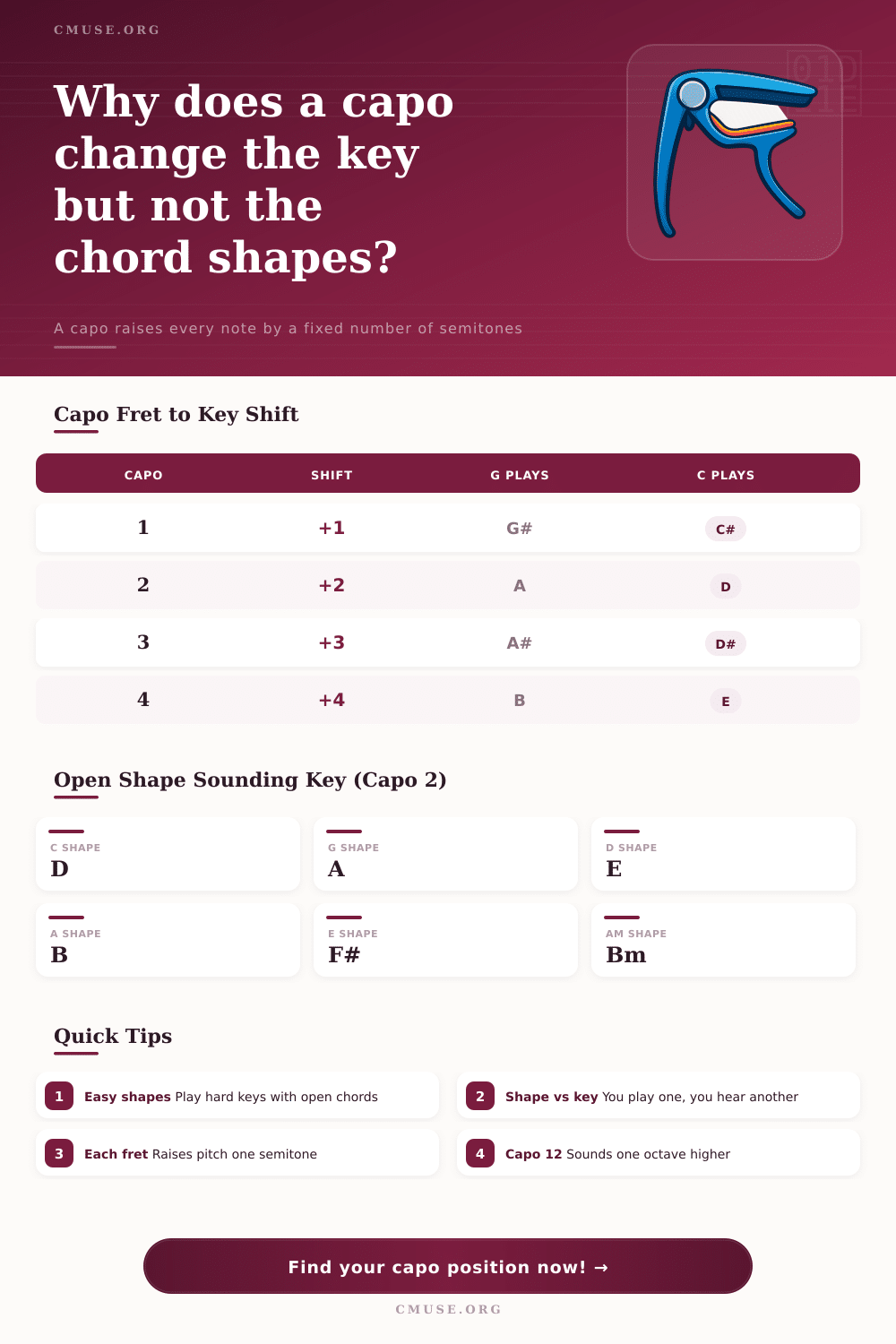
| Capo | Shift | C plays | G plays | D plays |
|---|---|---|---|---|
| 0 | +0 | C | G | D |
| 1 | +1 | C# | G# | D# |
| 2 | +2 | D | A | E |
| 3 | +3 | D# | A# | F |
| 4 | +4 | E | B | F# |
| 5 | +5 | F | C | G |
| 6 | +6 | F# | C# | G# |
| 7 | +7 | G | D | A |
| Want to play in | Use shape | Capo fret | Why it helps |
|---|---|---|---|
| Eb / D# | D shape | 1 | Open D voicings instead of barre |
| F | E shape | 1 | E chords avoid the F barre |
| A | G shape | 2 | Bright open-G feel in A |
| B | G shape | 4 | Easy open chords in hard B |
| D | C shape | 2 | Ringing C voicings in D |
| F | C shape | 5 | Common worship capo position |
| Index | Note | Sharp name | Flat name |
|---|---|---|---|
| 0 | C | C | C |
| 1 | C# | C# | Db |
| 2 | D | D | D |
| 3 | D# | D# | Eb |
| 4 | E | E | E |
| 5 | F | F | F |
| 6 | F# | F# | Gb |
| 7 | G | G | G |
| 8 | G# | G# | Ab |
| 9 | A | A | A |
| 10 | A# | A# | Bb |
| 11 | B | B | B |
Okay, so you know all the open chord forms, and your hands flow across the neck with ease when it comes to playing an A, a D, a G, or a C. Next thing you know, someone want you to play along with a B-major song. You get stumped as the chord shapes appear to be challenging fifth-fret handstands. The capo goes from being optional to being indispensable.
It lets you keep using those familiar open positions while making it sound like a completely diffrent key. The catch? What you finger isn’t necessarily what you hear; that’s where the difference makes the difference. To many players, the capo’s a magic wand used to make things sound higher, yet clamped on with no idea of what effect will be.
Why Use a Capo for Guitar?
In fact, the capo is a precisely tuned tool for changing pitch. A single turn of the bar. Up or down; shifts the instruments pitch upwards or downwards by a semitone. Two frets up, and you’re playing two semitones higher. Three frets up, it is a tone higher still. Four frets… you get the picture.
Plugging your fret placement into the calculator does all the maths for you, sparing you any mental arithmetic when changing sets. And it will tell you what key you’re now sounding, too, enabling you to find a matching vocal part without guesswork.
Think about this: When was the last time you played something in F major? If you’re like most people, it’s pretty hard to play with no capo on. The F barre chords can strain your wrist and dampen resonance. However, when you place a capo at the first fret, you now have E shapes. You use the same fingers as you learned before and the same chord progressions, just with a different sound.
It’s still an E major triad; the only difference is the strings is now tuned up a whole fret shorter, resulting in the sound being F. Capos do that; they separate finger comfort from complexities of harmonies. That’s why session players adore them.
They list it out nicely on the page so you can just check it against the table, but knowing how it works will allow you to work around it. For example, you might recognize that an ‘A’ shape sounds like it should A with the capo on two. Then you realize that means it’s going to sound like a B with the capo on four, and then a C with the capo on five. It’s a simple addition system.
But when you attempt to transpose backwards in your head as you are strumming along, that’s when it gets tricky. And that’s when the tool really works well. You choose the open position of the string you want to use and which key you need to play, and it figures out the number of the fret for you. You no longer have to slide the capo up and down during a pause to see if it sounds good.
The unmeasurable factor is also worth considering here… It’s all in the sound, which isn’t something you can put numbers to. Moving your capo further up the neck alters the sound of the guitar. As the strings get closer to the headstock they become stiffer and shorter, giving rise to a more thin, bright and almost piano-like tone.
That can work for you or not, depending on what you’re playing. If you were playing a rock track then it could lack the low end punch, but if it was a folk ballad then that shimmering quality could be a bonus. It’s all about finding the right balance between the character of the sound and how easy the chord shapes is. Sometimes that means opting for a slightly harder barre shape closer to the base of the neck simply to retain some warmth.
Beyond the twelfth fret another slip up people often make is forgetting to account for the octave change as they play further up the neck. Now they’re one octave above the standard tune, which if blended incorrectly with other instruments can sound thin and frail. This is something the tool takes into account displaying the semitone jump and indicating where it has crossed over to play in higher octaves.
This helps ensure they don’t move their parts accidentally into a part of the vocal range that doesn’t work well or clashes with the high frequencies in the mix. So in conclusion, the capo is all about freedom. It gives you the freedom to play without hard-to-reach chords and the freedom to concentrate on feel, dynamics, and rhythm.
Whatever kind of music you play, whether it’s pop standards, folk covers or even worship music, knowing how to transpose on the fly makes you adaptable. It allows you to take any simple progression you have under your fingers and use it in complex keys that otherwise might take you months to learn. It is simple math but offers a huge musical payoff. Keep your fingers where they want to be and let the capo do the transposing work for your ears. It is a small piece of plastic, but it opens up the whole fretboard.