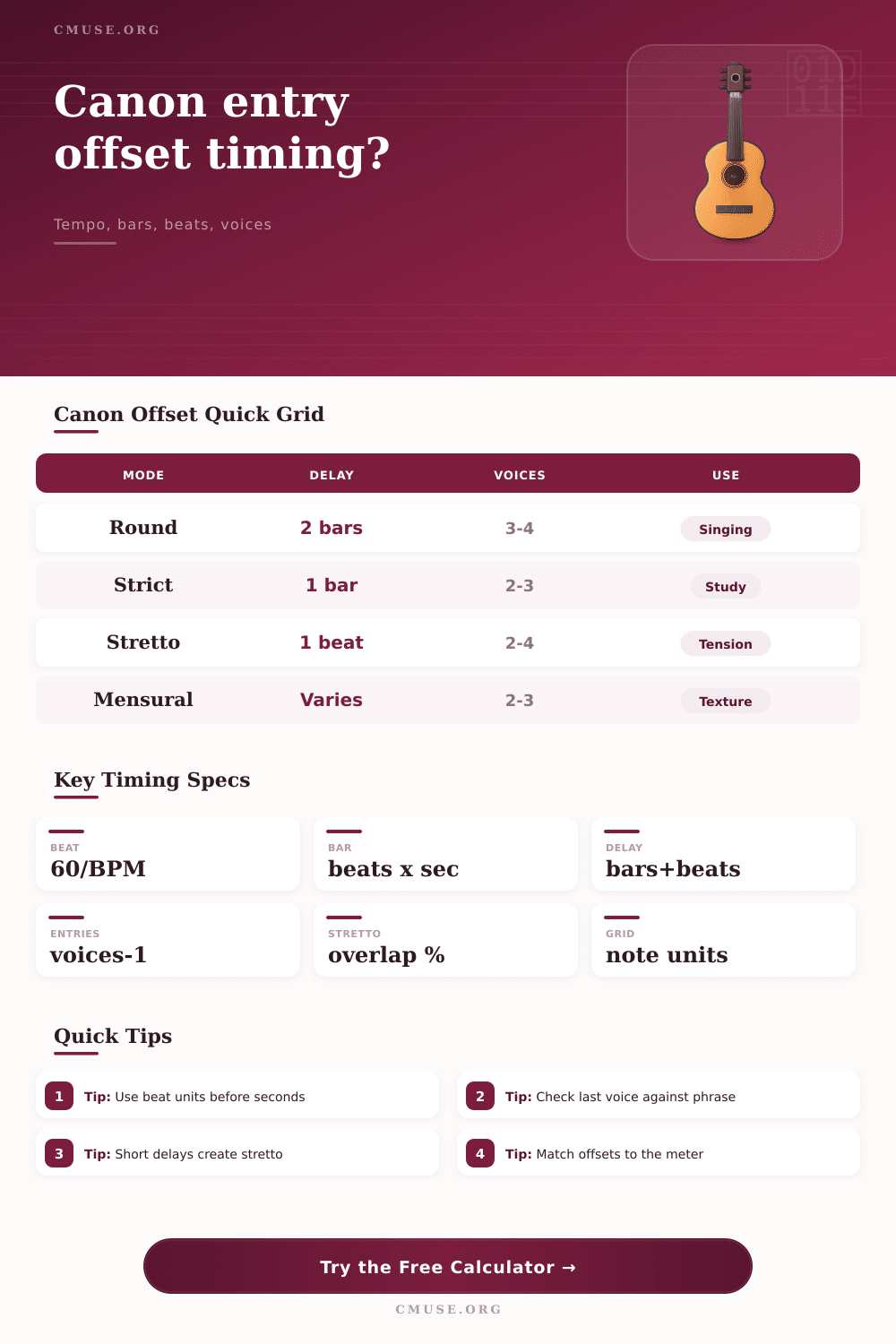
Canon Entry Offset Calculator
Convert a leader tempo, follower delay, bars, beats, voices, rhythmic value, pitch distance, and canon mode into practical entry timing.
Used to judge overlap and stretto pressure.
Adds anacrusis time before the first full bar.
Follower entry offset
0.00 sec
0 bars + 0 beats
Rhythmic count
0
quarter-note units
Last voice enters at
0.00 sec
after leader start
Stretto overlap
0%
mode pressure
Canon timing breakdown
| Rhythmic value | Beat value in 4/4 | At 90 BPM | Best canon use |
|---|---|---|---|
| Whole note | 4 beats | 2.667 seconds | Broad entrances and slow rounds |
| Half note | 2 beats | 1.333 seconds | Clear phrase imitation |
| Quarter note | 1 beat | 0.667 seconds | Default offset counting |
| Eighth note | 0.5 beat | 0.333 seconds | Close stretto entries |
| Sixteenth note | 0.25 beat | 0.167 seconds | Dense contrapuntal overlap |
| Mode | Follower behavior | Offset target | Watch point |
|---|---|---|---|
| Strict canon | Same melody and rhythm | Phrase or motive boundary | Accidental clashes at entry |
| Round | Loopable strict canon | Full phrase segment | Last voice must still cadence cleanly |
| Stretto | Follower enters early | Less than phrase length | Overlap pressure rises quickly |
| Augmentation | Follower rhythm stretches | Longer perceived delay | Pulse can feel heavy |
| Diminution | Follower rhythm compresses | Shorter perceived delay | Fast values may blur |
| Mensuration | Voices use different speeds | Shared barline or cadence | Compare beat grids before rehearsal |
| Scenario | Typical meter | Entry distance | Practical result |
|---|---|---|---|
| Children's round | 4/4 | 2 bars | Easy sectional entrances |
| Vocal rehearsal canon | 3/4 | 4 bars | Phrase-level clarity |
| Keyboard invention study | 2/4 or 4/4 | 1 bar | Close imitation without full stretto |
| Stretto passage | Any simple meter | 1 to 2 beats | High overlap and tension |
| Minimal phase texture | 4/4 | 1 eighth note | Fine-grain rhythmic displacement |
| Tempo | Quarter beat | 4/4 bar | Two-bar entry |
|---|---|---|---|
| 60 BPM | 1.000 seconds | 4.000 seconds | 8.000 seconds |
| 72 BPM | 0.833 seconds | 3.333 seconds | 6.667 seconds |
| 90 BPM | 0.667 seconds | 2.667 seconds | 5.333 seconds |
| 120 BPM | 0.500 seconds | 2.000 seconds | 4.000 seconds |
| 144 BPM | 0.417 seconds | 1.667 seconds | 3.333 seconds |
What about when to enter? How do you know what will sound good? Well, the math of the conversion is handled by the calculator above (so no guessing). It converts your chosen meter and tempo into exact timing for your following voice. Understanding why it works can help you know how to use it.
In a round such as Frere Jacques the spacing need to be wide because there isn’t very much melody and repetition occurs. There must be enough space between entries for each voice to set up the tune then another enters. Compressing this timing too far mean that the phrases trip over each other and become a messy tangle instead of a clean layer.
How to Choose When to Enter
That’s the part people gets wrong. They think all canons is simply delayed versions of themselves without thinking about effect of phrase length on the required breathing space. A good example would of comparing a stretto passage to one in strict canon. Here’s how that works.
Strictly speaking, the leader are followed exactly by the follower who waits a beat or more before repeating. Each statement stand out clearly from the next. Pressure is what makes stretto tick. Cut back the entry delay to one or two beats and the voices pile up on one another. There are several statement of the theme all competing for attention. The harmonic tension quick build. There are now so many elements competing with one another.
The tool will show you amount of overlap (in percent). Get it too high and you have a dense and muddy texture. It is useful, but only if you are aware off the density.
The offsets depends greatly on rhythmic value, which is something many composer underestimate. It makes sense to think of a quarter note as your starting point with common time, but this may be too wide a beat for a faster-moving diminution canon where the offset need to be closer. Perhaps an eighth or even a sixteenth note will provide enough tightness in the weave without disrupting the pulse. The table below on the page illustrates just how long each note realy lasts depending on tempo.
A quarter note lag at a slow ninety beats per minute leaves you well over half a second to inhale before continuing. At 144 beats per minute, the same unit of music dissapears in less than half a second. The maths stay the same. It’s just how our ear adapts to the speed.
The pitch distance also play into perception in the brain. With an octave canon, the harmonic conflict is minimal; what you hear are two voices supporting one another’s ideas. If you move down a step to a third or a fourth, you end up with voice leading conflicts and dissonance on every beat of the music. This is where the calculator let you set the interval but cannot speak to whether or not your ears can cope with the friction that might result.
Listen.
An even simpler idea is to move entries slightly on the beat, such as by fractions of a beat (minimal phase canon). What you end up with is something that does not sound like a melody at all but more of a texture as the human ear cannot follow distinct line that closely. That said, it is an effective way to create a bed of atmosphere in moddern music composition, but less so in the world of traditional vocal learning that wants clarity of separate lines. A singer want to know what their part is and not feel lost in a sea of shimmering sound.
A canon works as well because it can be clear without being simplistic. It can be exciting while still remaining safe. It’s all about finding a way through the maze. How do you measure that? Well, for the most part, it is a question of knowing what you’re measuring.
A complex multi-voiced fugue differ from a simple school round by the nature of how the entry points interact. If you get the entry point correct then the rest tends to follow suit. However, just know that although the math in music isn’t, time is elastic. You have created an opportunity for real musical suspense when the leader hasn’t completed their thought by the time the final voice joins. That is exactly why you did it.