Cabinet Wiring Impedance Calculator
Calculate series-parallel speaker cabinet load, amp safety margin, internal wire resistance, cabinet RMS rating, and voltage/current behavior for guitar, bass, and PA cabinets.
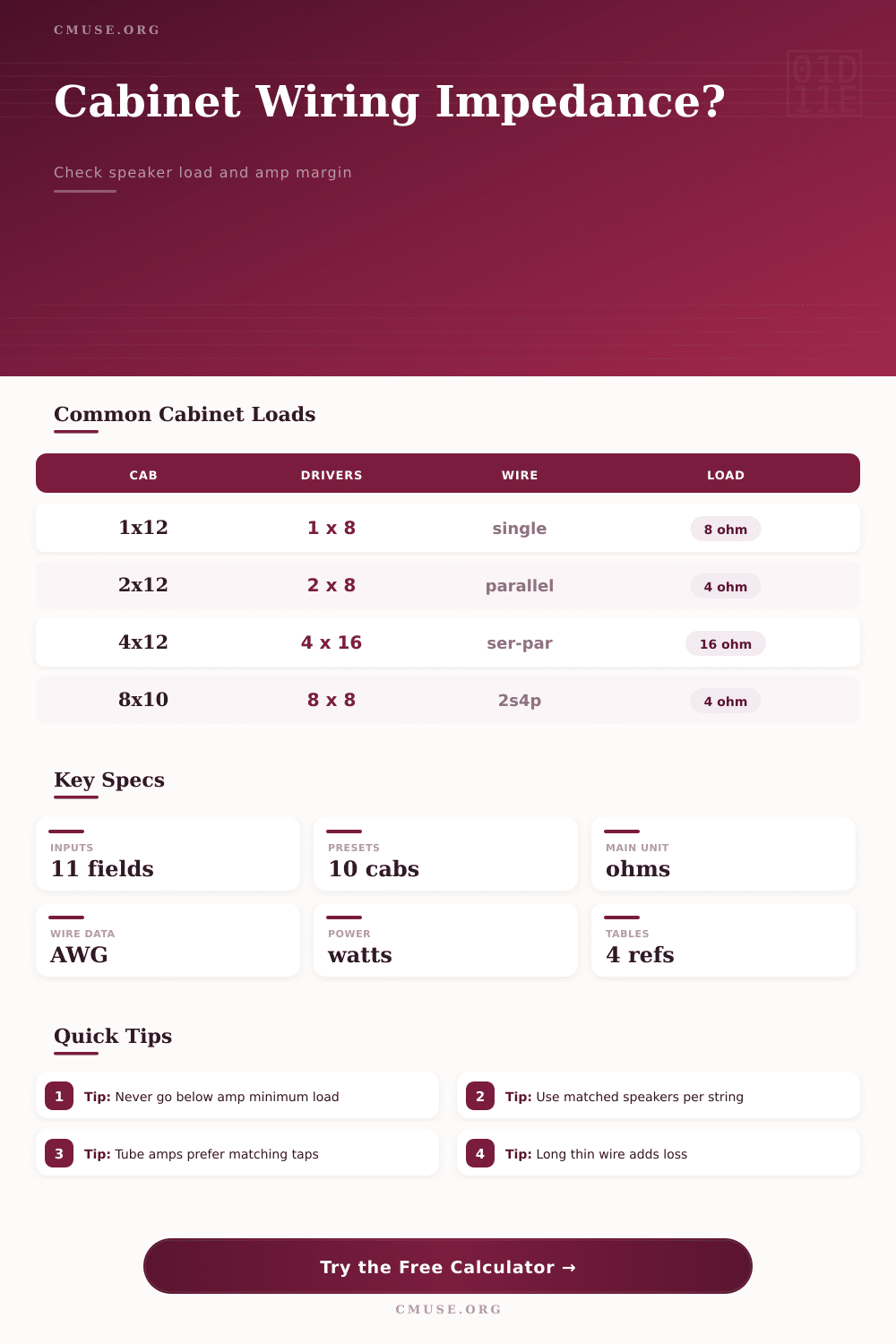
| Cabinet | Drivers | Wiring Pattern | Nominal Load | Typical Amp Match |
|---|---|---|---|---|
| 1x12 guitar combo | One 8-ohm speaker | Single speaker | 8 ohms | 8-ohm tap or 8-ohm minimum |
| 2x12 parallel | Two 8-ohm speakers | Both positives tied, both negatives tied | 4 ohms | 4-ohm solid-state output or 4-ohm tube tap |
| 2x12 series | Two 8-ohm speakers | Amp positive to speaker A, A negative to B positive, B negative to amp | 16 ohms | 16-ohm tube tap or compatible amp |
| 4x12 series-parallel | Four 16-ohm speakers | Two series pairs in parallel | 16 ohms | Classic 16-ohm guitar cabinet load |
| 8x10 bass matrix | Eight 8-ohm speakers | Four series pairs in parallel | 4 ohms | Common bass head minimum load |
| Wiring Formula | Identical Speaker Rule | Example | Result | Design Note |
|---|---|---|---|---|
| Series | Ztotal = Z1 + Z2 + ... | 8 + 8 | 16 ohms | Raises impedance and reduces amp current |
| Parallel, equal speakers | Ztotal = Zspeaker / count | 8 / 2 | 4 ohms | Lowers impedance and raises amp current |
| Series strings in parallel | Ztotal = (Zspeaker x series) / strings | (16 x 2) / 2 | 16 ohms | Balances common 4-speaker cabinets |
| Parallel unequal branches | 1 / Ztotal = 1 / Z1 + 1 / Z2 | 8 || 16 | 5.33 ohms | Power does not divide evenly |
| AWG Gauge | Copper Ohms Per 1000 ft | 10 ft Round Trip | 20 ft Round Trip | Cabinet Use |
|---|---|---|---|---|
| 22 AWG | 16.14 ohms | 0.161 ohm | 0.323 ohm | Short low-power runs only |
| 18 AWG | 6.385 ohms | 0.064 ohm | 0.128 ohm | Common guitar cabinet wiring |
| 16 AWG | 4.016 ohms | 0.040 ohm | 0.080 ohm | Useful for bass and PA cabinets |
| 14 AWG | 2.525 ohms | 0.025 ohm | 0.051 ohm | Low-loss higher-current wiring |
| 12 AWG | 1.588 ohms | 0.016 ohm | 0.032 ohm | Heavy cabinet or external cable runs |
| Amplifier Situation | Load Rule | Safer Match | Risk Zone | Calculator Check |
|---|---|---|---|---|
| Solid-state head | Load should not be below minimum rating | 4-ohm cab on 4-ohm minimum amp | 2-ohm cab on 4-ohm minimum amp | Worst-case low load margin |
| Tube amp with taps | Use the matching output transformer tap | 16-ohm cab on 16-ohm tap | Large mismatch without manufacturer approval | Nominal load and tolerance range |
| Bridge-mode power amp | Minimum load is often higher than stereo mode | 8-ohm bridge load when specified | 4-ohm bridge load on an amp rated 8-ohm bridge | Set amp minimum to bridge rating |
| Stereo cabinet jack plate | Each side is a separate load in stereo mode | Two 8-ohm sides into stereo amp channels | Confusing mono and stereo jack labels | Calculate one side or mono network |
Most of the time when you unplug that guitar cable from your amp and don’t hear anything, your heart jumps up in your throat. It usually mean a blown speaker, but often culprit is just an impedance mismatch. It means your speaker has blown, or there’s some other slight problem. Or maybe sound gets all thin and compressed, or your amp is humming along to hot for safety.
More times than not, however, it isn’t the gear. There’s simply an impedance mismatch. You’re expecting your amplifier to deliver current to a load it wasn’t designed to provide. And this is why the cabinet wiring impedance calculator are so invaluable. It makes it arithmetic instead of guesswork.
How to Use a Speaker Impedance Calculator
Everyone knows that a speaker has an ohm rating stamped on the back plate. Here’s where things get tricky: What happens when you’re combining multiple drivers? Two eight-ohm speakers wired in parallel equal four ohms, and wiring two in series make the load sixteen ohms. It sounds like elementary school math but it matters a lot for keeping your stuff alive.
Solid-state amps generally produce more power, but they release more heat, meaning they can absorbs lower loads. Not so with tube amps. For effective energy transfer, tube amps needs a particular impedance match between their output transformers. Screw up a tube amp by a single ohm in the wrong direction and you might overheat the output transformer…or distort tone into something unrecognizable.
Before you even pick up a soldering iron, this network can be visualized with help of the calculator above. Simply enter the nominal impedance of your drivers, add number of drivers in series per string, and the number of parallel strings. The calculator will find the total impedance being presented at amplifier terminals. It also includes cabinet’s internal wiring. People often overlook this.
Long distance, thin gauge wire provides resistance. And that resistance doesn’t simply make things quieter. It alters effective load that the amp sees. If the designers had thinner conductors in mind when they design it, it could push amp into unsafe territory. Look at that tolerance setting on the tool. Because speakers are mechanical components with moving masses that interact with magnetic fields, they don’t show flat-line impedance. They vary by frequency. An eight-ohm speaker may actualy drop to six ohms at some frequencies. The tolerance slider lets you adjust for the worst case. Your calculated load under nominal conditions may be hovering dangerously near your amp’s minimum safe level. Throw in a ten percent variance and it could jump over the red line. That’s good data to know prior to plugging things in.
The same logic applies to power handling. Identical drivers is added together for an estimated total power at cabinet level based off their RMS ratings. That’s a sanity check: Does my amp deliver as much wattage as this cabinet can withstand? A fifty-watt head doesn’t sound like much, but when pushed into four ohms, you’ll find that it pushes far more current than what its nameplate eight-ohm rating implies. Your cabinet must be able to get rid of that excess energy or thermal failure will occur. Using math helps you avoid exceeding those limitations and protects your investement.
No, you don’t have to be an electrician to get some mileage out of it. Simply be familiar with your components. Input the driver specs, select the wiring pattern, and there you go: see what it spits out. The page features handy reference tables that help provide the context for common configs. Having a four-by-twelve series-parallel rig laid out alongside yours can help validate whether or not your figures match. If it looks like your result is radically different than others’ similarly configured cabs, check your entries again.
At its heart, wiring is about control. It ensures that electrical current goes where intended while not damaging the route taken. If you are rewiring your old combo or building a bass cabinet for touring, getting the impedance correct will save you headaches down the road. Keep the strings balanced. Load matches amp. Wire gauge checks out. All of these numbers match. The sound fits the music and the gear is protected.
That silence you were afraid of at the beginning, well it’s still silence. You should of checked your math first.