
The brass family has always held a special place in music. These instruments cut through orchestras, jazz ensembles, and marching bands with a bold, human voice that no other section can match. Whether you are listening to a triumphant fanfare or a mellow jazz solo, the brass section delivers both power and nuance.
Understanding the main instruments helps you appreciate what you hear and might even inspire you to pick one up yourself.
Each member of the brass family works on the same basic principle. You buzz your lips into a mouthpiece, send vibrations down a length of metal tubing, and use valves or a slide to change the pitch. The magic lies in how differently those tubes are shaped, how the bells flare, and how the mouthpieces are sized.
Those small design choices create everything from the bright bite of a trumpet to the warm rumble of a tuba. The following instruments represent the core lineup you will meet in almost any musical setting.
Common Instruments in the Brass Family
1. Trumpet
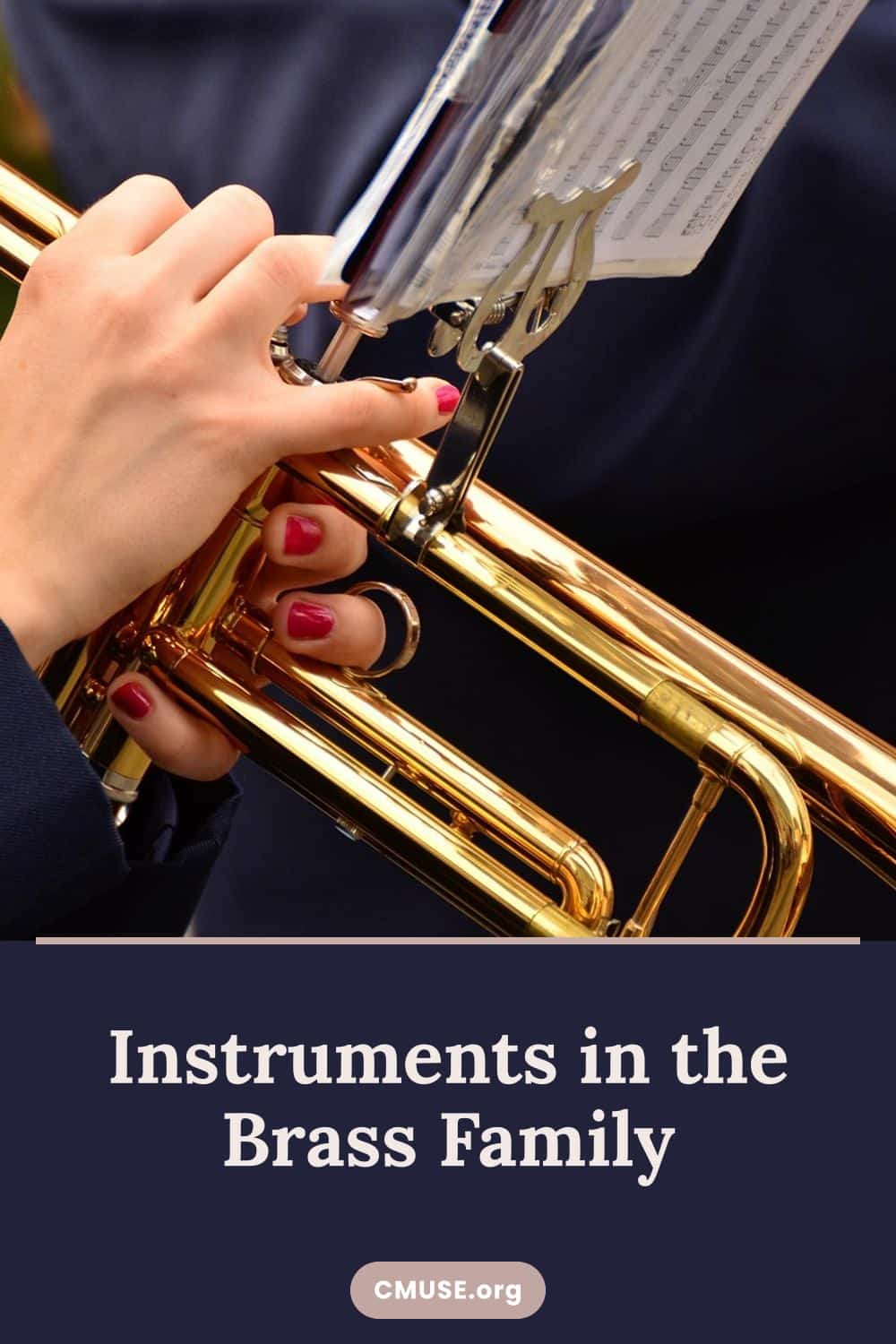
Trumpets lead most brass sections for good reason. Their compact size and bright tone let them soar above everyone else while still blending when asked. A standard B flat trumpet measures about two feet of tubing folded into that familiar shape, and its player can reach high notes with dazzling speed.
That combination of agility and projection is why you hear trumpets delivering fanfares at weddings, screaming over big band charts, and carrying the melody in orchestral climaxes. The instrument rewards precise embouchure and strong breath control, which is exactly why beginners often start here before graduating to larger horns.
2. French Horn
The French horn sits in a category all its own. Its tubing wraps in a wide circle, ending in a large, flared bell that the player can actually insert a hand into for special effects. This design gives the horn its famously warm, noble tone that composers love for romantic melodies.
Because the horn is pitched in F and uses rotary valves, it demands a different kind of finesse than the trumpet. Many players describe the sensation of coaxing a smooth line from the instrument as trying to sing through a garden hose, yet the results can be heartbreakingly beautiful. The tradeoff is that the horn is unforgiving.
A split note can sound like a goose honk in an otherwise elegant passage.
3. Trombone
Trombones bring something no valve instrument can match: a true glissando. The slide lets players move continuously between notes instead of stepping through them, which creates that signature wailing sound in jazz and the powerful, precise attacks in classical music. A tenor trombone in B flat is the most common model, but you will also encounter alto trombones for higher parts and bass trombones equipped with extra tubing and a rotary valve for the lowest notes.
The physical coordination required to hit exact slide positions while maintaining steady airflow is considerable. Once mastered, though, the trombone offers unmatched expressive range from silky smooth legato to gut punch fortissimo.
4. Euphonium
Euphoniums often get mistaken for baby tubas, but they occupy their own sweet spot in the brass family. The instrument looks like a small tuba with a conical bore that widens gradually from mouthpiece to bell, producing a rich, velvety tone that sits beautifully between trombone and tuba. In British brass bands the euphonium carries many of the lyrical solos, showing off its ability to sing with the warmth of a cello.
Players use either three or four valves, and the four valve models extend the low range significantly. The euphonium is forgiving for beginners yet rewarding for advanced players who want to explore its baritone-like agility.
5. Tuba
Tubas anchor the entire brass section with their deep, resonant foundation. The instrument comes in several keys, but the BB flat contrabass tuba and the C tuba are the workhorses of orchestras and bands. Its massive bell can measure two feet across, and the tubing snakes around the player in a way that requires a solid lap to rest it on.
Despite its size, a good tuba player can make the instrument surprisingly nimble. The real art lies in shaping those low notes so they support the harmony without muddying it. Sit close to a fine tuba section sometime and you will feel the notes vibrating in your chest, which is exactly the point of having one in the ensemble.
6. Cornet
The cornet deserves its own mention even though it looks like a shorter, chubbier trumpet. Its conical bore, slightly different from the trumpet’s cylindrical one, gives the cornet a rounder, more mellow sound that blends especially well in brass bands. British brass band tradition treats the soprano cornet, repiano cornet, and two solo cornets as distinct voices with separate parts.
Players who switch between trumpet and cornet often note how the cornet requires a gentler attack to sound its best. That softer approach is precisely why the instrument feels at home in lyrical passages where a trumpet might sound too brilliant.
7. Flugelhorn
Beyond these core instruments you sometimes encounter the flugelhorn, which looks like a trumpet but feels like a miniature euphonium. Its wide conical bore and large bell produce a dark, velvety tone perfect for ballads and jazz solos. Many trumpet players keep a flugelhorn in their gig bag because switching instruments mid set adds color without forcing them to change technique dramatically.
The mouthpiece is deeper than a trumpet’s, which changes the embouchure just enough to remind you that these instruments may be cousins but they are not twins.
Choosing which brass instrument to start with depends on your physical build, the kind of music you love, and how much patience you have for early sounds. Smaller players often begin on trumpet or cornet because the mouthpiece is manageable and the instrument is easy to hold. Larger students with good lung capacity might fall in love with the trombone or euphonium right away.
The French horn and tuba usually reward those who are willing to spend extra time on fundamentals before the instrument starts sounding good. No matter which one you pick, the shared technique of lip buzzing means skills transfer surprisingly well when you decide to try another member of the family later.
What ties every brass instrument together is the direct connection between player and sound. There are no strings to bow, no reeds to wet, no keys to press in complicated patterns. Just you, a mouthpiece, and a length of metal.
That simplicity is deceptive. It means every tiny change in your air speed, lip tension, or tongue position alters the tone instantly. The best players spend years refining these invisible adjustments until the instrument feels like an extension of their own voice.
The next time you hear a brass section blaze through a powerful chord or ease into a quiet chorale, listen for the individual personalities at work. The trumpet’s laser focus, the horn’s golden warmth, the trombone’s expressive slide, the euphonium’s velvet midrange, and the tuba’s bedrock foundation all combine into something greater than any single instrument could achieve alone. That is the real magic of the brass family.
Pick one, start buzzing, and you will quickly discover why so many players never want to put these instruments down.