BPM to ms Calculator
Convert tempo into note lengths, bar timing, and sample counts for delay sync, edit timing, and rhythmic planning.
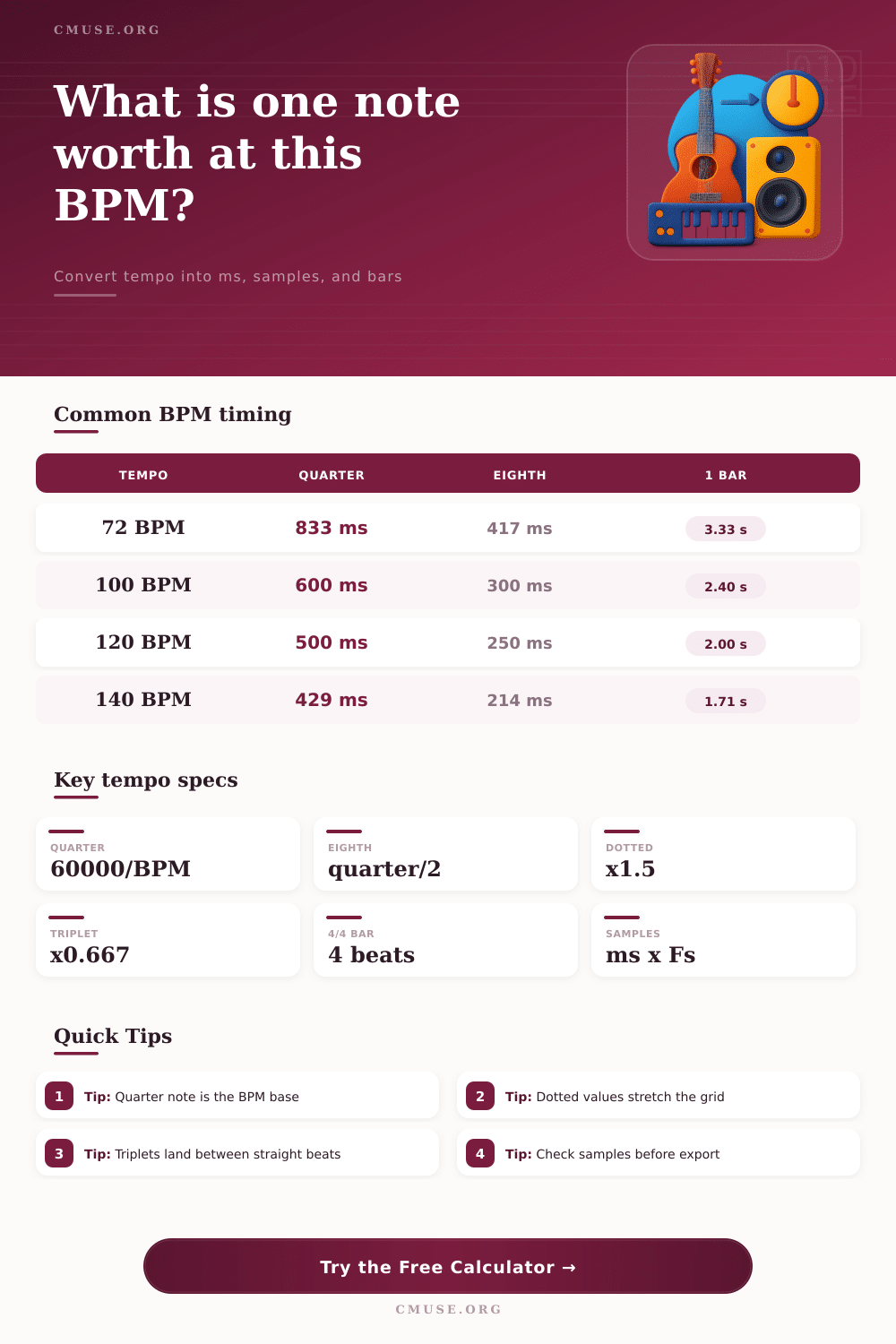
| BPM | Quarter | Eighth | 1 Bar 4/4 |
|---|---|---|---|
| 72 | 833.33 ms | 416.67 ms | 3.33 s |
| 100 | 600.00 ms | 300.00 ms | 2.40 s |
| 120 | 500.00 ms | 250.00 ms | 2.00 s |
| 140 | 428.57 ms | 214.29 ms | 1.71 s |
| Division | Factor | 120 BPM | 140 BPM |
|---|---|---|---|
| Whole | 4.00x | 2000.00 ms | 1714.29 ms |
| Half | 2.00x | 1000.00 ms | 857.14 ms |
| Quarter | 1.00x | 500.00 ms | 428.57 ms |
| Sixteenth | 0.25x | 125.00 ms | 107.14 ms |
| Rate | Quarter @120 | Quarter @140 | 1 Bar @120 |
|---|---|---|---|
| 44.1 kHz | 22050 samples | 18900 samples | 88200 samples |
| 48 kHz | 24000 samples | 20571 samples | 96000 samples |
| 88.2 kHz | 44100 samples | 37800 samples | 176400 samples |
| 96 kHz | 48000 samples | 41143 samples | 192000 samples |
| Use | BPM | Note | Match |
|---|---|---|---|
| Dotted delay | 100-128 | Dotted 8th | Offbeat lift |
| Half-time pocket | 70-90 | Quarter | Wide feel |
| Triplet fill | 120-174 | Triplet 8th | Rolling cadence |
| Long build | 128-140 | Whole | Transition bed |
Beats per minute (BPM) and millisecond is two different unit of measurement within music production. BPM are used to measure the speed of a song in the number of beat that occur in a minute. A digital audio workstation (DAW) measure time in milliseconds and in samples.
To align musical effects to the song’s timing, it is helpful for producers to use math to calculation the number of milliseconds in a beat at a specific BPM. At 120 BPM, a quarter note last for 500 milliseconds. A half note would last for 1,000 milliseconds and an eighth note would last for 250 milliseconds.
BPM, Milliseconds and Samples for Music Timing
These measurement in milliseconds can be used to set the timing for musical effect. Musical notes has different lengths of timing within a song. A quarter note lasts for a standard unit of time within a song.
A dotted note, however, is a modified unit of time that last longer than a quarter note. A dotted quarter note will last for 1.5 times as long as a regular quarter note. Other notes that are modified includes triplet notes, which squeeze three note into the time for two notes to occur, and swing notes, which use a swing slider to move the upbeats within a bar of music.
The producer can adjust the percentage of swing to allow for a specific type of music to be created. Time signature can change the length of the bar of music. A time signature of 4/4 means that there is four quarter notes in a bar.
Other time signatures will change the length of the bar. If the time signature of a project is change, the length of a bar will be changed. The total length of a musical section can be calculated by multiply the number of bars of that section of music by the length of one bar.
Additionally, another unit of measurement that can be calculated is the number of samples of a musical section. At 48 kHz, there are 48,000 samples in one second of music. This sample rate can be used to align waveforms more precise than using only milliseconds to calculate timing.
Using sample counts allow producers to ensure that there musical edits are precise. At 48 kHz, a 500-millisecond quarter note is 24,000 samples. If a producer slice the audio at 24,000 samples, it will chop the audio at the correct timing for that note.
Sessions with a high resolution often use a sample rate of 96 kHz. At 96 kHz, there are 96,000 samples in one second of music. Although 96 kHz allows for more samples to allow for more precise edits, it will use more of the computer’s CPU power.
Using the sample count as a measurement will bridge the gap between the musical grid and the digital grid to ensure that the audio do not drift during export of the project. Many producers make mistake if they do not use math to calculate the timing of musical element within their project. For example, some may ignore the importance of BPM and note types, such as dotted note and swing notes.
Others may ignore the importance of the sample rate. Regardless of the reason for these incorrect adjustment to musical elements, producers can always use the visual representation of the song within the DAW to ensure that their musical elements are correctly placed. For instance, the echo effects should land on the correct offbeats and chop of audio should not cause phase issue.
Producers can often use the presets within a DAW to find the correct timing for different genre of music. For example, a preset that utilize a dotted note will create a specific type of music within house music productions. A triplet preset will create a specific type of music within trap music productions.
Small change to the BPM of a song will change the timing of the musical notes within that song. For example, increasing the BPM will make the length of each note within the song shorten, while decreasing the BPM will make each note last for longer within the song. To create a song with the correct timing, producers should use both there ears and their knowledge of mathematical conversion.
In order to produce music with the correct timing, producers should utilize the mathematical relationship between the BPM, the types of musical notes, the time signatures, the length of bars of music, the number of samples per second, and how small change to the BPM will impact all other element of the song’s timing. By using these method of calculating the timing of music, producers will have a better understanding of the correct way to create music with the most best possible timing.