BPM Semitone Calculator
Convert between playback pitch, BPM ratio, cents, percent speed, and sample length for tempo-matched music editing.
🎹 Quick Presets
🎚 Pitch and Tempo Inputs
📐 Core Ratio Formulas
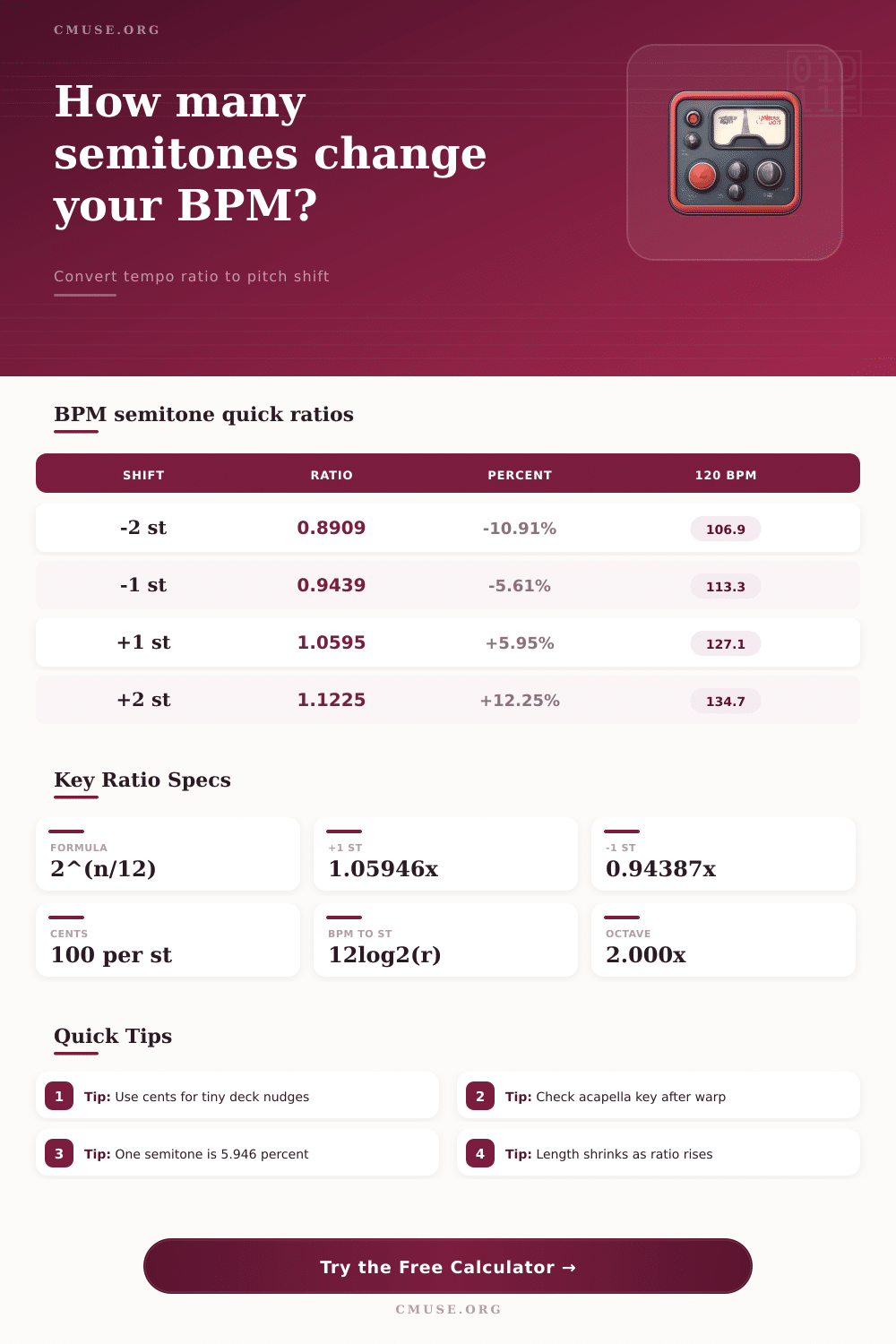
📊 Semitone Ratio Reference
| Pitch Shift | Ratio | Speed Change | 100 BPM Becomes | 120 BPM Becomes |
|---|---|---|---|---|
| -12 semitones | 0.50000x | -50.00% | 50.00 BPM | 60.00 BPM |
| -7 semitones | 0.66742x | -33.26% | 66.74 BPM | 80.09 BPM |
| -5 semitones | 0.74915x | -25.08% | 74.92 BPM | 89.90 BPM |
| -2 semitones | 0.89090x | -10.91% | 89.09 BPM | 106.91 BPM |
| -1 semitone | 0.94387x | -5.61% | 94.39 BPM | 113.26 BPM |
| +1 semitone | 1.05946x | +5.95% | 105.95 BPM | 127.14 BPM |
| +2 semitones | 1.12246x | +12.25% | 112.25 BPM | 134.70 BPM |
| +5 semitones | 1.33484x | +33.48% | 133.48 BPM | 160.18 BPM |
| +7 semitones | 1.49831x | +49.83% | 149.83 BPM | 179.80 BPM |
| +12 semitones | 2.00000x | +100.00% | 200.00 BPM | 240.00 BPM |
🎼 Common Production Moves
| Scenario | Source | Target | Semitone Result | Use Case |
|---|---|---|---|---|
| One semitone lift | 120 BPM | 127.14 BPM | +1.00 st | Brighter repitch |
| House to pop tempo | 128 BPM | 120 BPM | -1.12 st | Blend without warp |
| 45 from 33 playback | 100 BPM | 135.14 BPM | +5.21 st | Turntable speed |
| 33 from 45 playback | 135 BPM | 99.90 BPM | -5.21 st | Slowed vinyl color |
| Acapella stretch | 92 BPM | 124 BPM | +5.16 st | Check key drift |
| Breakbeat speedup | 136 BPM | 170 BPM | +3.86 st | Classic repitch |
🎶 Key Interval Ratio Table
| Interval | Semitones | Ratio | 120 BPM Result | Musical Note |
|---|---|---|---|---|
| Minor second up | +1 | 1.05946x | 127.14 BPM | Small lift |
| Major second up | +2 | 1.12246x | 134.70 BPM | Whole step |
| Minor third up | +3 | 1.18921x | 142.70 BPM | Key color |
| Perfect fourth up | +5 | 1.33484x | 160.18 BPM | Large jump |
| Perfect fifth down | -7 | 0.66742x | 80.09 BPM | Deep drop |
| Octave up | +12 | 2.00000x | 240.00 BPM | Double speed |
⏱ Length and Loop Timing Examples
| Current Audio | Shift | Ratio | New Length | Tempo Effect |
|---|---|---|---|---|
| 8.000 sec loop | +1 st | 1.05946x | 7.551 sec | Faster |
| 8.000 sec loop | -1 st | 0.94387x | 8.476 sec | Slower |
| 16.000 sec loop | +2 st | 1.12246x | 14.254 sec | Faster |
| 16.000 sec loop | -2 st | 0.89090x | 17.959 sec | Slower |
| 4.000 sec hit | +35 cents | 1.02043x | 3.920 sec | Slight lift |
| 4.000 sec hit | -35 cents | 0.97998x | 4.082 sec | Slight drag |
When you change the speeds of a musical recording, you are changing both the tempo and a pitch of that recording. These two elements is connected to each other in a fixed mathematical curve. If you increase the speed of the recording, the pitch of that recording will also increases.
If you decrease the speed of the recording, the pitch of that recording will also decrease. The calculator can provide these specific numbers for you based off the mathematical curve that correlate these two elements of music. Musical scales is comprised of twelve equal steps that make up a musical octave.
How Speed Affects Pitch and Length
Each semitone within that musical scale represent a frequency ratio of approximately six percent. Because each semitone within a musical scale represent a frequency ratio of approximately six percent, you can use that relationship to adjust the tempo of music by applying that percentage to the beat per minute of the music. Using this relationship, the calculator can show you the new tempo of your musical tracks, the length of those tracks, and the cent value for those tracks.
A cent is a smaller unit than a semitone within a musical scale, and it allow for fine adjustments to the pitch of those musical tracks. When people attempt to play two musical tracks at the same time, it is very common for them to encounter problem with the tempo of each track. For instance, a house record may have a tempo of one hundred twenty-eight beats per minute while a pop vocal track might have a tempo of one hundred twenty beats per minute.
If you play these two tracks at the same time without making any adjustments to them, they will not be in sync with one another. There are, however, two main solution for this problem. One solution is to warp that file while maintaining its current pitch but change its tempo.
The other is to change the pitch of that file to allow it to be in time with the other musical file. The calculator will show you the number of semitones that separates these two tempo so that you can decide which fix you would like to apply to each musical file. The same mathematical relationship between tempo and pitch also apply to vinyl records.
For example, when a record that plays at thirty-three RPMs is played at forty-five RPMs, the pitch of that record will increase by five semitones. Additionally, the length of that record will also decreases when played at this speed. This is simply a result of the turntable playing that record at a different rate from when it was recorded.
Small adjustment to pitch and speed can be made for a variety of musical task. For instance, you can add thirty-five cents to a snare hit to change the speed of that beat by only two percent. The calculator also accepts these cent values so that you can determine how that adjustment will impact the pitch and length of your musical file.
The same adjustment to the speed of a loop by two percent will impact the pitch and length of that loop by the same two percent. The length of a musical file is also a significant part of changing the speed of that recording. When a file is played at a faster rate, it will be shortened, and playing it at a slower rate will create a longer file.
For example, if you raise the pitch of a four-bar loop by two semitones, you will make the loop end approximately thirteen percent sooner then the original length of the loop. This length adjustment must be accounted for in your musical project. The calculator will show you the length of your audio file after you make your adjustment to the speed of that file so that you can adjust the boundaries of the audio file before the next section of the song begin.
Another task that require the use of this mathematical relationship is to even out the pitch of two musically separate files. When two songs have different keys, you can calculate the distance between them in semitones. If the distance between two songs is three semitones apart, the speed of the files will have to change by approximately nineteen percent.
This change might not be feasible for a large distance between the two keys. While the calculator can compute the interval between the two musical keys, the musicians themselves must make the decision of whether or not the change in tempo between the two files is acceptable. This calculator is a tool that remove the need for manual mathematical calculations to determine the change in pitch and tempo.
The calculator will tell you the mathematical answer to this changing tempo, but it is up to each musician to decide if the change in pitch is acceptable. Similarly, the change in tempo is up to the musician to decide if it is acceptable to the song. Although the calculator can determine the change in pitch and tempo, the musical choice remain up to the musicians.