BPM Percent Change Calculator
Compare source and target BPM, calculate tempo percent change, estimate pitch shift, and convert the change into real clip and bar timing.
🎚 Tempo Change Presets
⏱ BPM Percent Inputs
📌 Formula Spec Grid
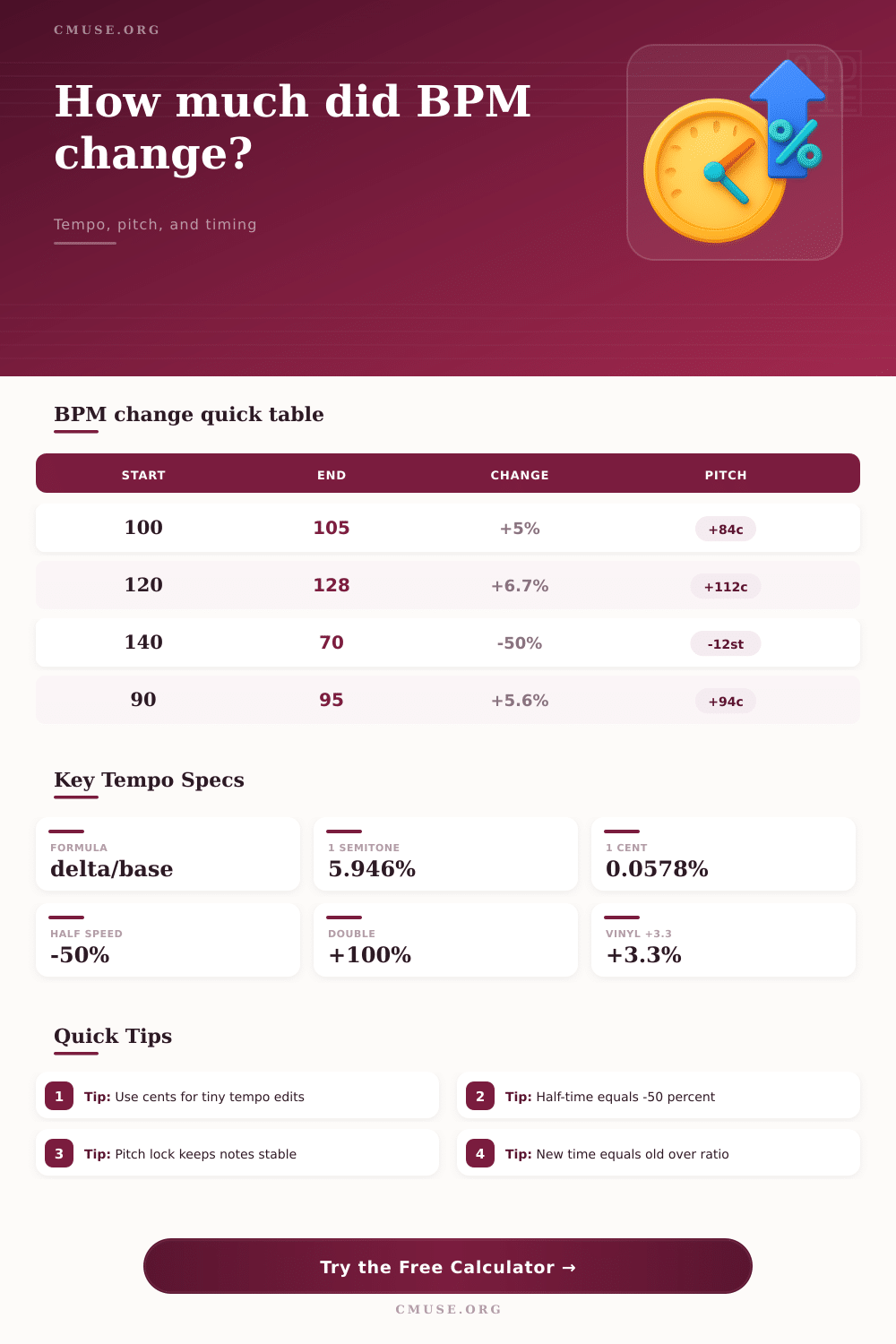
📊 Common BPM Percent Changes
| Move | Tempo Ratio | Percent | Pitch if Resampled |
|---|---|---|---|
| Half-time conversion | 0.5000x | -50.000% | -12.00 semitones |
| Double-time conversion | 2.0000x | +100.000% | +12.00 semitones |
| One semitone up | 1.0595x | +5.946% | +1.00 semitone |
| One semitone down | 0.9439x | -5.612% | -1.00 semitone |
| Vinyl-style +3.3% | 1.0330x | +3.300% | +56.22 cents |
| Small DJ sync move | 1.0169x | +1.695% | +29.09 cents |
🎼 Pitch and Tempo Comparison
| Pitch Shift | Ratio | Percent Change | 120 BPM Becomes |
|---|---|---|---|
| -2 semitones | 0.8909x | -10.91% | 106.91 BPM |
| -1 semitone | 0.9439x | -5.61% | 113.47 BPM |
| +50 cents | 1.0293x | +2.93% | 123.52 BPM |
| +1 semitone | 1.0595x | +5.95% | 127.14 BPM |
| +2 semitones | 1.1225x | +12.25% | 134.70 BPM |
🎛 Mode and Formula Comparison
| Operation | What You Enter | Formula Used | Best For |
|---|---|---|---|
| Target BPM | Source and target BPM | (target - source) / source | DJ matching and remix edits |
| Percent Change | Source BPM and percent | source × (1 + percent / 100) | Turntable pitch slider math |
| Pitch Shift | Semitones plus cents | source × 2^(steps / 12) | Resampling and key-aware changes |
| Duration Check | Clip length and ratio | old seconds / tempo ratio | Loop timing and arrangement length |
📝 Real Project Reference Table
| Scenario | Source to Target | Change | Timing Effect |
|---|---|---|---|
| Pop verse lift | 96 to 102 BPM | +6.25% | 45 s becomes 42.35 s |
| House beatmatch | 124 to 128 BPM | +3.23% | 16 bars shorten by 1.94 s |
| Boom bap tighten | 88 to 92 BPM | +4.55% | 2 min becomes 1:54.78 |
| Half-time switch | 150 to 75 BPM | -50.00% | 16 bars become twice as long |
| DnB cleanup | 172 to 174 BPM | +1.16% | 64 beats shorten by 0.26 s |
BPM change occur in many situation in music production. BPM change occur when you are matching two different track, or when you are changing the tempo of a loop. A change in BPM can change the pitch of a sound sample, as well as change the duration of that sound sample.
In order to make change to BPM, it is important for producers to understand the relationship between BPM, pitch, and duration. Although percentage change to BPM may seem small, those percentage changes can have a more large effect upon the way the listener is to feel the song. If you change the BPM of a sample without using a time stretching algorithm, the pitch of that sample will change.
What Happens When You Change BPM
If you increase the BPM, the pitch will rise. If you decrease the BPM, the pitch will fall. These two element are directly linked to one another, and cant be considered separate parameter within a song.
A BPM calculator can help producers understand the exact ratio of BPM to pitch change. The BPM can be changed either with the understanding that the pitch will change with it, or by utilizing a pitch locking algorithm so as to ensure the pitch of the sample dont change. Changing the BPM of a sample will also change the duration of the musical phrase played by that sample.
With BPM increased, the musical phrase will take up less time. With BPM decreased, the musical phrase will take up more time. The length of the phrase will change in relation to the BPM change.
The BPM calculator can display the new duration of the musical phrase after changing the BPM of the sample. Beyond BPM itself, there are other element of music that impact the way BPM changes is to be felt. For instance, a four bar musical phrase in 4/4 time is not of the same length as a four-bar musical phrase in 6/8 time.
The BPM calculator allows producers to alter both the top and bottom number of the time signature, so that the time of the musical phrase is always accurate. The different choice for time signature impact how fast the music is to be felt, especially when used with BPM changes. Using half time and double time move are two of the most extreme choice for changing the BPM of a song.
Using half time will cut the BPM in half, and will drop the pitch of the song by one full octave if the song is to be resampled. Many song producer prefer to use pitch lock when utilizing half time move. The BPM calculator can help producers to understand the percentage change and resulting pitch of the song, so that they can make an informed decision about which version of the song to use in their production.
There are two main way to handle pitch when changing the BPM of a song: time-stretching and resampling. Time-stretching with pitch lock will allow producers to change the BPM of a song while keeping the pitch of the musical note the same. Resampling will allow the pitch of a song to change along with the BPM.
Each time-stretching parameter has its use, and neither is considered to be better than the other. Some of the most common mistake for producers is to treat the percentage shown for BPM as if it is an abstract number. A five percent increase in BPM will shorten the duration of every bar of a song.
Sixteen bar of a five percent BPM increase will shorten the song by several second. Such a second can cause a transition in a song to fail. It is important to always check the duration of a sample after changing it’s BPM.
It is also possible for two track with the same BPM to appear as if they are out of time with one another. This is usually due to difference in the swing percentage of each track. While the BPM will ensure that each track will be moving at the same speed, difference in musical skill in playing each track will cause difference in how the tracks feel to the listener.
Using the BPM calculator to find the main ratio between two song, producers can then use their musical ears to make small adjustment to the pitch or playing of each track. Using a BPM calculator allows producers to focus on the musical feel of the tracks after determining there relative BPM.