Borrowed Chord Calculator
Calculate modal-mixture chords from parallel major, minor, and church-mode sources with roman numerals, chord tones, and voice-leading distance.
🎼 Borrowed Chord Presets
🎹 Modal Mixture Inputs
📊 Parallel Mode Source Grid
🎶 Borrowed Chord Comparison Grid
| Parallel Source | Scale Formula | Triads by Degree | Typical Borrowing |
|---|---|---|---|
| Ionian / major | 1 2 3 4 5 6 7 | I ii iii IV V vi viio | Major IV or V in minor, Picardy I |
| Dorian | 1 2 b3 4 5 6 b7 | i ii bIII IV v vio bVII | Major IV and ii in minor keys |
| Phrygian | 1 b2 b3 4 5 b6 b7 | i bII biii iv vo bVI bvii | Neapolitan bII, dark bVII |
| Lydian | 1 2 3 #4 5 6 7 | I II iii #ivo V vi vii | II major, #iv diminished color |
| Mixolydian | 1 2 3 4 5 6 b7 | I ii iiio IV v vi bVII | bVII and minor v in major keys |
| Aeolian / minor | 1 2 b3 4 5 b6 b7 | i iio bIII iv v bVI bVII | iv, bVI, bVII, bIII in major |
| Harmonic minor | 1 2 b3 4 5 b6 7 | i iio bIII+ iv V bVI viio | V, V7, and viio in minor |
| Melodic minor | 1 2 b3 4 5 6 7 | i ii bIII+ IV V vio viio | IV, V, and raised-six minor color |
| Borrowed Chord | Common Source | Roman in Major | Resolution Use |
|---|---|---|---|
| Minor iv | Parallel Aeolian or melodic minor | iv | Moves to I with common tonic and lowered sixth color |
| Flat six major | Parallel Aeolian or harmonic major | bVI | Often moves bVI to bVII to I, or bVI to V |
| Flat seven major | Parallel Mixolydian or Aeolian | bVII | Backdoor/plagal color before I or IV |
| Flat three major | Parallel Aeolian | bIII | Chromatic mediant color with shared tones |
| Flat two major | Parallel Phrygian | bII | Neapolitan color, often first inversion before V |
| Major IV in minor | Parallel Dorian or melodic minor | IV in minor | Bright pre-dominant lift from raised sixth |
| Roman Root | Major-Key Meaning | Minor-Key Meaning | Color Cue |
|---|---|---|---|
| I / i | Tonic or Picardy exchange | Tonic quality change | Changes mode identity most directly |
| bII | Neapolitan from Phrygian | Phrygian bII color | Strong half-step above tonic |
| bIII | Parallel minor mediant | Diatonic minor mediant | Shared tonic-note relationship |
| iv / IV | Minor iv from parallel minor | Major IV from Dorian or melodic minor | Great common-tone plagal motion |
| bVI | Parallel minor submediant | Diatonic minor submediant | Dark predominant or sequence color |
| bVII | Mixolydian or Aeolian borrowing | Diatonic minor subtonic | Backdoor and rock cadence color |
| Preset | Home Key | Source Mode | Calculated Chord |
|---|---|---|---|
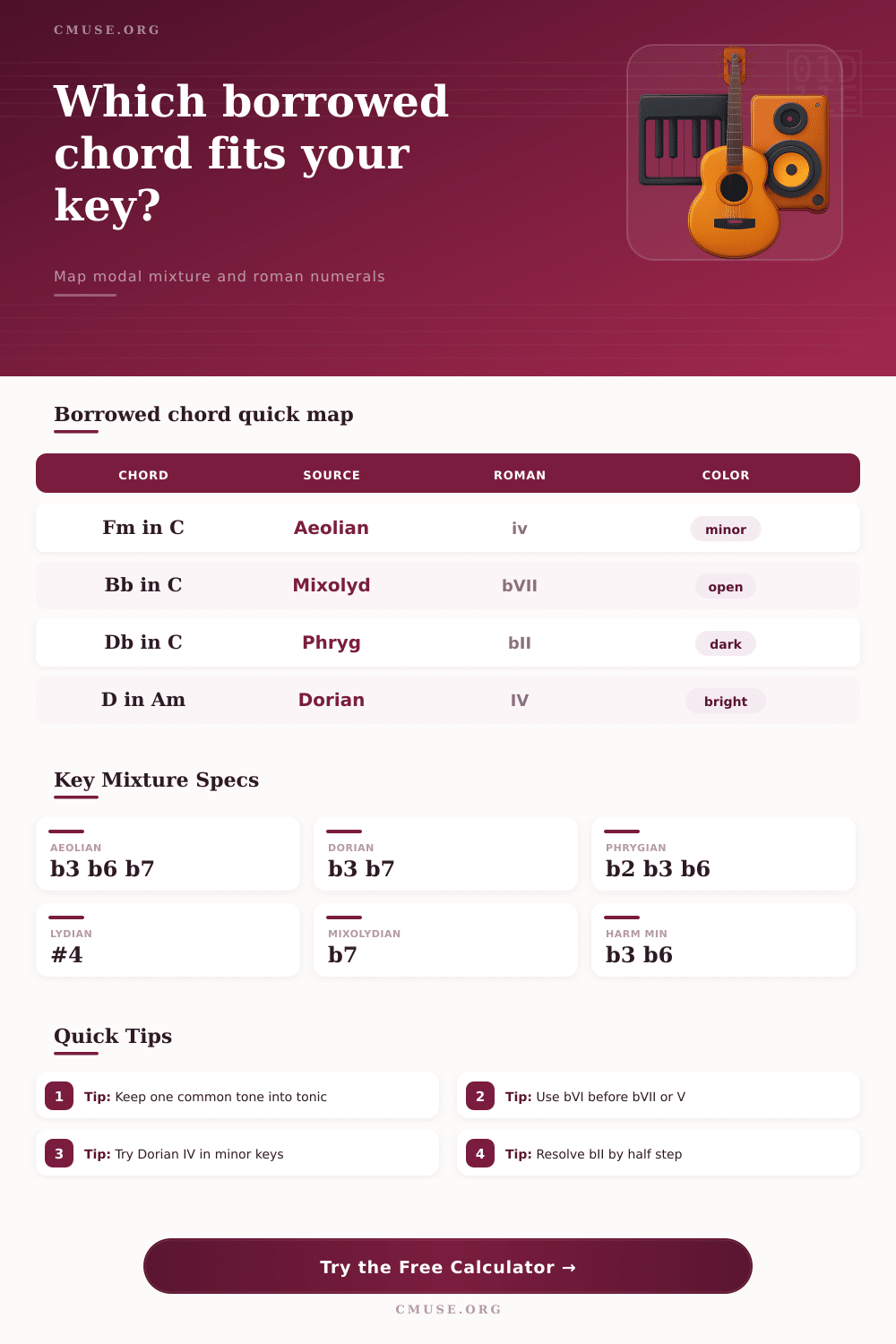
| C Major iv | C Ionian | C Aeolian | F Ab C, roman iv |
| C Major bVII | C Ionian | C Mixolydian | Bb D F, roman bVII |
| C Neapolitan | C Ionian | C Phrygian | Db F Ab, roman bII |
| A Minor IV | A Aeolian | A Dorian | D F# A, roman IV |
| A Minor V7 | A Aeolian | A harmonic minor | E G# B D, roman V7 |
| D Lydian II7 | D Ionian | D Lydian | E G# B D, roman II7 |
Borrowed chord occur when a chord from a different mode within a given musical piece is use within the home key of that piece. The chords change the sound of the piece, but the tonic note of the home key are not changed. The tonic note within a key is the central note of that key.
The use of borrowed chords create a sense of surprise within the listener because the borrowed chords does not belong to the home keys scale. However, they are connect to that same key due to the use of the tonic note. The use of borrowed chords within a musical composition is also refer to as modal mixture.
Easy Guide to Borrowed Chords
Modal mixture occur within major and minor modes because both modes uses the same tonic note for their scales. The calculator that is provide to those who wish to calculate the details of a borrowed chord allow a person to calculate the details of a borrowed chord by selecting the home key of a composition, the mode from which the borrowed chord is derive, and the scale degree of the borrowed chord. Based on these choice, the calculator will display the chord spelling, the roman numeral that represents that chord in a musical score, and the number of tone that exist outside of the home mode for that composition.
The number of tones outside of the home mode indicates to a composer or musician how different the borrowed chord will sound from the home key’s scale. A borrowed chord with many tone outside of the home mode may be more challenging to incorporate into voice leading for a musician. Many songwriter choose to use the source mode of Parallel Aeolian to generate borrowed chords for their musical compositions.
In this mode, a songwriter can generate the minor iv chord, the major bVI chord, and the major bVII chord. These three chord are commonly found in many pop, rock, and film music composers’ compositions. Furthermore, the major bVII chord can act as a backdoor dominant to the tonic.
This is because the major bVII chord shares no tone with the tonic’s V chord. The altered degree for this chord can be found using the calculator. Another mode that songwriters often use for borrowed chords is the mode of Parallel Dorian.
This mode create a raised sixth note within a composition, which convert the iv chord to a major IV chord. Additionally, the iio chord change to a minor ii chord when using this mode. In minor key, using this mode can create a sense of brightness to the music without changing the tonic note of that key.
Many music composer and arrangers use this mode because the raised sixth note within the composition allow the songwriter to create a gentle color to the pre-dominant chord in their composition. Another mode that composers may turn to is the use of Phrygian borrowing. This mode create an aggressive addition of borrowed chords within a composition.
Phrygian borrowing can lead to the production of the Neapolitan chord, bII. This chord use a lowered second degree from the home mode. Furthermore, the root of this chord is one half step above the tonic note.
This is commonly use in classical music, where this chord is used in first inversion so that its bass descend by step into the dominant key. In moddern music, however, the chord can be use without inversion to add color to the music. The half-step motion of this chord can be locate using the calculator.
In addition to the modes mentioned, the Lydian and Mixolydian mode can also be borrowed in musical compositions. The Lydian mode create a raised fourth note in a composition, which change the supertonic chord to a major II chord. Additionally, the Mixolydian mode introduce a lowered seventh note within a composition, which create the bVII chord.
Both of these borrowed chord modes require careful consideration of voice leading within a musical composition. This is because the signature chord of the Lydian and Mixolydian modes sit close to the home mode within a musical composition. A composer or musician must decide how many borrowed chord to use within their composition.
Using too many or too few borrowed chords can create issue within the song. By using the calculator to determine the number of borrowed chords that contain common tone within a composition, a writer or composer can have more control over the sound that they would like to create within their song. Another important element to consider when using borrowed chords is voice leading.
If a person wish to create a smooth sound with borrowed chords within a composition, they must ensure that at least one tone within the borrowed chord remain the same within the following chord within the composition. This tone will act as an anchor for listener to process the borrowed chord within the music. The calculator will display the number of common tone for borrowed chords, but the person must decide if they would like to use borrowed chords with the voice leading structure suggested by the calculator.
The resolution path for borrowed chords are also important to consider when composing music with borrowed chords. In some case, borrowed chords will require the bass note to descend by step into the following chord. However, other borrowed chords may need to resolve by a half step or a common tone within the composition.
The function menu below the borrowed chord section of the calculator allow a person to choose different resolution path for their borrowed chords. These resolution path are not strict rule for musicians and composers. However, they do show how borrowed chords within music are supposed to resolve.
The primary value of borrowed chords is the effect that the borrowed chords will have on the rest of the music within a composition. For instance, incorporating a minor iv chord into a song that is utilizing a major key will darken that composition’s musical phrase when the melody use the lowered sixth note of the composition. Additionally, the use of a bVII chord for a chorus will make the chorus more wider in its musical arrangement.
This mathematical data can be found through the borrowed chord calculator. However, a songwriter must use their musical ear to decide where and how to include borrowed chords in their compositions. In case where the data matches what a person hear with their ears, borrowed chords will feel as if they are a natural part of the song that they are create.