Blues Scale Calculator
Build minor, major, dominant, or composite blues scales in any key with note spelling, interval formula, blue-note focus, chord fit, and fretboard position output.
Preset use: Load a familiar guitar, bass, horn, keyboard, or vocal blues setting, then adjust key, spelling, blue-note emphasis, position width, and chord target.
Calculation Breakdown
Core rock, blues, soul, funk, and guitar-box sound over minor or dominant settings.
Sweeter country, jump blues, gospel, and piano vocabulary over major or dominant chords.
Blends major blues color with dominant chord tones for horn lines and jazz-blues phrases.
Combines the minor blue note with the major third for gritty dominant soloing.
Map reading: Dark cells are roots, wine cells are selected blue notes, and filled cells are other scale tones inside the chosen fret range.
| Scale Family | Semitone Set | Degree Formula | Typical Use |
|---|---|---|---|
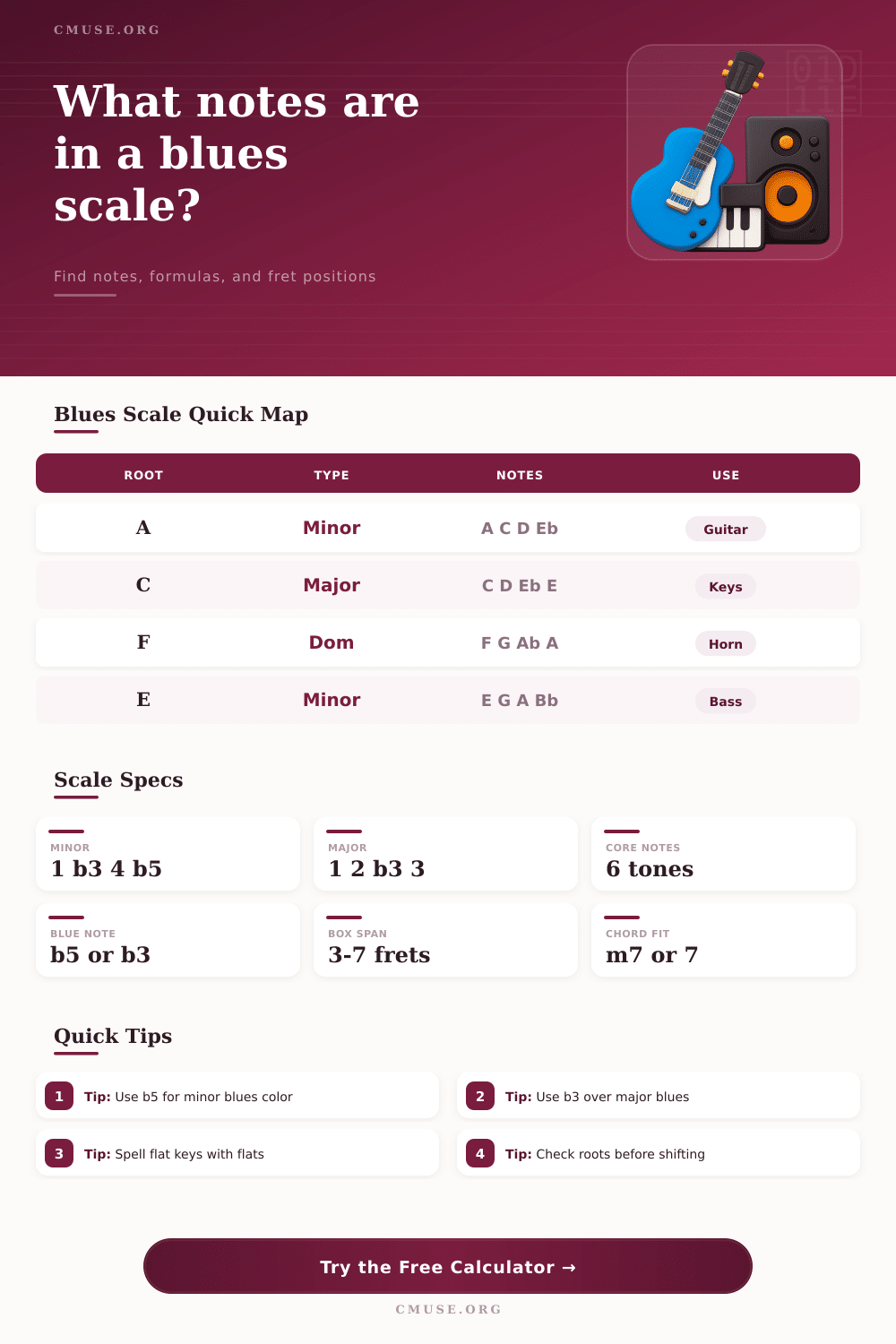
| Minor blues | 0, 3, 5, 6, 7, 10 | 1 b3 4 b5 5 b7 | Minor 7, dominant 7, power-chord riffs, classic guitar boxes |
| Major blues | 0, 2, 3, 4, 7, 9 | 1 2 b3 3 5 6 | Major 6, dominant 7, country blues, jump blues, gospel lines |
| Dominant blues | 0, 2, 3, 4, 5, 7, 9, 10 | 1 2 b3 3 4 5 6 b7 | Horn lines, jazz blues, mixed major-minor dominant vocabulary |
| Composite blues | 0, 3, 4, 5, 6, 7, 10 | 1 b3 3 4 b5 5 b7 | Dominant riffs where the minor third bends into the major third |
| Key | Minor Blues Notes | Major Blues Notes | Common Instrument Context |
|---|---|---|---|
| A | A C D Eb E G | A B C C# E F# | Guitar box 1, bass riffs, vocal blues ranges |
| E | E G A Bb B D | E F# G G# B C# | Open guitar shuffle, bass grooves, blues-rock riffs |
| C | C Eb F Gb G Bb | C D Eb E G A | Piano blues, organ, voice, concert lead sheets |
| F | F Ab Bb B C Eb | F G Ab A C D | Horn-friendly blues, jazz combo charts, sax sections |
| Bb | Bb Db Eb E F Ab | Bb C Db D F G | Tenor sax, trumpet concert transposition practice |
| G | G Bb C Db D F | G A Bb B D E | Country blues, open-position guitar, fiddle-friendly keys |
| Root And Position | Minor Box Range | Primary Roots | Practice Focus |
|---|---|---|---|
| A minor box 1 | 5th to 8th fret | 6th string fret 5, 4th string fret 7, 1st string fret 5 | Bend the b5 into the 5 and resolve to A or C |
| E open blues | Open to 3rd fret | Open 6th, open 1st, 2nd string fret 5 when extended | Use open E and A strings for shuffle riffs |
| G major blues | 2nd to 5th fret | 6th string fret 3, 4th string fret 5, 1st string fret 3 | Target B and E for a major-six color |
| D bass pocket | 5th to 10th fret | A string fret 5, G string fret 7, D string open when shifted | Anchor root, b7, and blue-note approach tones |
| B high box | 7th to 12th fret | 6th string fret 7, 4th string fret 9, 2nd string fret 12 | Keep the b5 quick so the line returns to chord tones |
| Chord Target | Best Scale Family | Strong Tones | Watch Notes |
|---|---|---|---|
| Minor 7 | Minor blues | 1, b3, 4, 5, b7 | b5 works best as a passing tone or bend note |
| Dominant 7 | Composite or dominant blues | 1, 3, 5, b7 with b3 color | Balance b3 and 3 so the chord quality stays clear |
| Major 6 or 6/9 | Major blues | 1, 2, 3, 5, 6 | b3 is expressive but should usually resolve upward |
| Power chord or riff | Minor blues | 1, 4, 5, b7 | b3 and b5 shape the blues identity around the riff |
| 12-bar turnaround | Dominant blues | 1, 3, 5, 6, b7 | Use chromatic approach tones near chord changes |
The blues scale can be used for many differents musical genres, such as blues, rock, country, and jazz music. The blues scale isnt a specific scale, but rather, is a group of different note sets that relates to one another and that revolve around three specific anchor notes. These anchor notes are the root, the fifth, and an flat seventh note.
Each of these notes can be used as an anchor for the musician to build the blues scale and add color tones to each of these notes. These color tones will change the mood of the music that is create, changing the emotion that the blues scale expresses. Before using the blues scale in a song, a musician must first decide whether the underlying chord is a minor chord or a major chord.
How to Use the Blues Scale
For minor chords, the flat third and the flat fifth is used to create the blues scale, creating a gritty sound. For major chords, the musician use the major second and the major third in place of the flat third, creating a brighter and more vocal sounding chord. A calculator can be used to compute the math behind each of these chord scale.
The calculator can handle the root of the chord and the spelling of the notes in flat keys. A musician must understand why one blues scale family sound correct with a specific backing track, and why another blues scale family does not sound correct with that same backing track. Within the blues scale, there is a specific note that is used within the scale: the blue note.
The blue note is not typically the final note of a phrase within the song. The blue note can be used as a passing tone to the next note in the scale or it can be used to bend the note towards the chord tones. For minor blues scales, the flat fifth note is the blue note.
For major blues scales, the flat third is the blue note. If musicians linger on the blue note, the musical line will sound unresolved. However, if the musician treats the blue note as motion rather than a resting place for the music, then the musical line will sound intentional.
Another factor that musicians must take into consideration with the blues scale is the position of the notes within the instruments tuning. The position of the notes and the tuning of the instruments will change the available notes for the musicians finger. On a guitar, five frets will allow the musician to use the “box” shape of the blues scale to easily bend the blue note.
On the bass, five frets will place the root note and the flat seventh on adjacent strings, which allows musicians to play shuffle patterns. For keyboard players, there is more room within a row of keys. A tool is available that allows the musician to set the starting fret for the chord and the span between the notes that are to be played in the chord.
The output of this tool will display the reach that the musician has for playing those notes on a specific instrument. The relationship between the blues scale and the chord that is used within the song is another layer to the music that musicians should pay attention to. Blues scales can be used over dominant chords to create a tension to the dominant sound created by the chord.
Major blues scales work best with backing tracks that contains a major third. For those using composite or dominant blues scale families, both the major and minor third notes are contained within the chord, allowing musicians to choose which note they wish to emphasize within their performance of the blues scale. Reference tables can display the relationship between the different scale tones and chord types.
These scales will display which scale tones are strong within particular chord types and which scale tones must quickly resolve to particular notes within those chords. Many musicians makes mistakes with the blues scale. Two common mistakes are using the blue note as the final note in a musical line and using the same box shape for every musical phrase.
Using the blue note as the final note in a musical line can cause the musician’s musical lines to sound unresolved. Using the same box shape for all musical phrases limits the musician’s musical vocabulary. To overcome these obstacles, musicians can try altering the start of the position of the chord or changing the way that the musician view the tuning of the instrument.
For all musicians that play the blues scale, the goal is to become accustomed to the sound of the blue note. Once musicians are accustomed to the sound of the blue note, the calculator is a tool that will help confirm what the musician’s ears has already determined.