Beats Per Phrase Calculator
Convert musical phrase length into total beats, real seconds, bar grouping, cue countdowns, and subdivision counts for songwriting, DJ edits, click tracks, charts, and DAW markers.
Phrase model: A phrase is counted as complete bars plus any pickup, tail, or cue offset you want to include in the working count. Standard beats use the time signature numerator; quarter-note timing is converted from the denominator and selected BPM beat unit.
Calculation Breakdown
Common in hip-hop loops, riff answers, fills, tags, and short call-and-response writing.
A frequent pop, rock, hymn, and folk unit for verses, hooks, and balanced melodic periods.
Useful for DJ phrasing, EDM sections, extended intros, dance breakdowns, and mix-ready edits.
Often used for full dance sections, film builds, long solos, or large-scale arrangement cycles.
| BPM | 4-Bar Phrase In 4/4 | 8-Bar Phrase In 4/4 | 16-Bar Phrase In 4/4 | Beat Length |
|---|---|---|---|---|
| 80 | 12.00 sec | 24.00 sec | 48.00 sec | 0.750 sec |
| 100 | 9.60 sec | 19.20 sec | 38.40 sec | 0.600 sec |
| 120 | 8.00 sec | 16.00 sec | 32.00 sec | 0.500 sec |
| 128 | 7.50 sec | 15.00 sec | 30.00 sec | 0.469 sec |
| 140 | 6.86 sec | 13.71 sec | 27.43 sec | 0.429 sec |
| 174 | 5.52 sec | 11.03 sec | 22.07 sec | 0.345 sec |
These values assume quarter-note BPM in 4/4, with no pickup, tail, or groove offset.
| Meter | Beats Per Bar | 4 Bars | 8 Bars | Phrase Use |
|---|---|---|---|---|
| 2/4 | 2 counted beats | 8 beats | 16 beats | Marches, polkas, fast short phrases |
| 3/4 | 3 counted beats | 12 beats | 24 beats | Waltz, hymns, triple-meter periods |
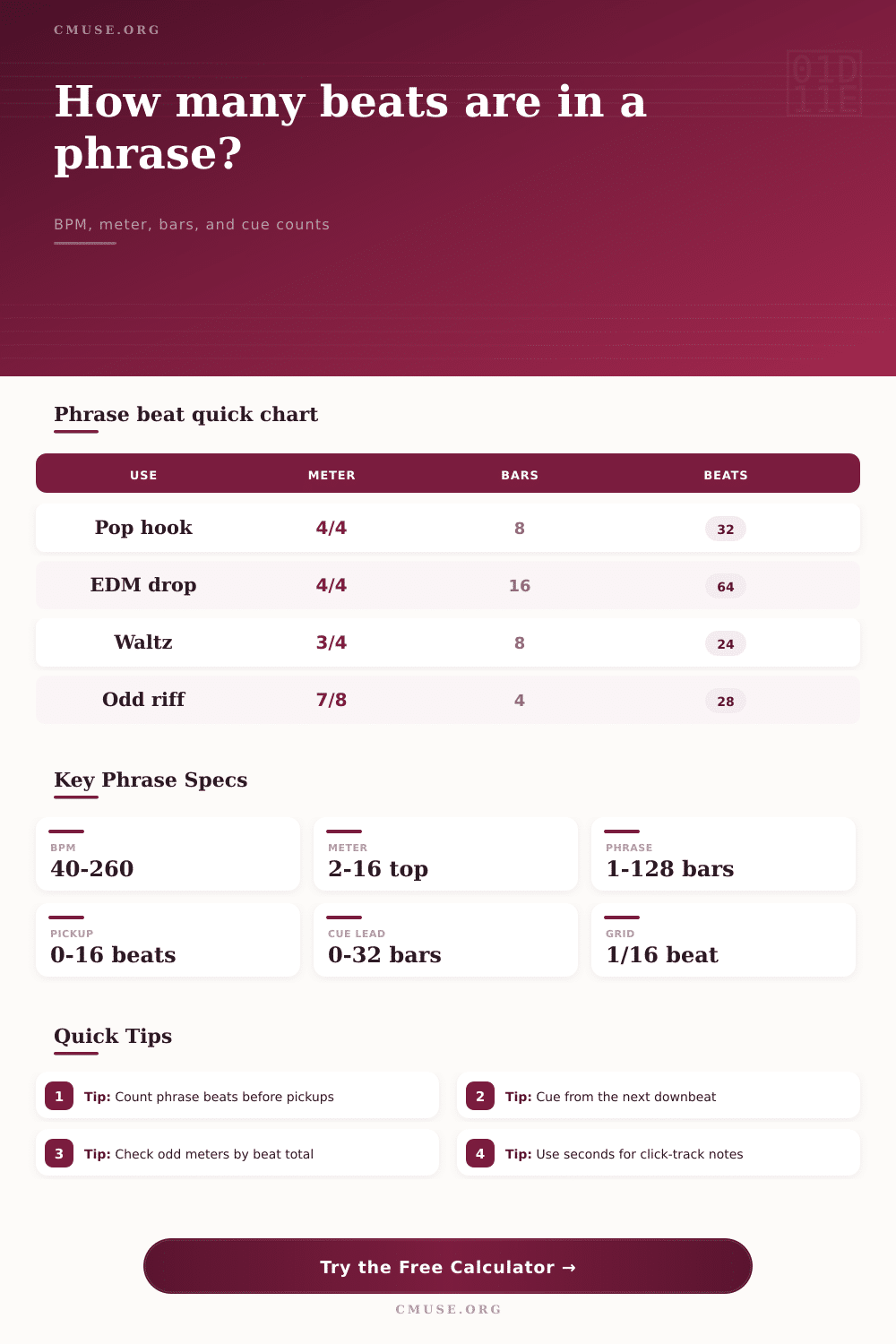
| 4/4 | 4 counted beats | 16 beats | 32 beats | Pop, rock, hip-hop, EDM, most DAW grids |
| 5/4 | 5 counted beats | 20 beats | 40 beats | Odd-meter riffs and progressive phrases |
| 6/8 | 6 written beats | 24 eighths | 48 eighths | Folk, ballad, compound two-feel phrases |
| 7/8 | 7 written beats | 28 eighths | 56 eighths | Asymmetric riffs and Balkan-style cycles |
| Cue Lead | 4/4 Beat Count | DJ Marker | Band Direction | Best Use |
|---|---|---|---|---|
| 1 bar | 4 beats | Short warning | Final count-in | Fills, stops, breath marks |
| 2 bars | 8 beats | Quick phrase cue | Ready for cadence | Pop hooks and live band turns |
| 4 bars | 16 beats | Mini phrase marker | Enter after four | Loop swaps and stage cues |
| 8 bars | 32 beats | Phrase marker | Next section in eight | Song sections and DJ phrasing |
| 16 bars | 64 beats | Club mix marker | Long build count | EDM, house, techno, DNB |
| Genre Or Setting | Typical Meter | Common Phrase | Beat Total | Timing Note |
|---|---|---|---|---|
| Pop / Rock | 4/4 | 8 bars | 32 beats | Verses and choruses often resolve in paired 4-bar ideas. |
| Hip-Hop | 4/4 | 4 or 8 bars | 16 or 32 | Loops may repeat every 4 bars while vocals phrase in 8. |
| House / Techno | 4/4 | 16 bars | 64 beats | DJ transitions commonly use 16- or 32-bar phrase blocks. |
| Drum And Bass | 4/4 | 16 bars | 64 beats | Fast BPM halves the clock time, not the bar count. |
| Waltz / Hymn | 3/4 | 8 bars | 24 beats | Cadences often appear at the end of 4- and 8-bar periods. |
| Jazz Blues | 4/4 | 12 bars | 48 beats | The form itself is the phrase cycle for solos and heads. |
| Film Cue | Flexible | 4-12 bars | Varies | Beat count is often adjusted to hit exact picture time. |
It’s two in the morning and you’re standing in the studio. Everything’s going great. The rhythm section are locked in. The hook sounds good. Then it hits you, something doesn’t feel right. When the chorus comes around, it seems like it’s coming too early. The build-up is breathless, the resolution unsatisfying. You pull up your DAW grid to verify bar count. It is eight bars long. You got the theory right, but the math behind what actualy happened feels wrong. That’s the distinction between a phrase on paper and a phrase in time.
The calculator bridges the gap: it converts theoretical bars into real world seconds, beats and cue points. The fact is most producers thinks in bars. One, two, three, four; one, two, three, four. And they group their bar into fours, eights or sixteens. That’s structural thinking. It’s key to how a song is composed because it provides the skeleton of the song. But a bar on its own doesn’t tell you how long it lasts. Eight bars at 120 BPM equals sixteen seconds. At 174 BPM equals an eleven and a bit second. That five-second variation change the whole feeling of the track.
Why Bars and Seconds Are Different
The calculator above will do the math for you, and convert your inputs of meter and tempo into real-world duration. It shows not only how many beats there is, but how much clock time they gobble up. The secret lies in knowing what’s really being counted. There seems to be a lot of confusion between duration and beat count. A bar has four beats (in 4/4) but six eighth notes (in 6/8). It can have two dotted-quarters as felt by a drummer. Unless you’re syncing your BPM setting with whatever is being counted, your seconds won’t match up.
You can choose the beat unit you want the tool to use, making sure that time conversion reflects how you FEEL it. This is where many people gets it wrong. They are setting the tempo to a quarter note, but they are hearing a dotted quarter breathing in time to their music. The result can be that phrase sounds dragged or rushed even though the number of bars is correct.
And what about that pickup? Well, as we say in the theory books, we call it anacrusis. In reality, it’s simply those added beats preceding the complete downbeat. So maybe you’ve started a phrase with a half-beat lead-in, beginning on the ‘and’ of four. If you don’t factor this in then you end up with something slightly too short. Compound that over sixteen bars and it could of been significant. The calculator enables you to include tail and pickup beats to achieve a spot-on workable length. It is small perhaps, but it is important if you’re synchronizing a visual cue or incorporating a vocal chop into a narrow grid.
Bar counting also falls short when it comes to cueing. When should the fade begin? Where does the conductor raise his/her hand? If they’re on the second half of beat 2 of bar 32, knowing that the section begins at bar 33 don’t help. By converting bars into seconds or beats, the table on the page becomes a way to translate distance in the score to distance in time in the room. In 4/4, an eight-beat cue is two bars. A sixteen-beat cue is four bars. What we’re talking about is how much runway do you have to make a smooth transition?
The length of phrases are dictated by genre conventions too. House music builds across sixteen bars. Hip-hop loops typically resolve on every four bar. The period of a waltz typically lasts for eight bars. These aren’t hard and fast rules but focal points. Tension is generated when you deviate from them. Knowing how many seconds away you are from these help you to manage the tension. Can you hear that a seven bar phrase sounds short? That’s because it really is only 1.5 seconds shorter than the expected eight. Hear that it’s long? Because the slow tempo pulls out the silence.
Rhythm organizes music into time. Bars are just markers on the map. Like a counter on a calculator, it provide the reading in terms of seconds. And that’s what you can use it for: To confirm what your gut is telling you. Is the feeling of the phrase too short? Check out those seconds. Do you feel like the cue is coming in late? Look at that beat count. The numbers don’t make the groove; they only ensure the groove is going to land exactly where you want it.
When feel meets math, the track finaly clicks. That’s when it happens. Your time is right, and the music will take care of the rest.