🎵 BPM Calculator & Tempo Converter
Calculate beats per minute, delay times, tap tempo, and note intervals for any music project
| Marking | BPM Range | Feel | Common Use |
|---|---|---|---|
| Larghissimo | 20–24 BPM | Extremely Slow | Funeral, Elegy |
| Grave | 25–45 BPM | Solemn, Very Slow | Classical, Sacred |
| Largo | 40–60 BPM | Broadly Slow | Classical, Hymns |
| Lento | 45–60 BPM | Slowly | Ballads |
| Larghetto | 60–66 BPM | Rather Broad | Classical |
| Adagio | 66–76 BPM | Slow & Stately | Ballads, Classical |
| Andante | 76–108 BPM | Walking Pace | Pop, Soul |
| Moderato | 108–120 BPM | Moderate | Pop, Rock |
| Allegretto | 112–120 BPM | Moderately Fast | Pop |
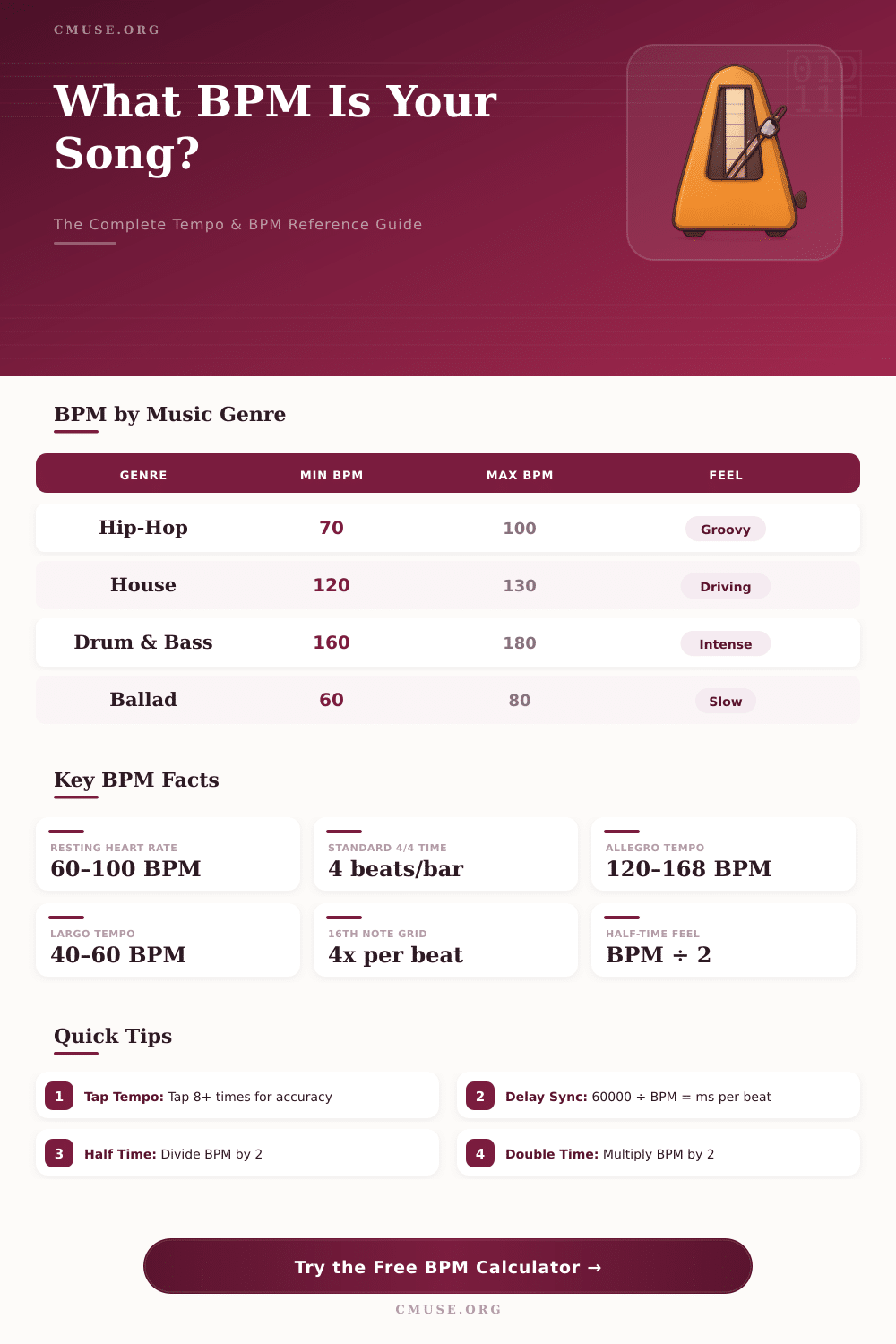
| Allegro | 120–168 BPM | Fast, Lively | Dance, Rock |
| Vivace | 168–176 BPM | Lively & Fast | Classical, Metal |
| Presto | 168–200 BPM | Very Fast | DnB, Metal |
| Prestissimo | 200+ BPM | Extremely Fast | Speedcore |
| BPM | Quarter (ms) | 8th Note (ms) | Dotted 8th (ms) | 16th Note (ms) |
|---|---|---|---|---|
| 60 BPM | 1000 ms | 500 ms | 750 ms | 250 ms |
| 80 BPM | 750 ms | 375 ms | 562 ms | 188 ms |
| 100 BPM | 600 ms | 300 ms | 450 ms | 150 ms |
| 120 BPM | 500 ms | 250 ms | 375 ms | 125 ms |
| 128 BPM | 469 ms | 234 ms | 352 ms | 117 ms |
| 140 BPM | 429 ms | 214 ms | 321 ms | 107 ms |
| 160 BPM | 375 ms | 188 ms | 281 ms | 94 ms |
| 174 BPM | 345 ms | 172 ms | 259 ms | 86 ms |
| 200 BPM | 300 ms | 150 ms | 225 ms | 75 ms |
| Note Type | Beats | Duration at 120 BPM | Formula |
|---|---|---|---|
| Whole Note | 4 beats | 2000 ms | 60000 / BPM x 4 |
| Half Note | 2 beats | 1000 ms | 60000 / BPM x 2 |
| Quarter Note | 1 beat | 500 ms | 60000 / BPM |
| 8th Note | 0.5 beats | 250 ms | 60000 / BPM / 2 |
| 16th Note | 0.25 beats | 125 ms | 60000 / BPM / 4 |
| 32nd Note | 0.125 beats | 62.5 ms | 60000 / BPM / 8 |
| Dotted Quarter | 1.5 beats | 750 ms | 60000 / BPM x 1.5 |
| Dotted 8th | 0.75 beats | 375 ms | 60000 / BPM x 0.75 |
| Quarter Triplet | 0.667 beats | 333 ms | 60000 / BPM x 2/3 |
| BPM | Quarter Hz | 8th Note Hz | 16th Note Hz | Bar (4/4) Hz |
|---|---|---|---|---|
| 60 | 1.000 Hz | 2.000 Hz | 4.000 Hz | 0.250 Hz |
| 80 | 1.333 Hz | 2.667 Hz | 5.333 Hz | 0.333 Hz |
| 100 | 1.667 Hz | 3.333 Hz | 6.667 Hz | 0.417 Hz |
| 120 | 2.000 Hz | 4.000 Hz | 8.000 Hz | 0.500 Hz |
| 128 | 2.133 Hz | 4.267 Hz | 8.533 Hz | 0.533 Hz |
| 140 | 2.333 Hz | 4.667 Hz | 9.333 Hz | 0.583 Hz |
| 160 | 2.667 Hz | 5.333 Hz | 10.667 Hz | 0.667 Hz |
| 174 | 2.900 Hz | 5.800 Hz | 11.600 Hz | 0.725 Hz |
Beats each minute, or BPM, are a basic part of song. It points how many beats happen in one minute of music. If you have 60 BPM then one beat happens every second.
If you raise it to 120 BPM, then two beats come each second. Here the main point: beat and BPM relates to same thing, only described differently. Beat is the general idea, while BPM show exactly how we measure it.
What BPM Means and How It Affects Music
Think about it as height against centimetres, one is the idea, the other is the unit.
The Italian word “tempo” simply means “time”. In music, BPM plays the role that kilometers per hour have for travel. It is the usual way to measure the speed of song.
Bigger BPM points faster music, while fewer beats make it slower. Really interesting is how beat affect the whole mood and energy of a song.
Electronic and dance music depends strongly on BPM. Knowing the beat of song help you match your moves, catch its rhythm and adapt beats during DJing. Even so, BPM alone do not reveal everything about the feeling of song.
Song at 140 BPM could play in half time and feel as if it runs at 70. On the other hand, a beat at only 100 BPM, filled with lively notes and strong percussion, can sound much more active, almost as if it goes in double speed. BPM so is only one peice of the whole jigsaw about energy.
Classical composers not always wrote exact numbers for beat in their books. Rather, they used Italian terms to point the speed. For instance, Adagio falls between around 42 and 66 BPM.
Later come Moderato and Allegro in the range of 109 until 132, while Presto reach from about 168 until 200 BPM. Everything faster than 200 is called Prestissimo. Adagio of the 19th century could range between 50 and 85 BPM, depending on reading.
Actually, Beethoven was the first important composer that noted exact BPM-numbers for all his symphonies.
Classical concerts do not have click tracks, as one finds in rock or pop albums. That allows conductors to stretch or shorten the beat according to there wish, so that same piece can sound totally different in different performances.
Metronomes help musicians stay true to beat during long time. They give a steady pulse, so that your playing stays matched. Modern online metronomes let you set beat between 20 and 260 BPM with a simple slider.
Some apps have built-in tappers, with which you can tap to find the pace of song by hearing. And there are also tools that listen through your microphone and detect BPM automatically.
The accuracy of BPM data matter for song more than one thinks. If song has wrong or missing beat in labels, it can miss in results of library searches. Libraries sort everything according to data like beat, so when someone filters for a certain speed, your song requires a good label to appear.
Jazz and funk usually move around 80 until 110 BPM. The main range for many styles is between 80 and 120 BPM, where 120 is typical for pop. Most of music moves on average between 90 and 120 BPM, although classical commonly goes a bit faster, from 120 until 140.
Converting BPM to milliseconds is easy (simply divide 60 000 by your BPM-number). At 120 BPM, every beat lasts around 500 milliseconds. When I practiced new song, I had more luck starting at two-thirds speed, around 60 BPM.
From there, I raised it one beat at atime, until it started to feel too fast, then I slowed it until it sounded right.