Beat Rate Tuning Calculator
Estimate audible beat speed from interval, reference pitch, partial pair, stretch, and cents adjustment for piano tuning, ensemble checks, and instrument setup.
Preset use: Load a real tuning check, then adjust the note, interval, cents, stretch, and coincident partials. Beat rate is the absolute difference between the two partial frequencies.
Calculation Breakdown
| Interval | Pure Ratio | Listening Partials | Equal Temperament Offset |
|---|---|---|---|
| Perfect fifth | 3:2 | Lower 3rd against upper 2nd | Upper note is 1.955 cents narrow from pure |
| Perfect fourth | 4:3 | Lower 4th against upper 3rd | Upper note is 1.955 cents wide from pure |
| Major third | 5:4 | Lower 5th against upper 4th | Upper note is 13.686 cents wide from pure |
| Minor third | 6:5 | Lower 6th against upper 5th | Upper note is 15.641 cents narrow from pure |
| Major sixth | 5:3 | Lower 5th against upper 3rd | Upper note is 15.641 cents wide from pure |
| Minor sixth | 8:5 | Lower 8th against upper 5th | Upper note is 13.686 cents narrow from pure |
| Octave | 2:1 | Lower 2nd against upper 1st | Equal temperament is pure before stretch |
| Twelfth | 3:1 | Lower 3rd against upper 1st | Equal temperament is pure before stretch |
| Check | Lower Note | ET Upper Note | Approx Beat Rate |
|---|---|---|---|
| Perfect fifth | A3, 220.00 Hz | E4, 329.63 Hz | About 0.74 beats per second |
| Perfect fourth | D4, 293.66 Hz | G4, 392.00 Hz | About 1.00 beats per second |
| Major third | F3, 174.61 Hz | A3, 220.00 Hz | About 6.50 beats per second |
| Minor third | C4, 261.63 Hz | Eb4, 311.13 Hz | About 7.81 beats per second |
| Major sixth | C4, 261.63 Hz | A4, 440.00 Hz | About 10.73 beats per second |
| Beat Rate | Counting Method | Typical Use | Practical Meaning |
|---|---|---|---|
| 0 to 0.25 Hz | One beat every 4 seconds or slower | Octaves, unisons, very slow checks | Nearly still; listen for slow waves and color |
| 0.25 to 1 Hz | Count for 8 to 12 seconds | Middle register fourths and fifths | Slow enough to count with a steady pulse |
| 1 to 4 Hz | Count 5 seconds and divide | Temperament checks and thirds in lower midrange | Clearly rolling but still countable |
| 4 to 10 Hz | Compare against neighboring thirds | Major thirds, minor thirds, sixths | Fast shimmer; progression matters more than exact counting |
| 10 Hz and above | Use relative smoothness | Upper register wide intervals | Very fast roughness; cent readings may help |
| Partial Pair | Pure Interval | Why It Beats | Best Register |
|---|---|---|---|
| 2 against 1 | Octave, 2:1 | Same harmonic line should nearly align | Midrange and treble octaves |
| 3 against 2 | Perfect fifth, 3:2 | Equal temperament narrows the fifth slightly | Temperament octave and midrange |
| 4 against 3 | Perfect fourth, 4:3 | Equal temperament widens the fourth slightly | Temperament octave and checks |
| 5 against 4 | Major third, 5:4 | Equal temperament makes the third quite wide | Useful for progressive third checks |
| 6 against 5 | Minor third, 6:5 | Equal temperament makes the third narrow | Cross-check against major thirds |
| 5 against 3 | Major sixth, 5:3 | The same 5-limit color appears higher apart | Midrange sixth progression |
Tuning a piano or any other instrument by ear require that you listen for pulsing sounds. These pulsing sounds are beats. Beats occur when two musical note are not in tune with one another.
The beats can tell you how far apart the partials of the musical notes are. Furthermore, the beats can also tell you whether or not you must move the tuning pin that adjusts the pitch of the musical note. The calculator included with this website help you to perform the mathematics necessary to determine these values.
Tune a Piano by Listening to Beats
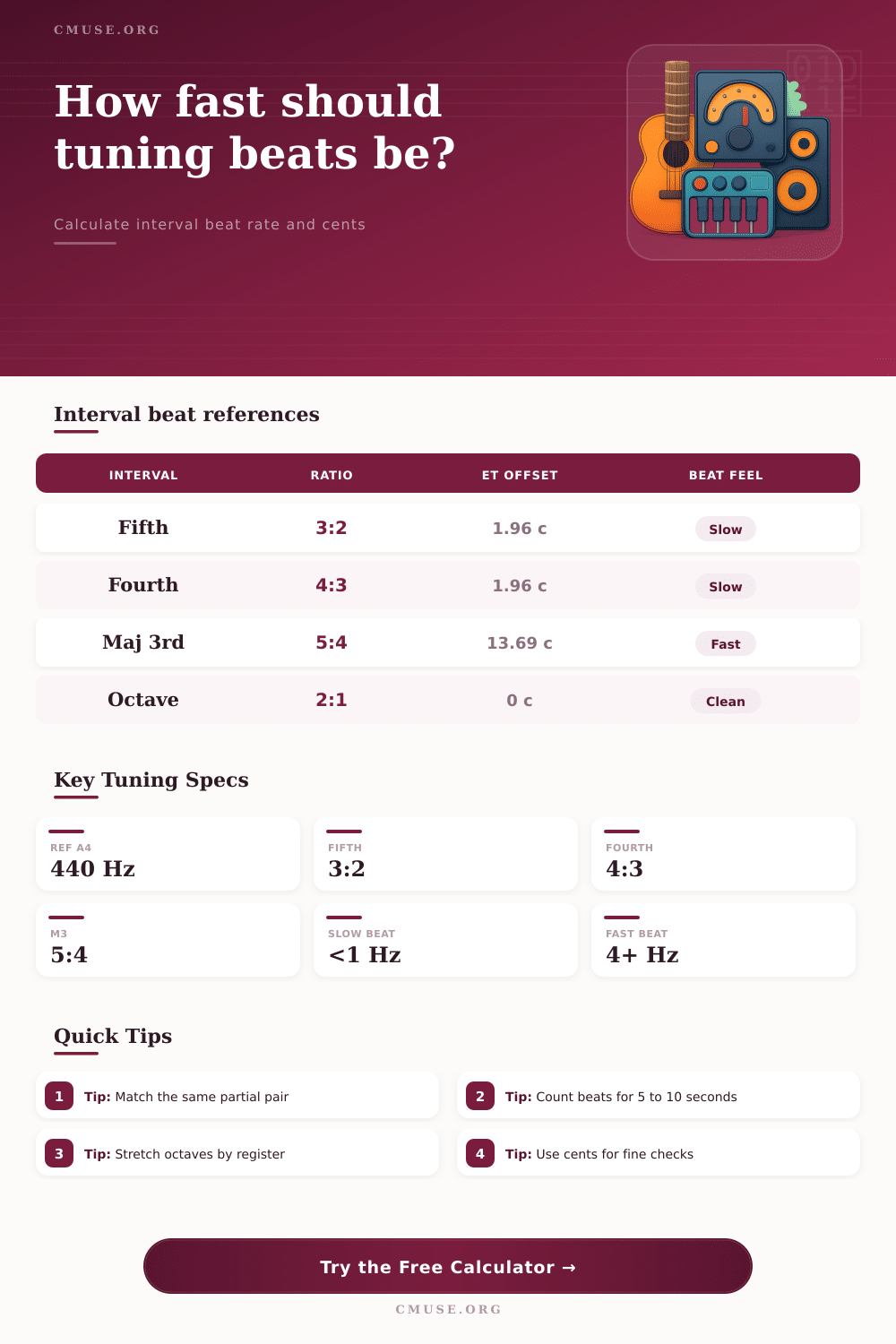
Thus, you can focus on the instrument in front of you rather than having to focus on the calculations necessary to determine whether or not you should move the tuning pin. Every musical interval have a temperament offset that is built into the system of equal temperament. For instance, the system narrows perfect fifths by approximately two cents relative to the just intonation tuning system, and major thirds is widened by nearly fourteen cents.
The lower partial of the bottom note and the upper partial of the top note create a difference tone. The calculator calculates the difference tone by performing the subtraction of the frequencies of the two notes. If the difference in frequencies are small, the pulsations (or beats) will be slow.
However, if the difference in frequencies is large, the shimmering of the note will be faster and harder to count. The reference pitch that you use in the calculator are very important. Many moddern pianos is tuned to 440 Hz for the note A4. However, many ensembles use either 442 Hz or 415 Hz for period work.
Thus, if you change the reference pitch that you use, all other calculations will change. For instance, a fifth that beats once every second at 440 Hz will beat more faster at 442 Hz. The calculator will reflect this so that you dont have to perform these calculations yourself.
Another variable that you can test using the calculator is the stretch that is applied to the octaves of a piano. The treble section of a piano is often tuned to the octaves slightly wide in order to allow for the upper partials of the octaves to line up with the inharmonicity of the piano strings. The opposite of this can happen in the bass section of the piano.
If you add any cents of stretch to an octave, the frequency of the upper octave will change. Furthermore, any intervals that are tuned to that upper octave will have alterations in their beat rate. While the effect of stretch on a single fifth is negligible, the effect of stretch on thirds within a temperament octave will become audible to the listener.
The choice of partials often explain why many piano tuners recieve inconsistent results. For instance, rather than using the fifth partial of the lower note and the third partial of the upper note, you could use the third partial of the lower note and the second partial of the upper note. Furthermore, you can even use higher partials.
Each of these different partials will result in a different number of beats. However, if the tuner uses the same partials each time they check the same interval, the tuner will be able to recognize whether or not the beats are speeding up or slowing down. The reference tables included with the calculator are an aid to those who would like to know the different partial pairs for each interval and how far equal temperament exist from true (just) intonation.
For instance, the tables will indicate that a just intonation major third will beat approximately six and a half times per second in the middle of the piano. Thus, the tuner can use these values to determine if the piano is in tune. The calculator also indicates the beat rate in categories that are easy to recognize.
Any rate that is below one hertz will take eight or ten seconds to count. Any rate that is between one and four hertz will be counted as a shimmering sound. These different categories allow the tuner to decide whether or not they should be counting the beats of a given musical interval.
This is especially important in the upper treble portion of the piano, where the beats are too rapid to count. Real pianos contain various complications that will shift the partials of the given note. Thus, while the calculator will provide the theoretical target for the pianist, the pianist must use their ears to determine whether or not the instrument should be tuned to that theoretical target.
Many experienced piano tuners will use the theoretical target that the calculator provides, but will also adjust the pitch of a few tenths of a beat to that instrument. Finally, you must learn which checks is the most important for the music that you are preparing. For example, ensuring that all fifths are slow and steady within the temperament octave is important.
Furthermore, ensuring that all thirds within that temperament octave are evenly progressive ensure that the piano maintains the color that the composer of the music desired. Thus, the calculator help to remove the need for mathematics to focus on the musical decisions that a pianist must make. When all of the calculations match what you hear from the instrument, the instrument will reach a state of clarity.
On the unisons and octaves, the beats will slow to almost nothing. For the wider intervals, though, there will be enough time for the pianist to recognize the beats. Thus, the calculator is built to help the pianist find that balance.